




In today's world, cloud technology has reshaped the way we work, build careers, and collaborate, especially for freelancers who highly depend on real-time access to tools, files, and global clients.
Whether it’s about managing projects on shared drives, joining virtual meetings, or delivering work across different time zones, cloud computing can only work smoothly if there is a strong internet connection behind it.
Having fast, reliable internet is no longer an option. If you’re a freelancer who wants seamless uploads, lag-free communication, and an uninterrupted workflow, choosing a provider like Xfinity can make all the difference. With strong speeds and a solid connection, it helps ensure your work runs exactly the way it should.
This article will walk you through how cloud technology has evolved, the pioneers who shaped it, and how it is benefiting the global freelance workforce.
The Evolution of Cloud Technology
The concept of cloud computing originated with computer scientist John McCarthy in 1960, who proposed that computers could be utilized as a utility, much like water or electricity. But later on, this concept started to evolve in the 1990s and 2000s, which is reshaping every day with innovations and technologies.
With time, businesses expand, and their data is beyond their capacity, so there is a need for computing power and flexible storage. Companies face significant challenges in maintaining their infrastructure, and this is where cloud storage solutions come in, allowing firms to access online resources with minimal effort to manage them.
With the development of cloud computing, many new models were introduced, such as Software-as-a-Service (SaaS), Infrastructure-as-a-Service (IaaS), and Platform-as-a-Service (PaaS). These models have redefined the infrastructure of businesses and the freelance industry with ready-to-use software and tools for building apps.
Today, cloud computing benefits many businesses regardless of their size, individual freelancers, and governments throughout the globe.
Pioneer Companies of Cloud Computing
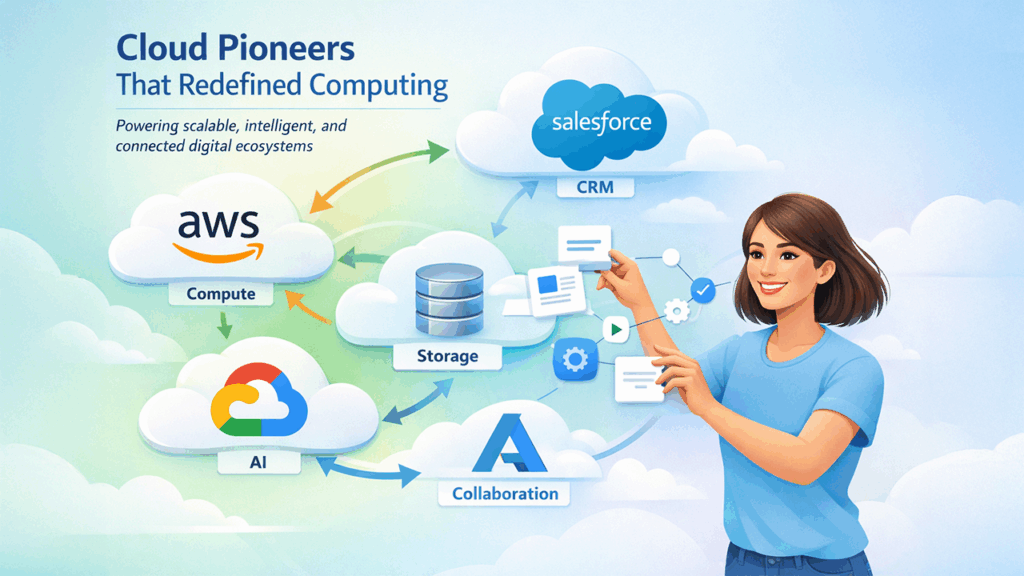
Amazon Web Services (AWS):
Amazon Web Services (AWS) was launched in 2006 and is considered to be one of the first cloud service providers. It started with a simple computing and storage service called S3 that enables businesses to scale up their operations without the need for their own infrastructure, which led businesses to save a lot of cost.
Salesforce:
Salesforce was the first company to provide a Customer Relationship Management (CRM) platform with Software as a Service (SaaS) in 1999. It transformed many IT industries by overcoming the old desktop applications with web-based solutions.
It allowed many firms to manage customer data, enabling businesses to access and store client information online without any need to update or install software locally.
Google:
Google Drive was launched by Google in 2012. It aimed to enable its users to collaborate on files and offered cloud storage.
Later on, it provided various cloud computing solutions with Google Cloud Platform (GCP), which supports everything from machine learning to storage.
Microsoft Azure:
Microsoft Azure was introduced in 2010 and became a direct competitor to AWS. It started as offering cloud-based collaboration tools, and now it provides various services, including AI tools, databases, and virtual machines.
Rise of the Global Freelance Workforce
A clear rise in the global freelance market workforce can be seen, since currently 1.57 billion people work independently as freelancers. The global freelance market is expected to grow from 7.65 billion dollars to 16.54 billion dollars by 2030 at a compound annual growth rate of 16.66%.
The United States dominates in the number of freelancers, which is projected to grow to 70 million by the end of 2025, which is around 36% of the US workforce. Moreover, other Asia Pacific regions like India and the Philippines are also experiencing fast growth rates.
Moreover, younger generations are more inclined towards working independently, as 67% of the freelancers are under the age of 35, and 52% of Gen Z are professionally engaged in freelance work. Additionally, the US freelance market contributed around 1.35 trillion dollars to the economy in 2023.
Many freelancers feel positive regarding their career choice, with 77% of them believing that they achieve a better work-life balance by working independently as compared to traditional employment.
Reasons for the Rise in the Freelance Market
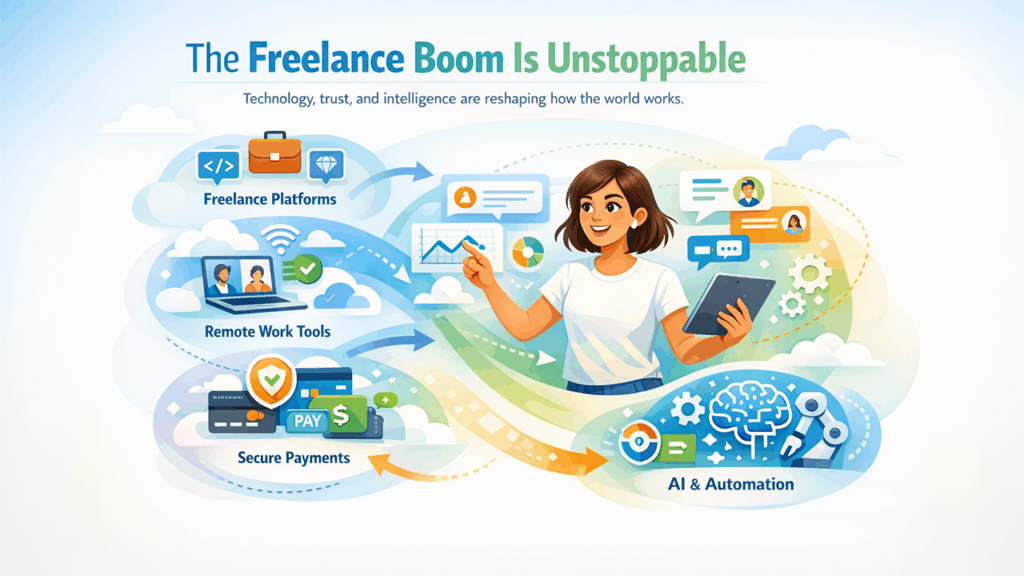
Global Freelancer Platforms
Many freelancing platforms like Fiverr, Toptal, and Upwork serve as intermediaries that connect freelancers with their clients throughout the globe.
Remote Work Technology:
Access to fast-speed internet, online collaboration software, and cloud technology has made remote work efficient and seamless, overcoming geographical barriers.
Secure Payment Systems:
Because of the global payment platforms like PayPal, Stripe, etc., the international online payment methods have become very smooth and have developed trust between the freelancers and the client.
Artificial Intelligence (AI):
Automation tools and Artificial Intelligence have increased efficiency by streamlining the tasks that allow freelancers to focus on complex work.
The Benefits of Cloud Technology for Freelancers
Cloud computing can provide many benefits to freelancers. Here it is, how it can impact their work:
1. Lower Cost
Cloud computing lowers the infrastructure cost, and there is no need to invest in expensive IT and hardware infrastructure. Cloud automation tools further reduce operational expenses by minimizing manual tasks.
2. More Productivity
Cloud computing encourages remote working as it enables access to software and files from anywhere. It increases the digital nomad productivity, allowing freelancers to work from home, virtual workspaces, or while travelling, which leads to more productivity.
With tools such as Microsoft 365, Google Workspace, and other cloud-based applications, remote team management becomes smooth as freelancers can manage projects, communicate with clients, and share documents in real time.
3. Data Security
Cloud technology ensures disaster recovery and backup by providing backup services. This means that important data is accessible and safe even if there is a technical failure, which reduces the risk of data being lost or hacked.
Many famous cloud providers have strong security features like data encryption, which ensures that freelancers' information is safe. For freelancers who manage the client's data, this enables peace of mind.
4. Access to Advanced Technologies
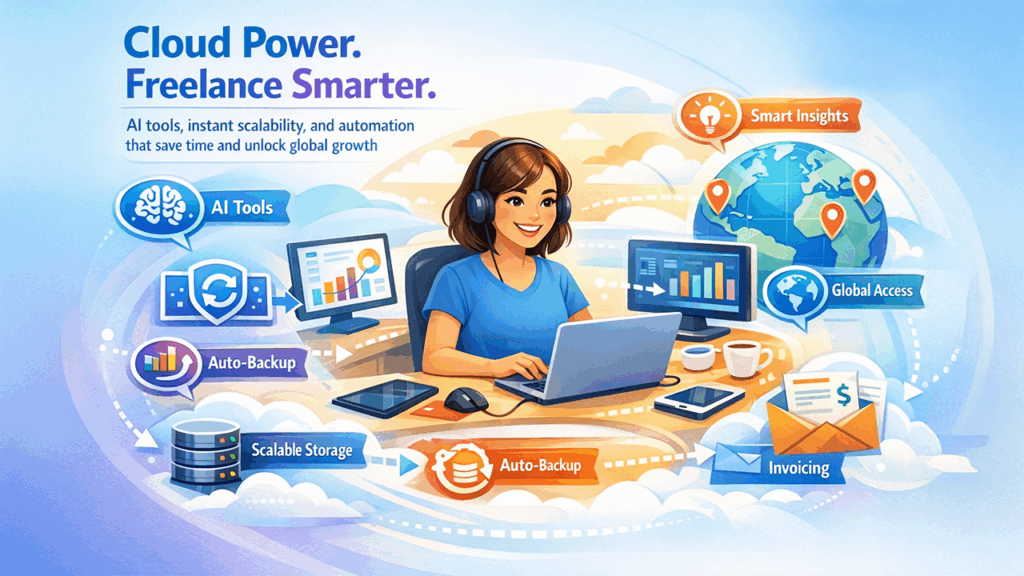
Cloud computing platforms provide access to advanced tools like machine learning and Artificial Intelligence without any major investment. Freelancers can use this technology to improve decision-making, offer their clients innovative services, and automate processes.
Moreover, cloud services offer large data storage capacity and tools that are important for analyzing big data, which can help freelancers to have insights about customer behavior and client data.
5. Scalability and flexibility
Cloud technology is used based on the business infrastructure. For example, if a freelancer faces a lot of workloads, they can add storage according to the demand. Moreover, freelancers can work for clients who are all over the world with fast access to services and low delay.
6. Time-saving Automation
Cloud technology provides tools that can process, automate tasks like software updates, file backups, and reporting. This saves the freelancers' time, allowing them to focus on their main business work.
Other software can easily be integrated with cloud-based systems that help in streamlining processes and improving efficiency.
For example, integrating project management tools with accounting software can help to generate invoices automatically.
7. Networking Opportunities and Collaboration
Cloud technology platforms such as Google Cloud, Amazon Web Services, and Microsoft Azure have communities where freelancers share knowledge, connect, and solve technical problems. This allows small freelancers to work with large organizations, which leads to cross-fertilization of ideas.
8. Competitive Edge
Adoption of cloud technology can make freelancers competitive in the market. As many firms and businesses are shifting to cloud-based and digital services, getting a know-how of these technologies can make a person an expert in their field.
9. Sustainability
Cloud computing allows freelancers and businesses to reduce their carbon footprint. Cloud data is energy-efficient than traditional businesses since they maintain their own servers, which leads to a sustainable approach.
Final Thoughts
To conclude, cloud computing enables freelancers with tools that can optimize their work, improve flexibility, reduce costs, and stay one step ahead in a competitive marketplace.
Having a deep knowledge of cloud applications helps you unlock many levels that can help to scale your business, provide better service to clients, and enhance productivity.
%201.png)

%201.png)

%201.png)