




The revolution of Customer Relationship Management (CRM) and Human Resources Management (HRM) has rapidly gained traction in the last few years. In the modern business landscape, these CRMs help organizations improve their workflow efficiency, boost productivity, and strengthen customer relationships. Progressive businesses continuously shift from traditional practices to these robust CRM platforms to transform internal processes, especially employee onboarding and HR automation.
This guide explains to you how CRM systems streamline employee onboarding while moving beyond traditional customer management.
The Evolution of Employee Onboarding CRM
Cutting-edge CRM solutions have changed far beyond their main function of handling customer records and monitoring sales pipelines. These advanced systems now provide cross-platform API integration, extensive data management features, and workflow automation tools. These feature supports make the platform ideal for managing internal business operations across the onboarding process. This transformation in CRM has created new opportunities to combine their fragmented operational tools into a single, centralized system.
Core Advantages of CRM Integration with HR Operations
Understanding how CRM systems streamline employee onboarding and implementation into their workflow, businesses experience:
- Unified databases that reduce likelihood of data silos across departments
- Streamlined workflows that automate redundant, daunting HR chores
- Smart integration capabilities with payroll, document, time-tracking systems
- Combined reporting dashboards for both client and employee insights
Technical Integration of HR Workflows into CRM Systems

Combining HR functions into your CRM needs strategic planning and technical deployment. The initial step includes data mapping, where you define which employee detail fields are required to be scanned and how they relate to current CRM structures. Most advanced CRMs support custom modules, letting you build specific sections for employee data that shape the flexibility of customer data management.
API Integration Strategy
Via RESTful APIs, CRMs can engage efficiently with the HR environment:
- Automated payroll systems for real-time synchronization of salary and tax data
- Time-tracking platform to keep track attendance and efficiency
- Document management tools for combined file storage
- Background review services throughout the hiring workflow
- Learning management systems for training module delivery
Workflow automation highlights another technical foundation of the HR-CRM connection. By utilizing business process automation tools within the CRM, you can build multi-step onboarding flows that are initiated based on particular events. For example, when a hiring manager changes a candidate's state to "Hired," the system can instantly trigger welcome emails, provide training resources, build access credentials, and set up orientation meetings.
Document Management and Compliance Using HR-CRM
One of the crucial benefits of leveraging CRM for HR process automation is its unified document management. All employee files, contracts, compliance documents, and performance metrics can all be logged within the CRM environment, synced with metadata for easy restoration, and monitored for review needs.
Compliance management becomes especially streamlined when tax documentation is managed through combined systems. New joiners need to complete essential paperwork, including employment agreements, benefits enrollment forms, and tax withholding documents like the W-4 form for the payroll tax deduction consent. By combining digital form completion into your CRM operation, you ensure that these essential compliance files are completed precisely and stored securely from day one.
The technical deployment often involves combining URLs or PDFs directly into automated email flows or CRM portal pages. When set up precisely, the system can monitor completion status, deliver reminders for pending forms, and automatically route completed documents to the appropriate departments. This level of automation significantly reduces the administrative burden on HR teams while ensuring compliance with regulatory requirements.
How to Build Automated Onboarding Flow
1. Pre-Boarding Phase: From Day 7 to Day 0
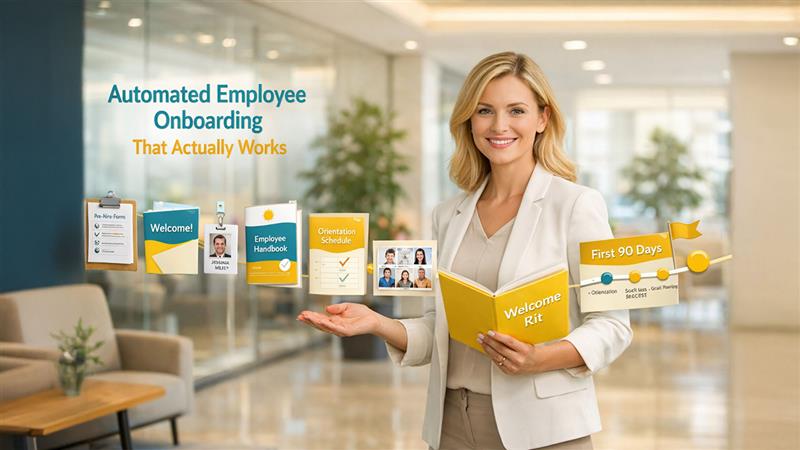
This is the first and crucial phase in the AI-driven onboarding process that starts with a candidate's acceptance of the job offer and ends on their first official day. During this phase:
- Welcome email is triggered with company detail and culture overview
- Sends a digital form to complete and necessary documentation to attach
- Provide employee portal credentials to login
- Information about first-day logistics, like dress code, arrival time, and parking instructions
- Equipment preferences, such as laptop, monitor, or connected devices
2. Day One Activation
On the candidate’s first day, a system-generated personalized welcome dashboard is shown with details like:
- Routine workflow with meeting times and locations
- Dedicated onboarding tasks with completion instructions
- Training module resources with expected completion times
- Team listing with photos and contact details
- AI-triggered task notifications to managers, staff, and IT teams
3. First 90 Days Progression
CRM systems streamline employee onboarding and monitor each stage of the entire journey:
- Week 1: Understand existing systems, review policies, and learn your role basics
- Week 2-4: Build product knowledge and train yourself through shadowing teammates
- Day 30: Share feedback and connects with manager for review
- Day 60: Evaluate progress and get extra resource assignments to support growth
- Day 90: Complete onboarding and access performance metrics
Leveraging Analytics for HR Insights
The most powerful factor in managing HR processes through a CRM is that it provides real-time analytical capabilities. While CRM helps track metrics, visualize data, and create reports, connecting with HR can transform this into a robust workflow analytics platform. These tools can:
- Monitor onboarding completion rates based on roles and departments
- Identify common challenges occurring throughout the process
- Evaluate correlations between employee onboarding experiences
- Assess timely productivity metrics for new joiners
- Enduring employee engagement during the onboarding process.
These informed, data-driven insights enable ongoing enhancement of HR processes and increase ROI against HR automation investments.
Final Verdict
Today, CRM platforms are efficiently utilized in HR processes to streamline repetitive tasks, increase opportunities, and automate employee management. These robust technical integrations help organizations improve data integrity, boost process efficiency, and enhance employee experience. With API integration, document management, and automated workflows, they can create advanced onboarding systems that reduce administrative stress without compromising compliance and uniformity.
As CRM technology is continuously evolving with AI-driven automation, it will scale out robust customization capabilities and the possibilities for HR-CRM integration. Businesses that embrace these integrations today will gain greater workflow efficiency and a competitive edge in the future talent market.
%201.png)

%201.png)

%201.png)