



As businesses expand, handling customer relationships becomes greatly complex. Sales pipelines grow, more communication channels emerge, and data volumes improve. Without having a structured platform, this generally leads to missed opportunities, fragmented data, and inefficiencies across various teams.
Custom CRM (Customer Relationship Management) solutions are crafted to address such challenges by automating workflows, centralizing data, and aligning business processes. Contrary to generic platforms, custom platforms are developed around particular operational requirements, enabling organizations to ensure flexibility while enhancing performance.
What Are Custom CRM Development Services?
Custom CRM development services emphasize developing personalized systems that align with exact business workflows. Instead of adjusting operations to align with pre-developed software, businesses can create systems that are tailored to their exact business operations.
To understand how these platforms are implemented and structured, resources such as custom crm development deliver insights into approaches to development and architecture of the system.
The objective is to create a simplified environment where communication history, customer data, and operational processes are incorporated into a single tool.
Main Characteristics of Modern Custom CRM Platforms
A CRM platform that is well-designed involves a broad range of features and provide support to distinct departments while ensuring consistency of data.
Typically, main features involve the following:
- Centralized storage of customer data for simple access and management.
- Opportunity and lead monitoring to handle sales pipelines.
- Automation or workflows to minimize manual tasks.
- Reporting and analytics platforms for data-based decisions.
- Personalizable dashboards as per the roles of the user.
Such features enable teams to more effectively collaborate and respond to customer requirements with higher accuracy.
Advantages of Personalized CRM Solutions
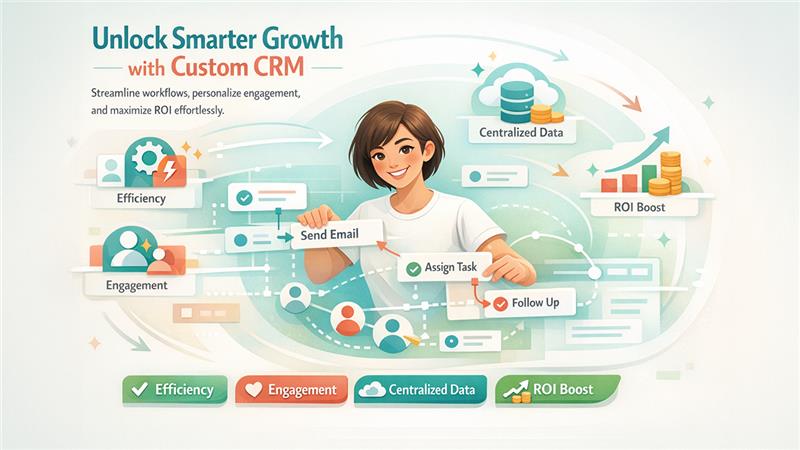
Custom CRM platforms provide numerous advantages as compared to off-the-shelf solutions, specifically for evolving businesses with unique processes.
Key advantages are as follows:
- Enhanced efficiency via automation of repetitive tasks.
- Higher level of customer engagement.
- Centralized data that minimizes errors and duplication.
- Better ROI over time because of optimized workflows.
By aligning the platform with business processes, companies can reduce unnecessary characteristics and emphasize on only what provides better value.
Read More: Custom CRM: Why Your Business Requires a Personalized CRM Solution?
What Are the Different Types of Custom CRM Development Approaches?
Businesses can select distinct approaches to CRM development as per their needs as well as technical requirements.
Prevalent approaches are as follows:
- Fully custom-developed CRM platform, built from scratch.
- cloud-driven CRM tools for removing scalability and access.
- hybrid platforms integrating custom modules with the present systems
- integration-driven development tethering diverse business platforms.
Each approach provides a diverse balance between cost, flexibility, and implementation time.
What Are Custom CRM Implementation Challenges?
Despite the benefits, building a custom CRM platform involves specific challenges that must be managed carefully.
Common challenges are as follows:
- Determine needs clearly at the initial stage.
- Ascertaining smooth migration of data from present platforms.
- User training and adoption across various departments.
- Ensuring performance of the system as volume of data improves.
Resolve such challenges needs effective collaboration and planning between development teams and stakeholders.
Right Practices for Long-term Effectiveness of CRM
A CRM system must scale along with business requirements. Consistent enhancement makes sure that it stays efficient and relevant.
Suggested practices involve the following:
- Consistent feature enhancements and updates.
- Tracking performance of system and user behavior.
- Consistent training of staff;
- Adjusting workflows as per business modifications.
Such practices aid in ensuing efficiency of the system and ascertaining long-term value.
Ongoing Trends in Custom CRM Development
The CRM landscape continues to evolve as new technologies impact how businesses communicate with customers.
Present trends involve the following:
- AI integration for predictive insights.
- Enhanced use of cloud-driven architectures.
- Complex workflows automation.
- Improved compliance measures and data security.
Such trends showcase a trend toward smarter and adaptive platforms that provide support to dynamic business ecosystems.
Frequently Asked Questions
Q1. What is custom CRM development?
A1- It can be defined as the process of developing a CRM platform personalized to the specific processes, workflows, and goals of the company.
Q2. How is custom CRM distinct from standard CRM software?
A2- Custom CRM is specifically built for a business, while standard solution provides pre-built characteristics with limited flexibility.
Q3. Is custom CRM recommendable for small businesses?
A3- Yes, specifically for organizations with unique growth plans or processes that need scalable solutions.
Q4. How long does it take to create a custom Customer Relationship Management system?
A4- Development time changes as per the complexity, but it generally varies in the range from a few months to a year.
Q5. Can custom CRM platforms incorporate other platforms?
A5- Yes, one of the main benefits is the capability to incorporate with present platforms, ensuring a centralized digital ecosystem.
%201.png)

%201.png)

%201.png)