

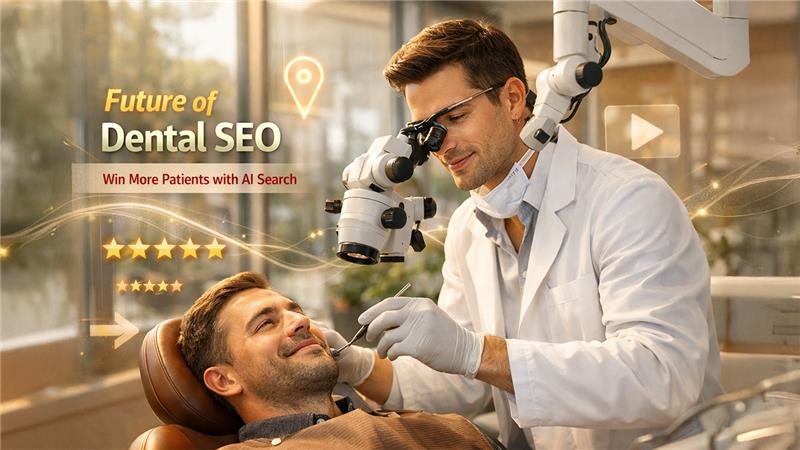

Winning the local search war in 2026 is all about how many trust signals you send to the NLP generative engines and search algorithms that now dictate patient behavior.
If your strategy is still focused on 2024 tactics, e.g., aggressive keyword stuffing and low-quality backlinks, you are invisible to modern patients.
Here is a comprehensive guide to professional and effective dental SEO in 2026.
1. GEO Shift (Beyond Traditional Keywords)
Generative Engine Optimization (GEO) has overtaken traditional SEO. Search engines like Google (SGE) and Perplexity don't just show a list of links; they synthesize an answer.
How to Rank Dental Keywords in AI Summaries?
- The Direct Answer Block: Every service page must lead with a 40-word summary that directly answers a high-intent question (e.g., "How much do dental implants cost in [City]?"). AI crawlers prioritize such knowledge for their featured summaries.
- Entity-Based Content: Start optimizing for dental entities, e.g., practitioner procedures and locations. Link your practice to your NPI (National Provider Identifier), your university credentials, and local business associations. When Google sees your practice mentioned on a local news site and a dental board directory, it connects the dots and recognizes you as a legitimate local authority.
- Semantic Depth: Move away from surface-level descriptions. Instead of saying "We offer root canals," explain the clinical process, equipment used (like dental microscopes), and recovery expectations. This content effort signals to Google that you aren't just an AI-generated site, but a clinical expert.
2. Hyper-Local Map Pack
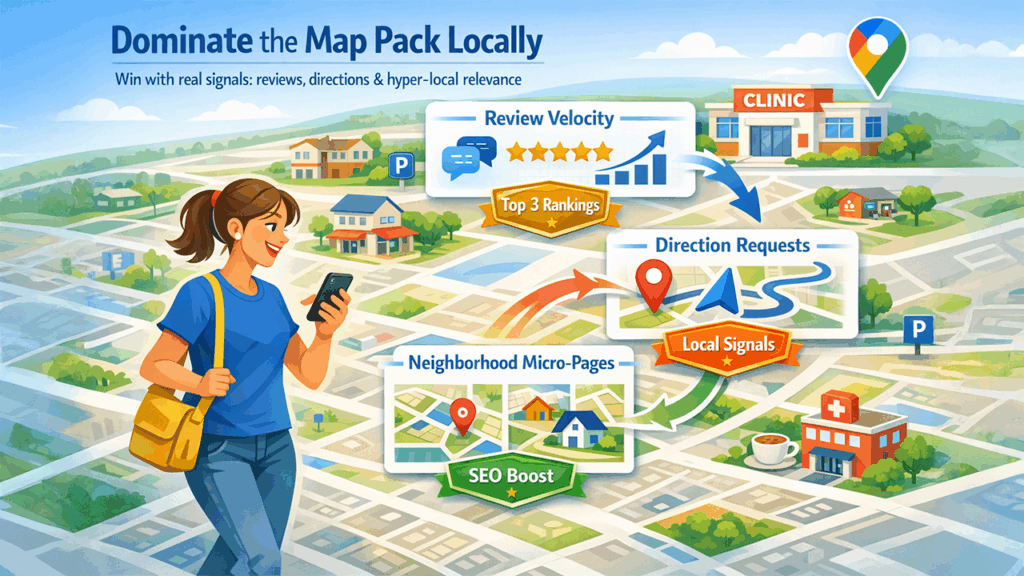
Google now tracks Real-World Signals to determine who gets the top three slots, proximity alone is no longer powerful.
The New Map Pack Ranking Factors:
- Review Velocity & Sentiment: It’s not about having 500 reviews, but the speed at which you get them. A practice receiving 3 detailed reviews per week will outrank a practice with 1,000 reviews that haven't had a new one in a month.
- Direction Requests: Google tracks how many people click "Directions" to your office, which is a massive local signal. Hence, embed a live Google Map on your "Contact" page and encourage patients to use it.
- Neighborhood Micro-Pages: Competitors usually target "City SEO," and to outstand, you should target "Neighborhood SEO." Create dedicated pages for the 2-mile radius around your office, mentioning local landmarks, nearby schools, and parking specifics. This captures the hyper-local intent that AI assistants prioritize.
3. The Technical Trust Stack: Schema & Core Web Vitals 4.0
In 2026, technical SEO is about data clarity, which means managing backend codes and files is equally important as frontend web layout.
Advanced Implementation:
- Dental-Specific Schema (JSON-LD): Don't just use the "LocalBusiness" schema; use the specific MedicalSpecialty, OfferCatalog, and Dentist markups. This act tells search engines which insurances you accept and which specific procedures you perform (e.g., Endodontic, Prosthodontic).
- Video-Object Schema: If you have a video of the doctor explaining a procedure (which you should), use Video Schema so that the video thumbnail appears directly in the search results.
- 1-Second Rule: With the rollout of INP (Interaction to Next Paint) as a major metric, your mobile site must be interactive. Use high resolution but small-sized, e.g., in KBs, and fully optimized images to ensure quick loading and top rankings.
4. Video SEO

Google 2026 search results are now 40% visual. If you only have text, you are losing 40% of the real estate.
- Short-Form Education: Embed YouTube Shorts directly on your service pages.
- Visual Alt-Text: Use descriptive, geo-tagged alt-text for every photo. For example, use emergency-dentist-in-chicago-treatment-room.jpg instead of IMG_001.jpg.
How Can Dental SEO Services Help?
Dental SEO services help your practice build digital authority, increase visibility in search engines, and consistently attract more high-quality organic dental appointments. While you focus on clinical excellence, these dental SEO professionals make sure that your clinical expertise is translated into a language that generative engines and search algorithms understand. Here is what you get when you hire them:
- Strategic Keywords Implementation: A step up from generic "dentist near me" keywords to build a complex map of "entities" (your doctors, your specific tech, and your local neighborhood) that establishes you as the dominant local provider.
- Technical Integrity: Deep-level JSON-LD schema and Core Web Vitals 4.0 updates for search engine visibility. These are often too technical for general web developers.
- AI Adaptability: A dental SEO expert crafts the "Direct Answer Blocks" and semantic content needed to ensure your practice is the cited source in AI-generated summaries. Pairing this with the right AI SEO Tools for 2026 helps automate entity optimization and track how your practice appears across generative search engines.
- Performance Monitoring: Adjustments in content and SEO strategy following direction requests and review velocity for maintaining top rankings.
Instructions for Your Dental SEO
SEO requires consistent maintenance to sustain your authority over Google. Consider the following expert advice to enjoy leads in the long term:
Daily: Plaque Audit
Check your Google Business Profile for "Suggested Edits." Competitors or automated bots can change your hours or phone number. A 2-minute daily check prevents digital rot from confusing your patients.
Weekly: Flossing Routine
Post one update to your Google Business Profile to signal the algorithm that your business is active and operational. Share a quick tip on oral health or a photo of a successful "Before & After" (with consent).
Monthly: Professional Cleaning
Audit your top 5 service pages. Are the prices still accurate? Is there a new technology you're using? Refreshing the text and updating the "Last Reviewed" date tells Google your clinical information is current and safe for patients.
Quarterly: X-Ray (Backlink & Technical Review)
Run a technical scan to find broken links or slow-loading pages. Check your backlinks, if you’ve been mentioned in local news or a dental blog, verify if the link is working. High-quality local links keep your SEO strong.
Final Words:
The shift from traditional search to AI-driven discovery means your practice can no longer hide behind generic keywords. In 2026, the dental practitioners who dominate the local market prioritize clinical authority, technical details, and hyper-local engagement. By regularly investing in SEO, you increase your chances of appearing when a local resident asks their AI assistant for the best care nearby.
%201.png)

%201.png)

%201.png)