




Most healthcare practices don’t have a marketing problem. They have a systems problem.
They’re running ads without tracking where leads come from. They’re collecting patient inquiries but following up manually—or not at all. They have a website, but it’s not connected to anything that moves the needle.
After helping over 1,000 dental practices build and scale their marketing at Firegang Dental Marketing, we’ve seen one pattern repeat itself over and over: the practices that grow fastest aren’t the ones spending the most on marketing. They’re the ones with the right tools connected in the right order.
Here’s the digital marketing stack that actually works for healthcare practices—and what each piece does in the growth engine.
1. A Website Built to Convert, Not Just Look Good
Your website is the center of your entire marketing stack. Every ad, every email, every Google search sends people here. If it doesn’t convert, nothing else matters.
But here’s what most healthcare practices get wrong: they build a website that looks nice and stop there. A pretty site that’s slow on mobile, buries the phone number, and has no clear call to action is just an expensive business card.
What a conversion-focused healthcare website needs:
- Mobile-first design. Over 60% of healthcare searches happen on phones. If your site isn’t fast and easy to use on a small screen, you’re losing patients before they ever see your services.
- Clear calls to action above the fold. “Book Now,” “Call Us,” or “Request an Appointment” should be visible within seconds of landing on any page.
- Online scheduling. Patients expect to book online. If you’re forcing everyone to call during business hours, you’re creating unnecessary friction.
- Trust signals everywhere. Reviews, team photos, credentials, and patient testimonials should be prominently displayed—not hidden on a separate page.
- Fast load times. Aim for under 2.5 seconds. Every extra second costs you conversions.
Pro tip: Before spending another dollar on ads, audit your website’s conversion rate. A site that converts 5% of visitors instead of 2% effectively makes every marketing dollar 2.5x more productive. That’s where dental website design starts—with the conversion fundamentals, not the aesthetics.
2. SEO That Puts You in Front of Patients Already Looking for You
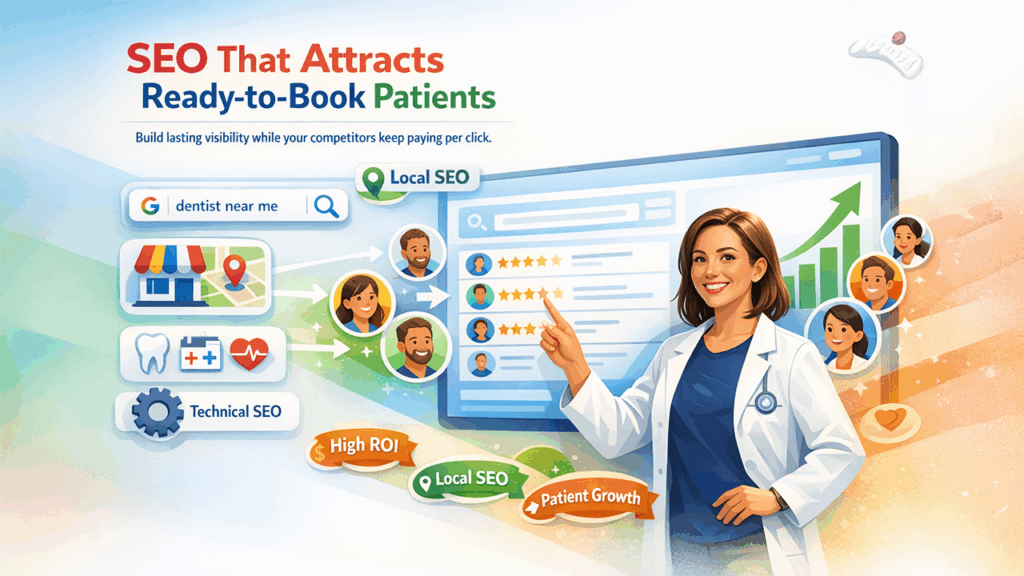
Paid ads get you visibility today. SEO gets you visibility that compounds over time.
For healthcare practices, search engine optimization is one of the highest-ROI investments in the entire marketing stack. Why? Because your ideal patients are already searching for exactly what you offer. “Dentist near me.” “Pediatric urgent care [city].” “Best dermatologist in [neighborhood].”
The practices that show up for those searches consistently win new patients without paying per click.
The SEO essentials for healthcare:
- Google Business Profile optimization. This is non-negotiable. Your GBP is what shows up in the map pack, and for most local healthcare searches, the map pack gets more clicks than the organic results below it.
- Service-specific landing pages. Don’t lump all your services on one page. Build dedicated pages for each service with unique, helpful content.
- Local content. Blog posts and pages that reference your community, your area, and the specific patient population you serve.
- Technical health. Clean site structure, fast load times, proper schema markup, and mobile optimization.
Pro tip: Dental SEO doesn’t produce overnight results. Budget for 6–12 months of consistent investment before expecting significant compounding. But once it kicks in, it becomes your most cost-effective patient acquisition channel by far.
3. A CRM That Captures and Nurtures Every Lead
Here’s where most healthcare practices leak money: they generate leads and then lose them.
A patient fills out a form on the website at 9 PM. Nobody follows up until the next afternoon. By then, they’ve already booked with a competitor who responded in minutes.
A CRM (Customer Relationship Management) system solves this by giving your team a centralized place to capture, track, and follow up with every lead—automatically.
What to look for in a healthcare CRM:
- Automated lead capture. Forms, calls, and chat inquiries should flow directly into the CRM without manual entry.
- Speed-to-lead automation. Instant confirmation emails or texts the moment a lead comes in. This alone can double your conversion rate from inquiry to booked appointment.
- Pipeline visibility. Your team should be able to see at a glance which leads are new, which need follow-up, and which have been contacted.
- Integration with your website and ad platforms. The CRM should connect to your website forms, Google Ads, and social campaigns so every lead is attributed to a source.
Pro tip: The best CRM in the world won’t help you if your team doesn’t use it. Choose a system that’s simple enough for your front desk staff to adopt, not one that requires a dedicated admin to manage.
4. Review Management That Runs on Autopilot
Online reviews are one of the most powerful tools in healthcare marketing. They influence both search rankings and patient decisions.
But most practices approach reviews reactively. They check Google once in a while, maybe respond to a negative review when someone on the team notices it, and hope for the best.
That’s not a strategy. That’s wishful thinking.
What a proper review management system looks like:
- Automated review requests. After every appointment, the patient gets a text or email asking for a review. No manual effort from your staff.
- Review monitoring dashboard. A single place to see all your reviews across Google, Yelp, Healthgrades, and other platforms.
- Response templates and alerts. Get notified instantly when a new review comes in so you can respond within hours, not days.
Pro tip: Review velocity matters as much as total count. A practice adding 8–10 reviews per month signals to Google that the business is active and trusted. Build the ask into your operational workflow so it happens consistently, not just when someone remembers.
5. Paid Advertising With Proper Tracking
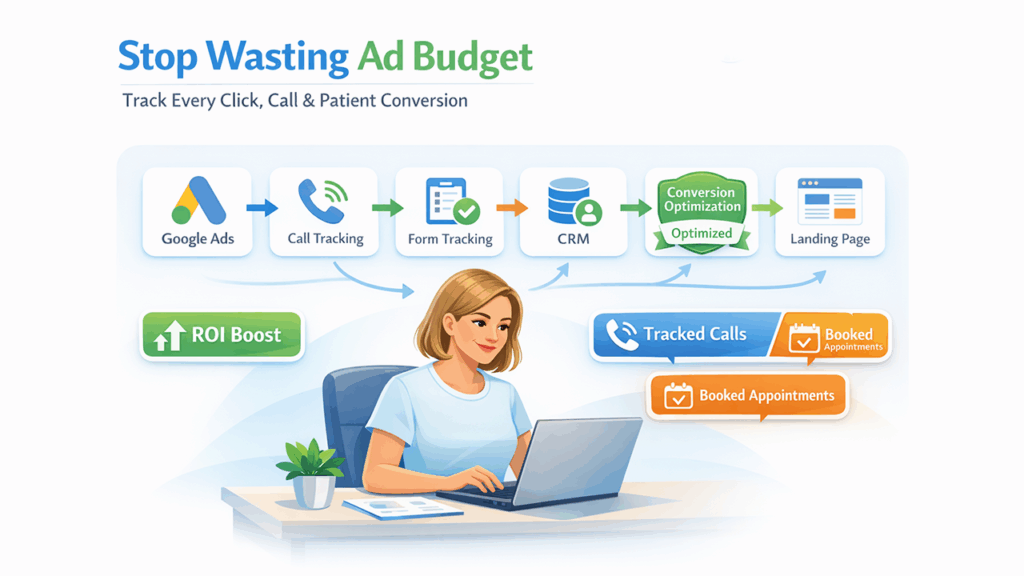
Google Ads and social media advertising can produce immediate visibility for healthcare practices. But without proper tracking, you’re flying blind.
We’ve audited hundreds of ad accounts for dental practices and the same problem shows up constantly: the practice is spending $2,000“$5,000+ per month on ads and has no idea which campaigns are producing booked appointments and which are wasting money. Working with ROI-focused digital marketing firms helps practices tie every dollar of ad spend directly to booked appointments, not just clicks.
The paid ads essentials:
- Call tracking. Every ad-driven phone call should be tracked back to the specific campaign and keyword that generated it.
- Form submission tracking. Online inquiries from ads should be tagged with campaign source data in your CRM.
- Conversion-based optimization. Optimize your campaigns for actual patient inquiries, not clicks or impressions.
- Landing pages, not homepages. Every ad campaign should point to a dedicated landing page built for that specific service and audience, not your generic homepage.
Pro tip: Run paid ads to cover the short-term gap while your SEO builds momentum. As organic traffic grows, you can strategically reduce ad spend on keywords where you’re already ranking well—lowering your overall cost per acquisition over time.
6. Email and SMS Automation That Keeps Patients Coming Back
Acquiring a new patient is significantly more expensive than retaining an existing one. Yet most healthcare practices invest almost all their marketing budget in acquisition and almost nothing in retention.
That’s a costly mistake.
Email and SMS automation fill this gap by keeping your practice top of mind with patients who’ve already chosen you.
The automations that matter:
- Appointment reminders. Reduce no-shows with automated text and email reminders 48 hours and 24 hours before appointments.
- Recall campaigns. Automatically notify patients when they’re due for a cleaning, checkup, or follow-up visit.
- Post-visit follow-ups. A simple “How was your visit?” message after an appointment shows you care and opens the door to a review request.
- Re-engagement sequences. Patients who haven’t visited in 12+ months get a gentle nudge to rebook.
Pro tip: Keep these messages short, personal, and useful. Nobody wants a marketing blast from their dentist. A quick text that says “Hey [Name], you’re due for your 6-month cleaning—tap here to book” performs significantly better than a long promotional email.
7. Analytics and Reporting That Connect Marketing to Revenue
The final piece of the stack ties everything together: reporting that shows you what’s working and what’s not.
Most healthcare practices have access to data but don’t have it organized in a way that informs decisions. They can see website traffic in Google Analytics and ad spend in Google Ads, but they can’t answer the most important question: how much did it cost to acquire each new patient, and which channel produced them?
What your reporting should answer every month:
- How many new patient inquiries did we generate?
- What was the cost per inquiry by channel? (Organic, paid, referral, social)
- What percentage of inquiries converted to booked appointments?
- Which campaigns or pages are underperforming and need attention?
Pro tip: If you can’t answer these four questions with confidence every month, your marketing stack has a visibility gap. Fix the reporting layer first. Every other optimization decision depends on it.
The Stack Is Only as Strong as Its Connections
Here’s the thing most practices miss: having all seven tools isn’t enough. They have to work together.
Your website feeds leads into your CRM. Your CRM triggers automated follow-ups. Your review management pulls from your appointment data. Your analytics connect your ad spend to actual booked patients. Your SEO compounds in the background, gradually reducing your reliance on paid channels.
When these tools are connected, they create a growth engine that gets more efficient over time. When they’re siloed, you end up with a collection of expensive subscriptions that don’t talk to each other. That's why having digital marketing services that align with your overall growth strategy matters as much as the tools themselves.
Start with the foundation: a conversion-focused website and a CRM that captures every lead. Then layer in SEO, paid ads, review management, and automation. Build the stack in the right order, connect the pieces, and let the system compound.
%201.png)

%201.png)

%201.png)