



Digital Transformation Reshaping Oil & Gas Industry
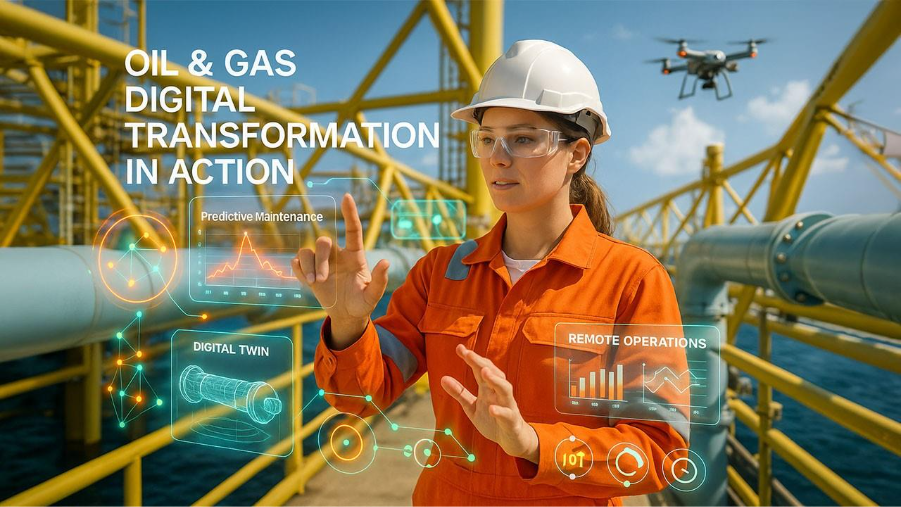
Oil extraction used to be all about physical strength and intuition. Geologists worked with paper maps, engineers manually measured pressure and temperature, and reports were compiled into thick folders sent by fax. Today, all of this feels like a wild anachronism. Now drilling rigs operate under AI supervision, thousands of sensors collect data, and analytics happen in the cloud in real time.
We don't live in the Dune universe where people extracted "spice" in the middle of the desert with nothing but faith in intuition. Our energy extraction is much closer to cyberpunk: smart systems, drones, digital twins, big data analytics.
The global trend is obvious. Right now, energy sector companies are rethinking the very logic of extraction, transportation, and resource management. In a world where energy demand is growing and pressure for decarbonization is increasing, digital technologies have become the main bridge between efficiency and sustainability.
The social prerequisites for this shift are also clear. Due to global instability, there's a need to reduce the human factor, transition to "smart" energy grids, and generally accelerate technological progress.
If you could compete in oil and gas by drilling depth before, today it's only possible through data. Let's look at 5 practical use cases that show exactly how digital transformation has already changed the industry.
Use Case #1: Cloud Integration
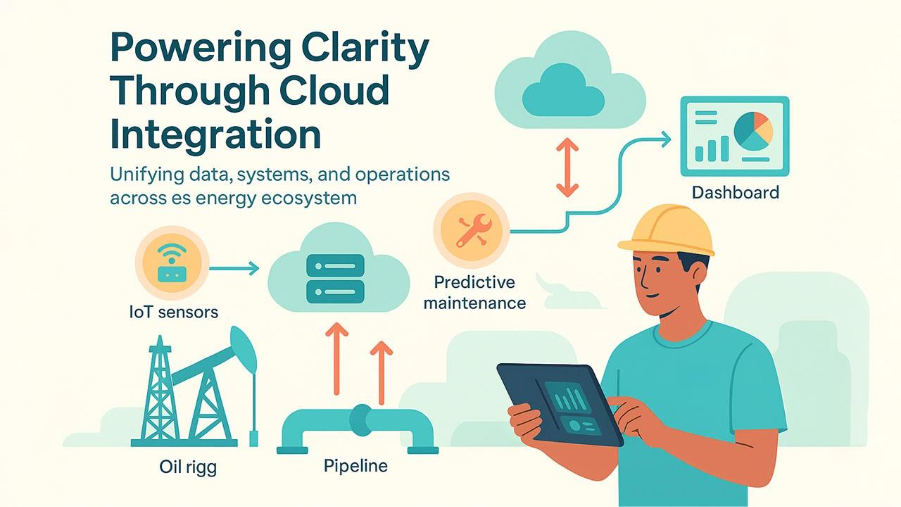
Cloud integration is the process of uniting separate cloud and/or local applications, systems, and data into a single, centralized platform. It connects massive flows of field data, corporate ERP systems, analytics, and operational solutions into a unified cloud ecosystem.
The first attempts to integrate cloud services in oil & gas appeared back in the 2010s, when companies started moving geological archives to the cloud to make access and collaboration between offices easier. Since then, everything has grown into a massive digital transformation: now everything is processed in the cloud, from extraction planning to predictive maintenance forecasting.
On a global level, cloud integration helps optimize production chain management: data from rigs in Texas can synchronize in real time with analytical centers in Europe or Asia. On a local level, it allows field engineers to get instant access to technical reports and equipment indicators right from a tablet.
Cloud platforms have become the central link in monitoring, accounting, and planning systems. IoT enabling technologies form the foundation of these integrations, connecting thousands of sensors and devices across remote locations into unified cloud ecosystems. They don't just eliminate the chaos of spreadsheets and emails. They create a single source of truth for the entire organization.
DXC helps energy enterprises integrate oil and gas software development solutions into large-scale corporate ecosystems, making data not just accessible but useful.
Use Case #2: Predictive Maintenance
Predictive maintenance is a service strategy that uses data to forecast the probability of equipment failure. In the oil and gas industry, this has literally become a matter of millions of dollars, because even a short drilling rig downtime can cost a company hundreds of thousands per hour.
The technology works through a network of sensors that continuously collect data about equipment condition: vibration, pressure, temperature, noise levels, even changes in power consumption. Then AI algorithms analyze these signals in real time, find patterns, and predict exactly when a failure will occur.
On a global level, predictive maintenance allows companies to plan repairs in advance and avoid emergency situations. More locally, an engineer can get a notification on their tablet: "compressor #4 needs inspection in 36 hours."
According to Deloitte estimates, enterprises that implemented predictive systems reduced unplanned downtime by an average of 20-30%, and maintenance costs by 15-20%. Companies like Schlumberger, Baker Hughes, and Honeywell are actively implementing such solutions. They're creating entire AI analytics ecosystems that cover thousands of pieces of equipment around the world.
In a world where political and economic instability has become the new normal, predictive maintenance gives companies what's most lacking right now: stability and confidence.
Use Case #3: Digital Twins
Digital twins are the creation of a virtual copy of a physical object, process, or system that updates in real time using sensor data. In the context of oil and gas, it's an exact digital copy of a well, field, pipeline, or even an entire plant. It "lives" in the cloud, reacts to changes in real time, and allows you to test solutions without any risk to real equipment.
On the production level, digital twins allow you to simulate system behavior: how pressure will change with increased load, how temperature will affect efficiency, how materials will react. This helps reduce accidents and increase efficiency without physical experiments. On a local level, engineers use twins for training, drilling planning, or hypothesis testing.
BP and Shell are already creating digital copies of their wells using platforms from Siemens and AVEVA. Shell uses digital twin to manage the Pernis plant in the Netherlands, which allows them to predict failures and plan optimal operating scenarios. Chevron and ExxonMobil are also investing in this technology, combining twins with IoT systems and big data analytics.
The practical effect is obvious: reduced time for testing new solutions, decreased environmental risks, and increased productivity.
It sounds like a video game, but the stakes here are much higher. At stake are billion-dollar assets, worker safety, and the stability of an entire energy system. And while digital twins sound like a "futuristic" technology for most industries, for oil and gas it's already daily practice that has changed the very logic of the industry.
Use Case #4: Data-Driven Exploration
Data-driven exploration is a new way to search for oil where algorithms and large data arrays play the main role. Before, discovering fields was a semi-intuitive affair: a geologist looked at the terrain, conducted a few test drills, and hoped to get lucky. But now this process has been optimized and made more successful.
Modern exploration is based on artificial intelligence that analyzes geological layers, seismic maps, 3D models, and historical drilling data. Machine learning algorithms can predict the probability of oil or gas presence even before the first well is drilled. They account for millions of variables, from soil structure to seasonal pressure fluctuations.
On a global level, this allows companies to avoid "blind drilling," reducing the risks of "dry wells" and saving millions of dollars. Chevron, Shell, and TotalEnergies actively use such AI solutions in their geological programs. Companies like Halliburton and Schlumberger already offer data-driven exploration platforms that combine modeling, machine learning, and integration with cloud environments.
Oil seekers used to literally walk through deserts with a pickaxe and compass. Today their tools are a laptop and an analytics dashboard.
Use Case #5: Remote Operations & Robotics
Remote operations and robotics are technologies that allow managing extraction processes, maintenance, and equipment control from a distance. If engineers used to have to work on drilling rigs even in the most difficult conditions, today they can do it from an office or even from home.
On a global level, robotic systems are used for pipeline inspection, checking drilling platforms, and repairs in hard-to-reach regions. Drones with cameras and sensors capture data in real time, and autonomous robots can perform technical inspections without human participation. On a local level, AR solutions allow specialists to conduct remote consultations, see data through augmented reality glasses, and coordinate on-site teams.
Equinor, BP, and Petrobras are already actively implementing remote operations. Halliburton created the ROVER robotic system that can perform pipe maintenance without operator participation. Companies like ABB and Honeywell offer comprehensive solutions for facility monitoring using drones and IoT.
Such technologies make the industry safer, but at the same time require new skills from workers. It seems like robots will replace people, but that's not the case. The nature of work is simply changing. We're stopping being operators and becoming strategists who manage processes at the data level, not the lever level.
A New Standard in Oil & Gas
All these cases show one thing: the main value of digital transformation isn't just in technologies, but in the harmonious combination of people, processes, and data. Now it's hard to find a supplier who truly has expertise for this complex niche, because digitalization in oil and gas requires not just programmers, but engineers who understand energy.
But the market won't turn back anymore. Predictive maintenance, digital twins, cloud integration – all of this has become the new standard. Going forward, these solutions will only be improved, developed, and integrated into every stage of the energy lifecycle.
Digital transformation no longer looks like something from the cyberpunk world. It's our present: an ordinary but powerful thing that allows companies to remain influential, stable, and competitive in a world that's changing faster than ever before.
%201.png)

%201.png)

%201.png)