


The Limitations of Spreadsheets in Growing Businesses
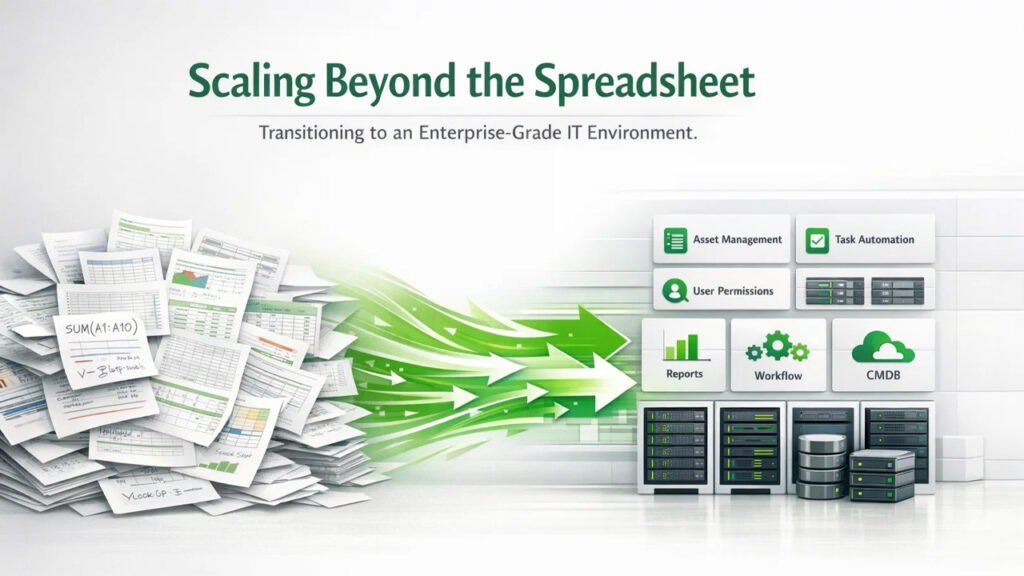
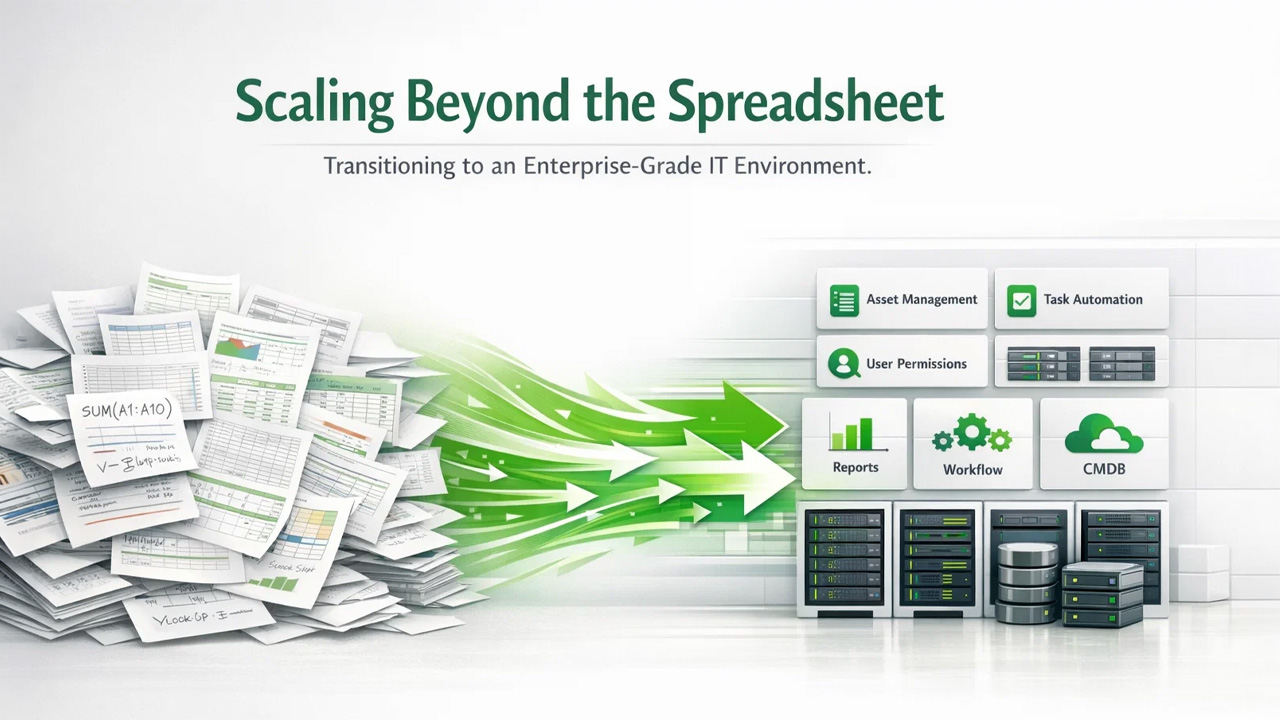
For numerous small to mid-level organizations, spreadsheets have emerged as the backbone for handling IT resources, monitoring assets, and managing support tickets. Their familiarity and accessibility make them a lucrative option for initial efforts in IT management. However, as businesses grow up, the shortcomings of depending on spreadsheets become much more apparent. Issues like limited collaboration capabilities, data inconsistency, and a lack of automation can reduce growth rate and impact operational efficiency.
While spreadsheets are quite versatile, they were never specialized in managing enterprise-level or complex workflows. They generally lack version control, triggering multiple copies of vital data. This fragmentation causes key errors that can spread across numerous operational processes. Furthermore, spreadsheets are essentially focused on single-users, limiting real-time collaboration among departments and IT teams.
As per the Forrester 2023 report, around 65% of evolving companies recognize inefficiencies in data management as a major barrier to growing operations. This statistic underlines the key significance for enterprises to transition from basic tools such as spreadsheets to a proper enterprise-grade IT environment. Moreover, a Gartner survey has revealed that around 47% of IT managers have reported that manual entry of data in spreadsheets would prove to be a major cause of errors that can affect service delivery.
As companies grow, the sheer volume of IT complexity and data grow exponentially. Spreadsheets are difficult to maintain. Not only are they tiresome, but they also lack audit trails, and do not support integration with main business platforms like ERP, CRM, or cloud solutions. Without the help of a scalable IT ecosystem, businesses can face bottlenecks that can restrain growth and innovation.
Why Select an Enterprise-level IT Ecosystem?
Going beyond spreadsheets means adjusting a complete IT infrastructure that provides support to real-time data access, comprehensive automation, and smooth integration with other business platforms. An enterprise-grade IT environment aids in simplifying workflows, enhancing service delivery, and improving security protocols. It also renders scalability, allowing businesses to adjust to growing demands without sacrificing performance.
Enterprise IT ecosystems provide centralized databases that remove silos in data, making sure that all stakeholders have access to updated and consistent data. Automation platforms minimize manual tasks like asset tracking, ticket routine, and report creation, which improves productivity and minimizes human error. In addition, such platforms provide support to role-driven access controls and compliance handling, which are pivotal in today’s industries that are sensitive to regulatory frameworks.
One vital component of this transition is choosing the best framework in IT support. For organizations looking for effective and reliable solutions, choosing Vendita's IT helpdesk provides personalized services that cater to the enterprise needs, making sure that IT support evolves along with the business growth. Selecting a partner with specialization in enterprise IT ecosystems can expedite the migration process and ensure consistent support as business scales.
Utilizing Local Expertise for IT Transformation
For businesses based in particular regions, a tie up with local IT organizations can provide great benefits like in-depth understanding of regional market service and tailored services. Local providers generally enjoy good relationships with local vendors, allowing quicker procurement and on-site support whenever required.
For instance, Cleveland companies like Zenetrix showcase how local companies can render tailored support that aligns with unique requirements of the clientele, ensuring seamless IT transitions and consistent management. This localized approach also aids in addressing compliance needs that change by industry and jurisdiction.
The importance of localized IT expertise shows in the industry data indicating that around 58% of organizations prefer to work with regional IT providers to attain quicker response times and more effective customization. Furthermore, a study by IDC has discovered that organizations' securing services from local IT companies experience a 30% greater reduction in downtime at the time of IT transitions compared to the ones utilizing remote-only support.
Main Advantages of Adopting Enterprise IT Solutions
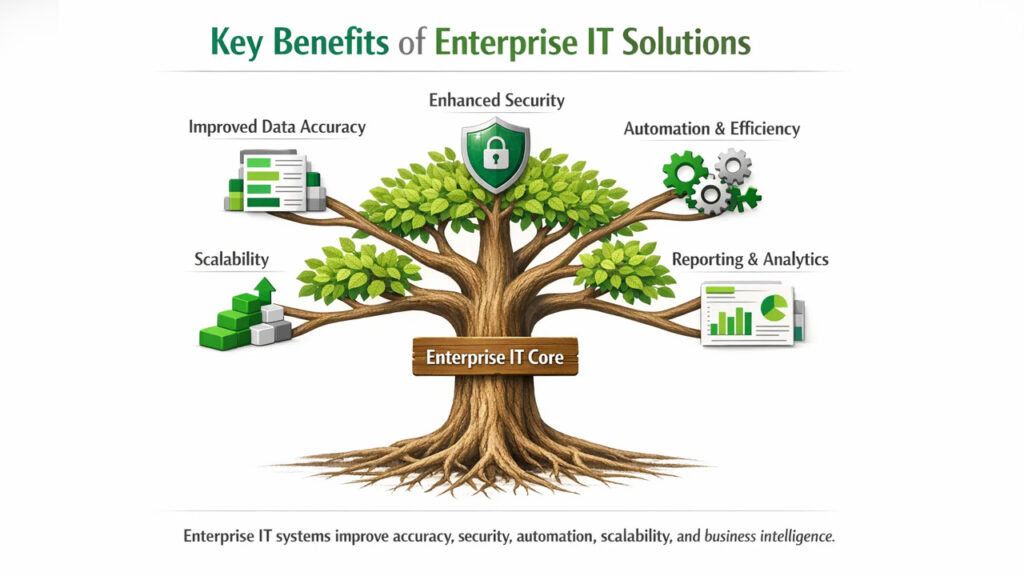
- Enhanced Accuracy of Data and Accessibility: Enterprise IT systems ascertain data storage in a centralized manner with updates in real-time, minimizing errors and allowing collaboration across departments. This leads to quicker decision-making and more dependable reporting.
- Improved Security Measures: Sophisticated IT ecosystems are introduced with powerful security protocols like multi-factor encryption, authentication, and consistent tracking to safeguard confidential information from cyber threats.
- Efficiency and Automation: Automated workflows reduce manual tasks, allowing IT teams to improve their productivity and concentrate more on strategic initiatives such as customer engagement and innovation. The right automation tools play an important role as it is explored in our blog “Best 7 Workflow Automation Tools in 2026.”
- Scalability: Such systems can accommodate greater workflows effortlessly as business growth is achieved without any major additional investments.
- Complete Analytics and Reporting: Accessibility to in-depth insights provide support to data-driven decision-making and ensures consistent enhancement, allowing businesses to remain compliant and competitive.
Through investment in enterprise-based IT solutions, businesses not only enhance their present processes but also make their infrastructure future-proof against changing technological requirements.
Detailed Steps to Comprehensively Transition Beyond the Spreadsheets
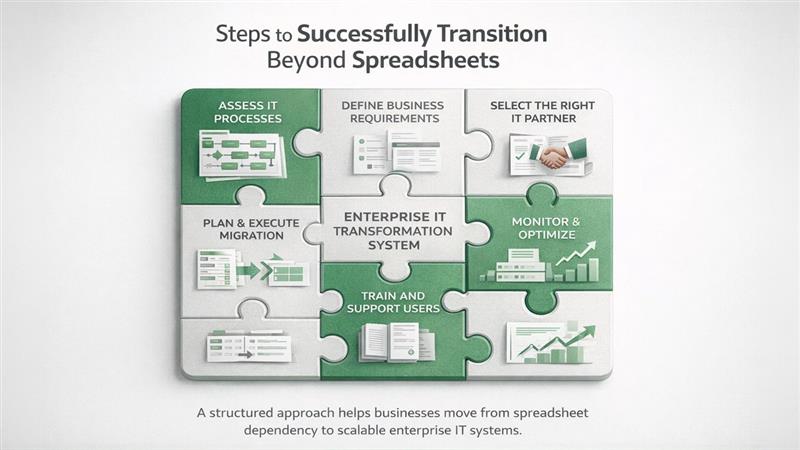
Assess Present IT Processes
Start by carrying out a detailed evaluation of present IT workflows and recognizing pain points associated with spreadsheet reliance. Engage key stakeholders across various departments to map flow of data and where inefficiencies happen. Record areas where integration or automation can add value and emphasize them as per the impact.
Determine Business Needs
Interact with stakeholders to comprehend their requirements and expectations from the new IT platform. This involves characteristics like helpdesk capabilities, management of assets, reporting, and integration with other business apps. Clear and well-defined needs aid in choosing a solution that aligns with organizational objectives and user requirements.
Choosing the Right Partner in IT
Choosing a vendor or service provider with relevant track record in enterprise IT executions is crucial. Their expertise can help businesses navigate the complications of adoption and migration. Assess potential partners as per their customer references, experience, and capability to render consistent support.
Strategize and Implement Migration
Create an in-depth migration plan that involves system integration, data transfer, and user training. Consider phased rollouts to reduce disruption and enable feedback-driven adjustments. Ascertaining data integrity and reducing downtime during migration are critical in ascertaining seamless transition.
Train As Well As Support Users
Complete training programs personalized to distinct user groups aids in reducing resistance and expedite adoption. Render accessible documentation and set up support channels to help users after and during the transition.
Monitor and Optimize
After migration, consistently track system performance and collect user feedback to recognize improvement areas. Leverage analytics to monitor important performance indicators like system uptime and ticket resolution times. Consistent optimization ascertains that the IT environment remains aligned with evolving business requirements.
The Importance of IT Helpdesk Solutions in Enterprise Ecosystems
An efficient IT helpdesk is one of the pillars of enterprise IT infrastructure. It ensures simplified support for service requests, incident management, and knowledge base access. Advanced helpdesk solutions utilize AI-based ticket routine, automation, and self-service portals to improve user experience and minimize resolution times.
By connecting with providers that excel in enterprise IT environments, businesses can tailor their helpdesk capabilities to align with particular operational demands, ascertaining responsiveness and scalability that spreadsheets cannot deliver simply. Characteristics like integration with asset management systems and automated prioritization simplify IT support workflows, minimizing costs and enhancing quality of services.
Studies indicate that enterprises executing sophisticated helpdesk solutions experience around 40% reduction in ticket resolution times. This efficiency directly translates to greater productivity and employee satisfaction.
Case Study: How Cleveland Organizations Adopt Enterprise IT?
Cleveland’s business landscape is full of success stories of effective IT transformations. Various companies have showcased how incorporating enterprise-based IT platforms leads to major enhancements in customer satisfaction and operational efficiency.
A recent Deloitte survey has found that around 72% of mid-level firms adopting enterprise IT solutions have reported a substantial increase in process efficiency within the first year. Such organizations have benefited from minimized manual workloads, enhanced accuracy of data, and improved compliance monitoring.
In one notable example, a Cleveland-based manufacturing firm transitioned from spreadsheet-based asset tracking to an integrated IT management platform. This shift reduced downtime by 25% and improved reporting accuracy by over 35%, enabling better resource allocation and faster response to maintenance needs.
Overcoming Transition Challenges
While the advantages are quite clear, transitioning to an enterprise-grade IT environment is not without its due challenges. A few prevalent obstacles involve data migration complexities, resistance to change, and budget constraints. Addressing such issues requires clear communication, effective leadership, and phased implementation strategies.
Frictions in transition can be reduced by involving users early on in the process, exemplifying the advantages of new platforms, and rendering consistent support and training. Data migration needs detailed planning to ascertain quality and integrity of data, generally involving validation steps and data cleansing.
Budget constraints can be handled by emphasizing vital functionalities and adopting scalable solutions that enable phased investments. Numerous vendors provide flexible pricing models and cloud-driven options that minimize upfront expenses.
Utilizing the expertise of specialized IT partners ascertains technical hurdles are resolved efficiently, and the right practices are followed throughout the transition.
Conclusion
Transitioning beyond the spreadsheet is a vital step for businesses looking to enhance their IT capabilities and support long-term growth. Scaling to an enterprise-based IT ecosystem ensures diverse benefits, including improved security, data management, and effective efficiency in operations.
By choosing the best IT helpdesk solutions carefully and partnering with experienced local providers, businesses can smoothly navigate this transformation. Industry research evidence suggests, and real-world case studies accentuate that investment in enterprise IT infrastructure is not just a technological level-up, but a strategic need for futuristic businesses.
This shift allows organizations to unlock new productivity levels, agility, and innovation-key factors for getting success in the competitive marketplace of today. As businesses evolve and grow, depending on enterprise-grade IT environment, it will be vital to maintain operational excellence and ensure high-level customer experiences.
%201.png)

%201.png)

%201.png)