


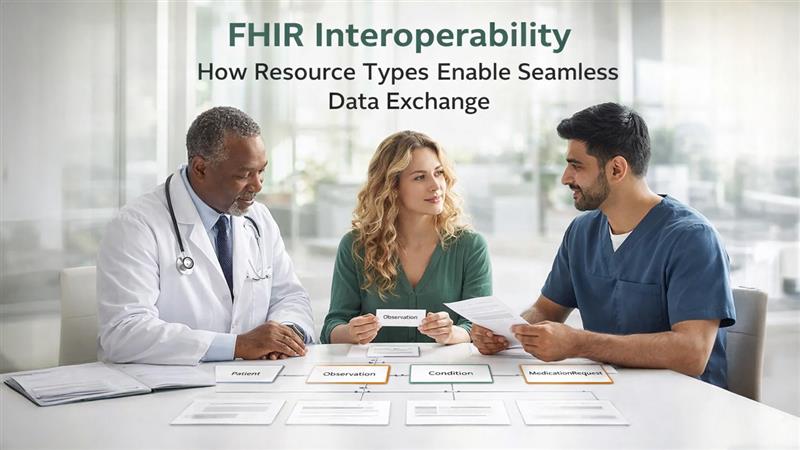

FHIR's Rise as the Global Standard for Healthcare Interoperability
For most of healthcare's digital era, data interoperability was a problem that everyone acknowledged and almost no one solved. Health systems ran on incompatible EHR platforms. Payers and providers spoke different data languages. Laboratories, pharmacies, imaging centers, and care management tools each maintained their own proprietary schemas. Patient data was complete in theory and fragmented in practice.
That is changing — and faster than the industry anticipated. HL7 FHIR (Fast Healthcare Interoperability Resources) has emerged as the technical standard that finally gives disparate systems a shared vocabulary. Regulatory mandates have accelerated adoption: the 21st Century Cures Act, ONC's Information Blocking Rule, and CMS interoperability requirements have made FHIR API compliance non-negotiable for US health systems and payers. Internationally, adoption is following a similar trajectory across the UK, Australia, Canada, and the EU.
At the center of FHIR's design is a deceptively simple idea: break healthcare data into discrete, standardized units called resources, each representing a specific clinical or administrative concept. Understanding fhir resource types is the foundation of understanding FHIR itself — because resources are not just the data model. They are the unit of exchange, the unit of query, and the unit of analytical reasoning across every system that speaks the standard.
This article examines how FHIR resource types work, why their design makes seamless data exchange possible at scale, how leading analytics platforms are using them to power real-time clinical intelligence, and what implementation teams need to know to get FHIR right in practice.
FHIR Fundamentals: Profiles, Bundles, and the Core Architecture
Resources as the Atomic Unit of FHIR
FHIR's architecture begins with resources — self-contained, structured data objects that represent a single healthcare concept. A Patient resource contains demographic and identity information. An Observation resource captures a measurement or assessment. A MedicationRequest documents a prescription. Each resource has a defined schema, a stable identifier, a RESTful API endpoint, and the ability to reference other resources through typed links.
This modular design is what makes FHIR fundamentally different from prior interoperability standards like HL7 v2 or CDA. HL7 v2 messages were monolithic — a single message type attempting to carry an entire clinical interaction. CDA documents were structured but not easily machine-queryable. FHIR resources are granular, individually addressable, and composable — they can be exchanged independently or assembled into larger structures as needed.
Profiles: Constraining Resources for Specific Contexts
Base FHIR resources are intentionally permissive. A Patient resource can accommodate the demographics of a US hospital patient, a UK GP practice registrant, or a clinical trial participant in Germany — because the base definition is broad enough to support all of them. In practice, implementations need tighter constraints.
FHIR Profiles address this. A Profile is a formal specification layered on top of a base resource that constrains which fields are required, which value sets are permitted, and which extensions are allowed for a specific implementation context. US Core Profiles define the minimum data requirements for US-based FHIR implementations. SMART on FHIR defines authorization patterns for third-party app access. National implementation guides define country-specific requirements for government health programs.
Profiles are what allow FHIR to be simultaneously universal and locally precise — a single standard that adapts to vastly different regulatory, clinical, and technical environments without fragmenting the underlying data model.
Bundles: Packaging Resources for Transactions and Documents
Individual resources handle point queries well. Clinical workflows often require multiple resources to be exchanged, validated, and persisted as a single atomic transaction. FHIR Bundles solve this by packaging multiple resources into a single structure with defined semantics.
- Transaction bundles: Multiple resource operations — creates, updates, deletes — processed as a single atomic unit. Either all succeed or none do.
- Document bundles: A clinical document (discharge summary, referral letter) represented as a structured collection of FHIR resources with a Composition resource defining the narrative.
- Message bundles: An event-driven exchange where a MessageHeader resource describes the event and payload resources carry the clinical content.
- Search result bundles: The standard container for FHIR search API responses, wrapping matching resources with pagination metadata.
FHIR Resource Types: A Structured Deep Dive
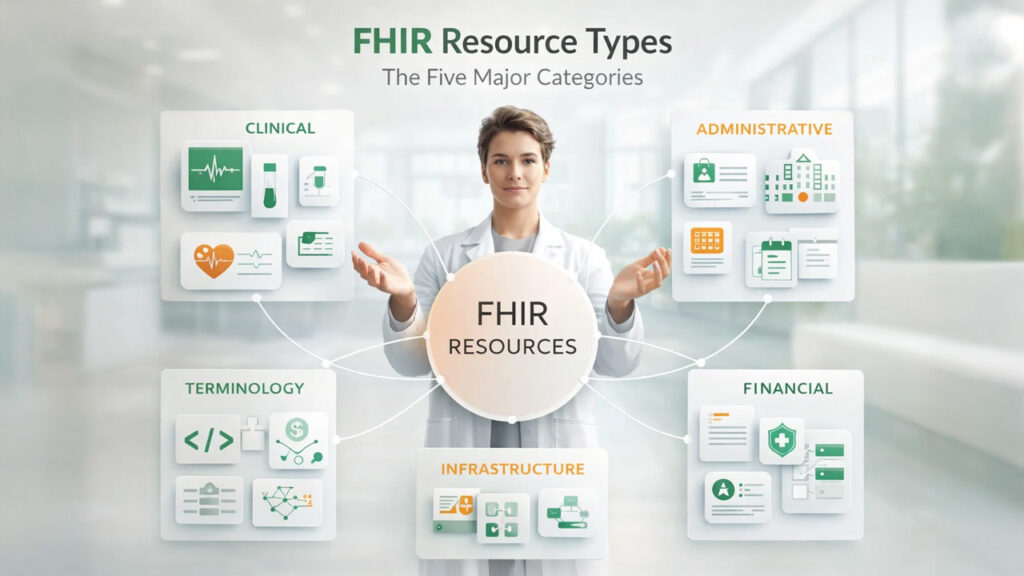
The Five Major Categories
FHIR defines over 150 resource types, organized into five functional categories. Each category serves a distinct domain within the healthcare data ecosystem, and understanding the boundaries between them is essential for designing integration architectures that are both technically correct and clinically meaningful.
| Category | Examples | Primary Function | Common Use Case |
|---|---|---|---|
| Clinical | Condition, Observation, MedicationRequest | Record patient health status and care events | EHR data exchange, quality reporting |
| Administrative | Patient, Encounter, Organization | Manage identities and care settings | Patient matching, scheduling |
| Financial | Claim, Coverage, ExplanationOfBenefit | Handle billing and insurance workflows | Payer-provider data exchange |
| Infrastructure | Bundle, CapabilityStatement, OperationDefinition | Structure and describe API behavior | System integration, API documentation |
| Terminology | ValueSet, CodeSystem, ConceptMap | Standardize clinical vocabulary | Semantic interoperability, code mapping |
Clinical Resources: The Core of Patient Data
Clinical resources carry the information that directly describes patient health status and care delivery. They are the primary target for analytics, quality reporting, and clinical decision support.
- Patient: The identity anchor for all clinical data. Every clinical resource is directly or indirectly linked to a Patient resource through typed references. Patient includes demographic information, identifiers across systems, communication preferences, and links to related persons.
- Observation: The workhorse of clinical data exchange. Observations cover laboratory results, vital signs, clinical assessments, patient-reported outcomes, and social determinants of health. Each Observation carries a code (from LOINC, SNOMED, or local vocabularies), a value, a status, and a reference to the patient and encounter context.
- Condition: Represents a diagnosis, problem, or health concern. Conditions carry clinical status (active, resolved, inactive), verification status, onset and abatement dates, and coded values from ICD-10, SNOMED CT, or both. Temporal Condition data is central to longitudinal care analytics.
- MedicationRequest: Documents a prescription or medication order. Links the prescribed medication to the prescribing practitioner, the patient, the clinical indication, and dosing instructions. Critical for medication reconciliation, adherence analysis, and pharmacovigilance.
- Procedure: Records clinical interventions — surgeries, diagnostic procedures, therapeutic treatments. Procedure resources include timing, performer, outcome status, and coded procedure identifiers from CPT or SNOMED.
- DiagnosticReport: Aggregates Observations into a structured clinical report — a lab panel, an imaging study, a pathology report. DiagnosticReport links to its constituent Observations and carries the narrative interpretation alongside structured data.
Administrative Resources: The Structural Framework
Administrative resources define the organizational and logistical context within which clinical care occurs. They are essential for patient matching, scheduling, and cross-system identity resolution.
- Encounter: Records a clinical interaction — an outpatient visit, an inpatient admission, a telehealth consultation. Encounters link patients to providers, locations, and time periods, and serve as the contextual anchor for clinical resources generated during that interaction.
- Organization: Represents any organization involved in care — a hospital, a clinic, a payer, a pharmacy. Organization resources enable provider directory functions and support cross-organizational data exchange.
- Practitioner and PractitionerRole: Separately model the individual clinician and the role they occupy within a specific organization. This separation allows a single practitioner to be associated with multiple roles across multiple organizations without duplicating identity records.
- Location: Represents a physical place where care is delivered — a ward, an operating room, a clinic address. Location resources support geographic analytics and care coordination workflows.
Real-World Integration: Resources Powering Analytics and AI

From Data Exchange Standard to Analytics Foundation
FHIR was designed as an exchange standard, but its impact on analytics has proven equally transformative. When clinical data is stored natively as FHIR resources — rather than flattened into relational tables or proprietary schemas — the analytical possibilities change qualitatively.
Consider population health analytics. A traditional warehouse approach requires extracting data from multiple EHR systems, mapping disparate schemas to a common model, and running batch ETL processes before any query can be executed. With a FHIR-native data model, the common schema is already in place — each data source contributes FHIR resources that are immediately queryable through the same API, using the same resource types and terminology bindings, without intermediate transformation.
This enables several analytical patterns that are difficult or impossible with conventional approaches:
- Real-time cohort queries: Patient cohorts defined by clinical criteria — specific Conditions, Observation value ranges, MedicationRequest histories — can be queried against live FHIR data without ETL delays. A query for diabetic patients with HbA1c above 8.0 and no endocrinology Encounter in the past six months executes directly against structured FHIR resources.
- Temporal pathway analysis: Because FHIR resources carry precise timestamps and typed references to Patients and Encounters, longitudinal care pathways can be reconstructed across time and care settings without custom join logic. Condition onset, treatment initiation, Observation trend, and Procedure outcome form a coherent timeline from the resource graph.
- Cross-institutional data mining: FHIR's standard resource types mean that clinical data from multiple health systems — each running different EHR software — can be aggregated and queried through a uniform interface. The analytical layer doesn't need to know which EHR generated a Condition resource to query it correctly.
- AI feature extraction: Machine learning models operating on FHIR-structured data can derive features directly from resource attributes and relationships — without the bespoke data preparation pipelines that warehouse-based training data typically requires. This capability is a major advancement for AI-driven healthcare data analytics.
Implementation Challenges: Validation, Extensions, and FHIR Servers
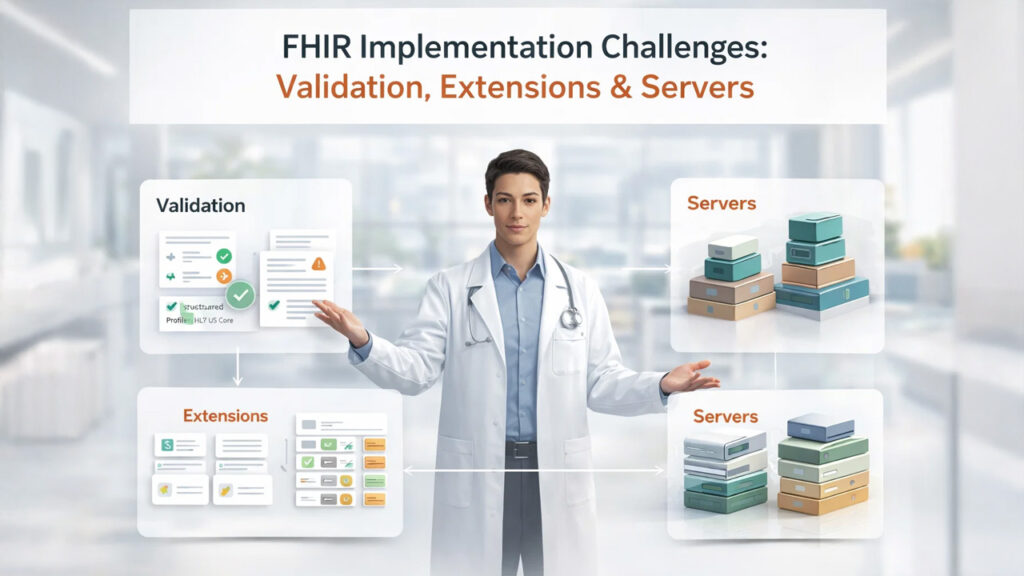
Where FHIR Implementations Break Down
FHIR's design elegance can obscure real implementation complexity. Getting resources to validate correctly against Profiles, managing extensions without breaking interoperability, and choosing the right FHIR server infrastructure are the three areas where well-intentioned implementations most commonly encounter problems.
Validation Against Profiles
A FHIR resource that validates against the base specification but fails a required Profile constraint is not interoperable for that implementation context. US Core, for example, requires specific identifier types, mandatory code system bindings, and must-support element populations that the base Patient resource doesn't mandate. Implementations that test only against base FHIR and not against the required Profile set routinely discover compliance gaps late — and expensively.
Effective validation strategy requires running resources through profile-aware validators (such as the official HL7 FHIR Validator or Inferno) during development, not just at deployment. Automated validation in CI/CD pipelines catches profile violations before they reach production.
Extensions: Power and Peril
FHIR's extension mechanism allows implementations to carry data elements that aren't defined in the base resource. Race, ethnicity, birth sex — clinical concepts important in the US context but absent from the international base specification — are typically represented as extensions on the Patient resource. Extensions are powerful, but they erode interoperability when overused or when they duplicate elements that exist in base resources or standard profiles.
The discipline required is to use standard extensions from established implementation guides wherever they exist, define custom extensions only when genuinely necessary, and document them formally in an Implementation Guide so consuming systems know how to handle them.
FHIR Server Selection
The FHIR server is the operational core of any FHIR implementation — the system that stores, validates, indexes, and serves resources through a standards-compliant API. Server selection criteria include FHIR version support (R4 at minimum; R5 for forward-looking implementations), Profile validation capabilities, search parameter support depth, transaction bundle handling, subscription and notification support, and performance under clinical-scale data volumes.
Platforms like Kodjin are purpose-built for this context — FHIR-native server infrastructure designed to support not just data storage but active clinical analytics on top of the FHIR resource graph, including AI-powered querying, cohort logic, and temporal pathway analysis without external data warehouse dependencies.
Future Directions: FHIR R6 and the Expanding Ecosystem
What FHIR R6 Brings
FHIR R5, finalized in 2023, expanded the standard significantly — adding richer genomics resources, enhanced subscription capabilities, and improved clinical reasoning support. FHIR R6 is currently in development, with several directions already signaled by the HL7 working groups.
- Stronger real-time notification patterns: R6 is expected to formalize subscription-based event notification with richer filtering and delivery guarantees — enabling truly event-driven clinical data architectures where downstream systems react to clinical events as they occur.
- Expanded AI and decision support integration: New resource types are being designed to support AI model outputs, clinical reasoning artifacts, and evidence-based decision support recommendations within the FHIR resource graph — not as external attachments but as first-class FHIR citizens.
- Improved support for multimodal clinical data: Genomics, imaging metadata, and patient-generated data from wearables and remote monitoring devices are receiving more structured resource representations — critical as clinical analytics increasingly spans multiple data modalities.
- FHIR for public health: Enhanced resources for population health reporting, syndromic surveillance, and public health case reporting are being developed in response to lessons from pandemic-era data infrastructure failures.
The Ecosystem Maturing Around FHIR
The FHIR ecosystem now extends well beyond the core specification. Implementation Guide libraries covering oncology (mCODE), genomics (Genomics Reporting IG), social determinants of health (Gravity Project), and clinical trials (VULCAN) are producing standardized resource patterns for domains that previously had no interoperability path.
SMART on FHIR 2.0 is extending the authorization framework to support backend service access patterns, enabling server-to-server FHIR integrations that don't require human-in-the-loop authorization flows. And the Da Vinci Project is producing FHIR-based implementation guides specifically for payer-provider data exchange — solving one of the most persistent and costly interoperability gaps in the US healthcare system.
Conclusion: Resources Are the Architecture
Getting FHIR right means understanding resource types deeply enough to model clinical data accurately, validate against the profiles your implementation context requires, use extensions judiciously, and choose server infrastructure capable of supporting not just data storage but active analytics and AI reasoning on top of the resource graph.
The regulatory tailwinds are strong. The ecosystem is maturing. The tooling has caught up to the specification. What remains is the implementation discipline to use FHIR as it was designed — as a shared clinical language that makes patient data genuinely portable, queryable, and useful across the full landscape of care.
That is what seamless healthcare data exchange actually looks like. And it starts with understanding the resources.
%201.png)

%201.png)

%201.png)