


Generative AI has moved from a fringe experiment to a mainstream phenomenon in remarkably little time. Not long ago, the idea of asking a computer to draft a marketing strategy from a handful of prompts seemed unrealistic. Today, AI-generated content is everywhere – from campaign concepts to convincingly realistic deepfakes that have sparked both viral memes and serious questions about what can still be trusted.
A 2024 Reddit post featuring Jerome Powell, Chairman of the U.S. Federal Reserve, speaking at a press conference, went viral. The video was fake. However, the damage was done… Redditors called it the dawn of the age of propaganda, expounding on how fake narratives can sway public opinion. What was once a scary theory is now our reality.
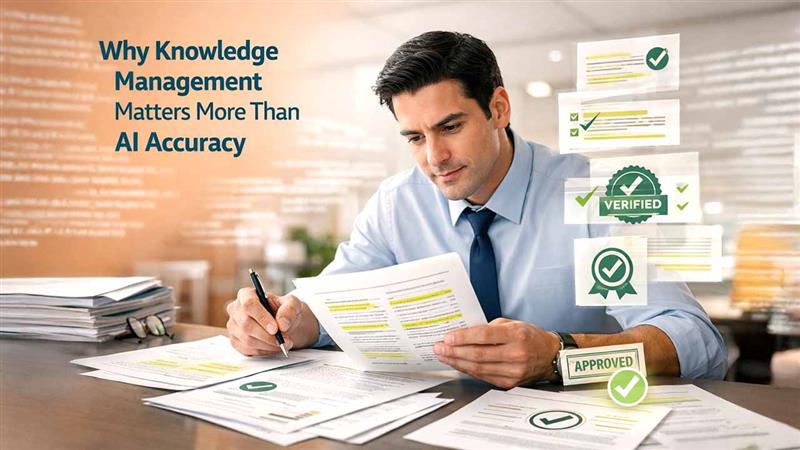
Machines can produce words at lightning speed, but the real power moves to the people who manage, verify, and protect the truth. In a nutshell, this is what knowledge management (KM) entails. It’s less about storing information… and more about keeping reality intact.
Knowledge What?
It sounds like a term invented by bored marketing interns with excessive caffeine intake.
Knowledge management, or at least the modern version of it, is often used in business lingo. It’s the system that captures and distributes information, so employees can make accurate decisions quickly.
As AI has begun to write, think, and sometimes lead alongside us, global institutions are adopting this approach as well. To illustrate this, and to give you a good idea of what knowledge management can do for you consider Africa CDC’s move to build a dedicated knowledge portal. When public health agencies treat knowledge as infrastructure, you know something has shifted.
AI or not, the ability to manage information becomes mission-critical. WoodWing says that while organizations use AI and machine learning to discover and leverage knowledge, our role as humans is to verify it.
AI Is Powerful, But It’s Not Your Source of Truth

AI generates text. It predicts patterns. It fills gaps. It, however, does not know what’s true. IBM, among others, reiterates that organizations need reliable frameworks that ensure the right information reaches the right people at the right time.
AI works well and generates great results when it’s fed trusted, structured knowledge. Without that, it’s like cooking from a recipe by someone who thinks salt and sugar are the same thing. This is why quality control has become the real differentiator. If AI is the engine, a solid knowledge management strategy is the steering wheel.
AI Needs Guardrails
AI is already transforming knowledge sharing in companies. The Indepth Research Institute says that AI can categorize content, extract insights, and automate information flows. AI also accelerates knowledge discovery and reduces the time employees spend ‘hunting’ for documents.
The problem is that AI amplifies whatever it is given. If your knowledge base is outdated, chaotic, or sloppy, AI will spread that misinformation faster than a juicy love-triangle rumour tearing through a company. So you don’t need data – you need good data.
The Rise of Misinformation Makes Knowledge Management Non-Negotiable
We’re no longer dealing with messy files. It’s much worse nowadays – we’re fighting misinformation on turbo mode. AI dramatically increases the volume and speed at which false information spreads. And trust, once lost, is hard to rebuild. With this awareness, it is easy to see the benefits of knowledge management.
Health is a Soft Target
The danger doesn’t stop at news feeds. Health misinformation is rising, too. Research published in Frontiers in Public Health details how confusing or misleading content undermines public safety and decision-making. And then there are deepfakes, the new nightmare fuel. UNESCO warns that manipulated content erodes the very idea of truth. The journal AI and Society highlights how generative systems can distort knowledge even when they’re not designed to deceive.
Quality Control Is Your New Competitive Advantage
AI can help you work faster, but only a knowledge management system allows you to work accurately. Clients don’t care how quickly you generate answers if those answers are wrong. Reliable processes ensure the credibility of your AI outputs. One incorrect piece of content, especially in regulated fields, can cost you money, reputation, or legal trouble.
AI needs structured, validated knowledge to improve. Without it, you’re basically letting a toddler alphabetize your library.
How to Strengthen Knowledge Management in the Age of AI
You don’t need a 200-page strategy. You need habits that keep truth front and center:
- Create a single source of truth: Centralize your documents and knowledge assets. Everyone should know where the truth lives, and where it does not.
- Validate before you automate: If your knowledge base is sloppy, AI will spread that sloppiness.
- Establish review cycles: Knowledge goes stale. Review it regularly and ruthlessly.
- Tag and organize everything: Metadata matters. Your AI can’t retrieve what it can’t find.
- Teach teams how to question AI: Blind trust in automation is the fastest path to misinformation.
- Implement it to customer touchpoints: These systems shouldn't stop at internal teams. AI-powered knowledge bases help improve customer services when they are created on the same verified, organized data that your employees use.
The Human Touch
Generative AI can predict, summarize, and generate content at scale. While it powers everything from generative AI ads to automated customer service, humans judge, verify, and contextualize. This balance is essential. If AI is the match, people are the fuel. Knowledge management provides humans with the structure they need to supervise AI intelligently, rather than emotionally. Not reactively, but accurately. That, ladies and gentlemen, is the real superpower.
%201.png)

%201.png)

%201.png)