


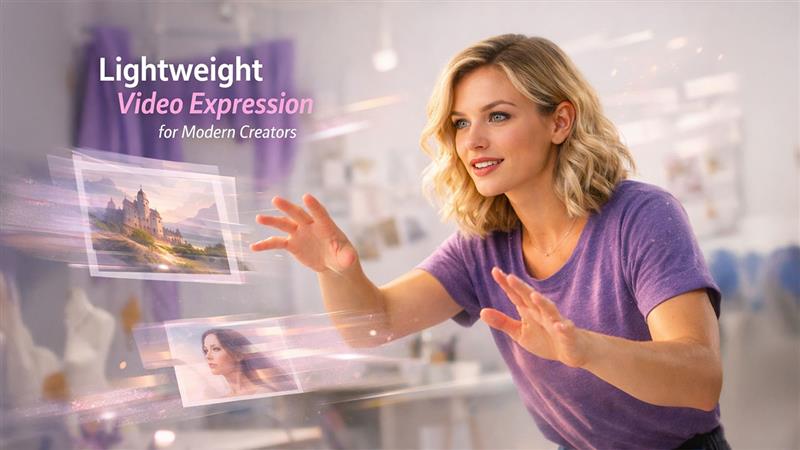

For many creators, visual expressions begin in still form. Often the most comfortable starting point for creators is illustrations, written ideas, concept art, and images that are composed carefully. They enable creators to focus entirely on tone, composition, and meaning without thinking about timelines or motion.
However, in this rapidly evolving world, digital platforms are also evolving at an incredible speed which makes static formats feel limited. While a single image can describe a moment, it may struggle to convey other factors such as progression, emotional flow, or atmosphere.
This is where some creators begin experimenting with lightweight AI video tools. Platforms such as PicLumen are often used not as full production environments, but as a way to gently extend existing visuals into motion without changing how creators already think or work.
But remember this shift does not signal creators wanting to become video editors. Instead of that, it mirrors a strong need for looking ways to bring existing ideas to life, polish and expand them without abandoning familiar creative processes.
Why Motion Feels More Expressive Than a Single Frame
Motion is essential as they make images more vivid and real by adding context which is difficult to express through still images alone. A subtle movement of the camera can suggest space and depth. Gradual changes in lighting can establish a particular mood as per your requirements. Even minimal animation can guide the viewer’s eye and create a sense of intention.
This is one reason short-form video has become common in creative communities. It occupies a middle ground—more expressive than static images, but far less demanding than full cinematic production. For many creators, this format feels approachable because it enhances ideas rather than replacing them.
However, the challenge is that conventional style video and animation tools often require a different perspective and a completely different mindset. Depending on how designers, creators and writers think; timelines, keyframes and rendering workflows can feel quite disconnected and lifeless.

Extending Finished Images Instead of Rebuilding Them
When an image feels complete, a familiar moment of creativity occurs, but somehow still feels constrained. The colors look balanced; the composition works perfectly, but the scene still looks lifeless or frozen. And after coming this far, starting a full animation from scratch feels overwhelming and unnecessary.
AI video generator offers an alternative solution. Rather than rebuilding assets from scratch, creators can extend the existing ones. Gentle motion, depth cues, and camera drift can transform a finished image into a short scene that feels alive rather than static.
Text as a Way to Shape Mood, Not Control Every Detail
Text also has a major role to play in visual creation that brings impactful changes. It does not function as a rigid script; instead, it acts as a descriptive guide. To influence how a scene should be seen or interpreted visually, adding a few sentences describing atmosphere, emotion, or movement works wonders for the viewers.
Text-to-video approaches are used to reflect this mindset. The goal is not to translate but to interpret. The resulting video often feels like a visual response to an idea rather than a literal execution of instructions.
This can be valuable especially for writers and concept-driven creators. It allows abstract ideas to be reborn in the visual form without needing storyboards, shot lists, or any technical strategy.
Experimentation Without Creative Disruption
One of the most practical advantages of these workflows is how smoothly they support experimentation. You can explore a single idea in multiple visual directions, whether slower or faster motion, softer or dramatic lighting, varying aspect ratios — all without reworking or rebuilding the original concept.
The top free AI video tools make short video generation useful not only for publishing, but also for exploration. Mood studies, visual tests, and early concept validation become faster and less resource intensive.
Crucially, creators remain focused on intent rather than execution details. Decisions happen at the level of feeling and direction, not software mechanics.
Knowing When Motion Actually Adds Value
Despite the growing popularity of video, it’s worth acknowledging that motion is not always necessary. Some ideas are strongest when they remain still. The value of video emerges when movement clarifies meaning, enhances atmosphere, or invites sustained attention.
As creation tools become more accessible, the decision to use video shifts away from technical constraints and toward creative judgment. Motion becomes an option—not an obligation.
Closing Thoughts
The movement from static to motion-based creation does not represent a dramatic change in how people create. Instead, it reflects a gradual expansion of expressive possibilities.
Modern generation AI tools support a more fluid creative process by allowing images and text to transition naturally into short video formats. For many creators, this evolution feels less like adopting a new discipline and more like discovering an additional dimension within the one they already know.
%201.png)

%201.png)

%201.png)