



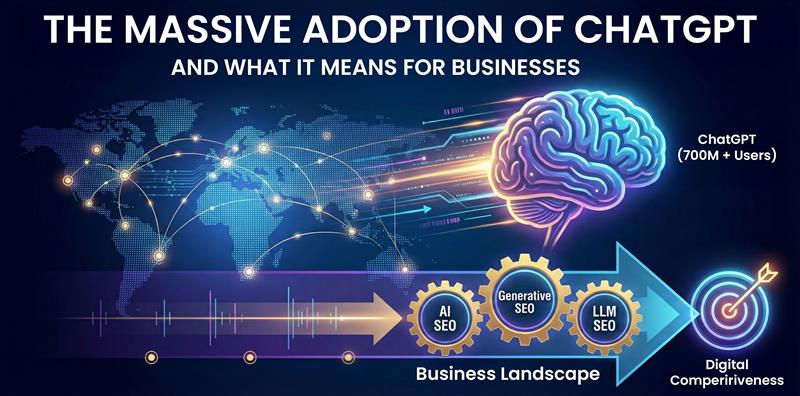

The way businesses are competing nowadays is influenced by how rapidly they adopt the latest technologies. Yet, there are plenty of innovations, like Generative AI that have taken the race to another level. By 2025, there will be more than 700 million users who actively use ChatGPT worldwide, making it one of the fastest-growing technology adoptions we have ever seen. What started as a prototype conversational tool has transformed into a central engine driving search, decision-making, productivity, and customer interaction across industries.
Such a level of adoption goes beyond a simple passing trend. It highlights a fundamental transformation in how people discover data, analyze brands, and determine what to buy. As we enter 2026, businesses that ignore adapting to this emerging AI powered environment face the risk of falling behind competitors who comprehend how generative platforms redefine visibility and boost trust.
Why ChatGPT Adoption Exploded So Quickly
The rapid adoption of ChatGPT did not happen overnight; instead, it was driven by several intersecting factors that fostered its growth over the past few years.
Fundamentally, accessibility is referred to as a critical element. As compared to previous AI systems that needed extensive technical expertise, ChatGPT provides a user-friendly interface that is accessible to all. From students, working professionals, marketers, developers, and executives gained immediate access to quick insights, drafts, summaries, and solutions—without needing complex setup processes.
Another factor influencing the expansion is its cross-platform integration. ChatGPT is now interconnected with different platforms, like CRMs, marketing platforms, analytics tools, content management systems (CMS), and operational processes. Consequently, it turns AI from just a standalone tool to an everyday assistant for millions of users.
Third, reliability and precision strengthen significantly. As large language models (LLMs) advanced, the responses became more dependable, nuanced, and tailored to real-world business requirements. This level of consistency fastens adoption at the enterprise level, where accuracy and consistency remain paramount.
A Quick Transformation: From Conventional SEO to AI-driven SEO
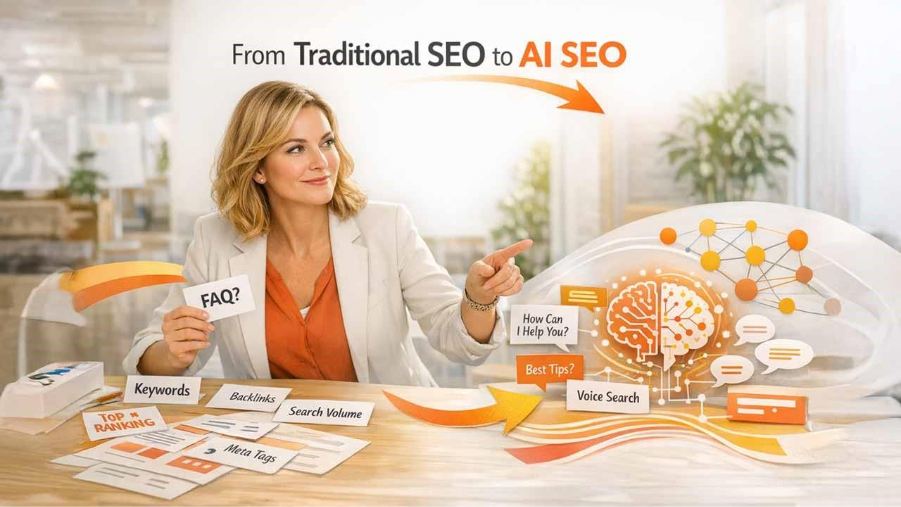
As people are increasingly adopting ChatGPT into their workflow, it has started redefining how users find information online. It eliminates the need to type fragmented keywords into search engines—enabling users to ask complete questions and receive cohesive and contextual answers. This change in user behavior has transformed the ever-evolving nature of search visibility.
Traditional SEO focused on ranking web pages for specific keywords. AI SEO, by contrast, focuses on how content is interpreted, summarized, and surfaced by large language models. ChatGPT does not just retrieve information. It evaluates credibility, context, structure, and authority before referencing sources in its responses.
Here is where robust strategies like Generative SEO and ChatGPT SEO shine. The competitive landscape has transformed: businesses don’t need to rely solely on search engine rankings but on inclusion and visibility within AI powered responses.
Understand LLM SEO and Its Contribution in 2026
For novice users, it’s essential to first understand what LLM SEO is and how Generative AI differs from large language models (Generative AI vs. LLMs). Refining this foundation makes the rest of the conversation flow smoother.
Large language models (LLMs) depend on patterns, reliable sources, and semantic connections to produce meaningful responses.LLM SEO involves refining the online content, making it more accurate, trusted, and cited by large language models.
By spending to implement LLM SEO, businesses are optimizing their content not only for human audiences but also for AI systems that shape discovery and decision-making. This involves enhancing structure, clarity, entity connections, contextual authority, and consistency across the web.
For brands looking to future proof their digital presence, learning how to align with large language models is no longer optional. It is becoming a competitive requirement.
A deeper look into professional LLM SEO strategies can be found here:
ChatGPT Rankings and the New Visibility Race
One of the most important transformations businesses need to understand is the hierarchy of ChatGPT rankings. Rather than ranking websites in the traditional manner, ChatGPT focuses on data sources according to their dependency, authority, and credibility.
When users prompt ChatGPT for suggestions, interpretations, or service providers, the AI is more likely to reference brands that maintain a consistent appearance across reliable sources online. This often means that online presence is determined by cumulative indicators and context rather than depending on an isolated keyword ranking.
Brands that positioned themselves with robust topical expertise, coherent conversations, and high-quality content among platforms are significantly more likely to be referenced as AI powered answers. Businesses ignoring this shift risk becoming invisible as every conversation influence purchasing decision.
Generative SEO and Its Impact on Business Growth
Generative SEO focuses on define how AI models represent and elaborate your brand. This explains how your services are demonstrated, what problems you are relate with, and how usually you visible in reliable contexts.
For instances, if a business decision maker prompt ChatGPT about CRM solutions, marketing techniques, or automation platforms, the AI benefits from its comprehension of the broader online landscape. Or if your brand is not strategically aligned within that ecosystem, it will be excluded from AI-driven discovery.
This transformation prioritizes content quality over quantity, marking it more critical than ever. Comprehensive authoritative content, organized information, expert analysis, and unified brand signals have become increasingly critical.
Why 2026 Will Be More Competitive Than Ever
The increasing adoption of ChatGPT has opened a short but critical window of opportunity. Currently, many businesses remain dependent on legacy SEO practices, while forward-thinking organizations are actively refining for AI powered discovery.
As AI SEO takes off, 2026 will be more competitive than ever. More businesses are expected to adopt Generative SEO, ChatGPT SEO, and AI SEO strategies into their existing workflows. This dynamic adoption makes things harder for late movers to stand out, making adoption difficult and more expensive.
Delaying action will result in significantly higher marketing expenditure and erosion of market share over time. Early Investment enables businesses to secure first-mover benefits, strengthen authority signals, and achieve extensive integration into AI powered ecosystems.
The Risk of Delayed Adoption
Ignoring or delaying adopting AI-driven search behavior does not mean it goes away; instead, it means your competitors take your place. As a result, ChatGPT becomes a robust research tool for both consumers and businesses alike, where visibility in its responses acts as a key driver of trust.
Falling behind in this space does not just impact traffic. It affects brand perception, lead quality, and sustainable growth. Businesses that are not identified by AI tools may struggle to remain relevant, even if they have strong products or services.
Preparing Your Business for the AI First Future
The massive adoption of ChatGPT in 2025 marks a turning point in digital marketing and business visibility. Smart technologies, like AI SEO, Generative SEO, and LLM SEO goes beyond just the latest concepts—they become core strategies for 2026 and beyond.
Businesses that move quickly can establish themselves as reliable authorities in their industries, maintaining the visibility where advanced decision-making starts. And those who overlook it will face intensified competition and greater expenses in the ever-evolving AI powered discovery landscape.
The future of search visibility is AI driven, contextual, and conversational. Investing now is the smartest move businesses can make for long-term competitiveness.
%201.png)

%201.png)

%201.png)