


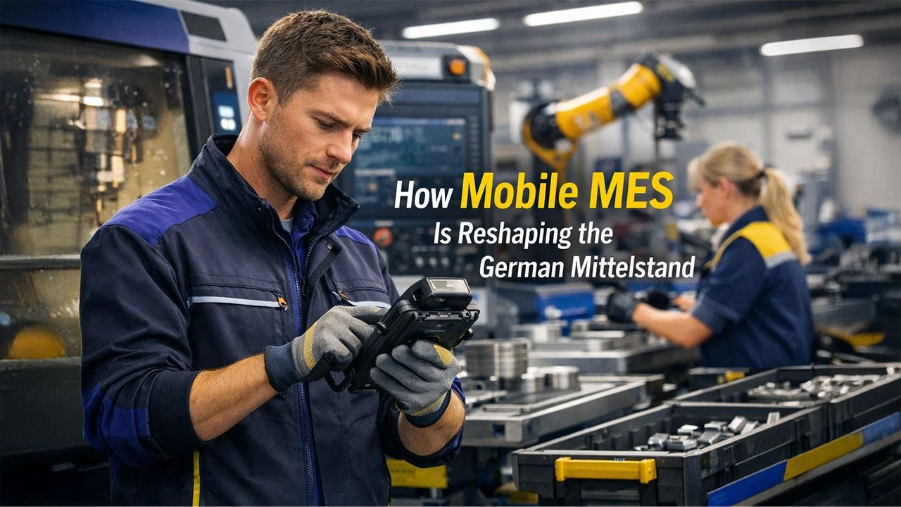

German SMEs often operate in environments where production is a combination of craft, engineering expertise, and highly structured processes. Unlike mass manufacturing, where large volume can smooth out small mistakes, the Mittelstand is frequently dealing with:
- short series and high product variety
- custom configurations
- fast changeovers
- strict traceability requirements
- high-value components
- customers who expect near-perfect consistency
In these conditions, speed and precision don’t compete with each other - they support each other.
A fast reaction is often what prevents quality from slipping.
If your team identifies a deviation immediately, it may be corrected in minutes. If it’s discovered two hours later in a report, it might require a full batch rework, quarantined inventory, and a painful investigation.
That’s why the most competitive manufacturers aren’t just trying to “collect more data.”
They’re working to build faster feedback loops.
What Mobile-First MES Actually Means (It’s Not Just a Smaller Screen)
Some companies hear “mobile MES” and assume it’s simply the same system, but available on a phone or tablet.
In reality, mobile-first MES is a different operational mindset.
It’s designed to capture and deliver information exactly where the work happens - right at the machine, at the assembly table, at the inspection point, or during material movement.
With mobile-first workflows, operators and team leads can instantly:
- confirm work steps
- report downtime reasons as they happen
- flag quality issues immediately
- Attach photos or notes for clarity
- Update WIP status on the spot
- escalate issues without leaving the line
This is where many companies discover something important: success depends heavily on whether the mobile experience is actually usable under real shop-floor conditions.
Industrial environments are harsh. People wear gloves. Lighting varies. Noise is constant. Workflows must be fast, simple, and reliable, even when connectivity isn’t perfect.
That’s why many Mittelstand manufacturers choose to work with a mobile app development company in Germany when building mobile-first MES layers - not for “nice design,” but to ensure the mobile tools are genuinely production-ready, operator-friendly, and aligned with how work happens in real life.
The Decision-to-Action Lag - and How Mobile MES Shrinks It
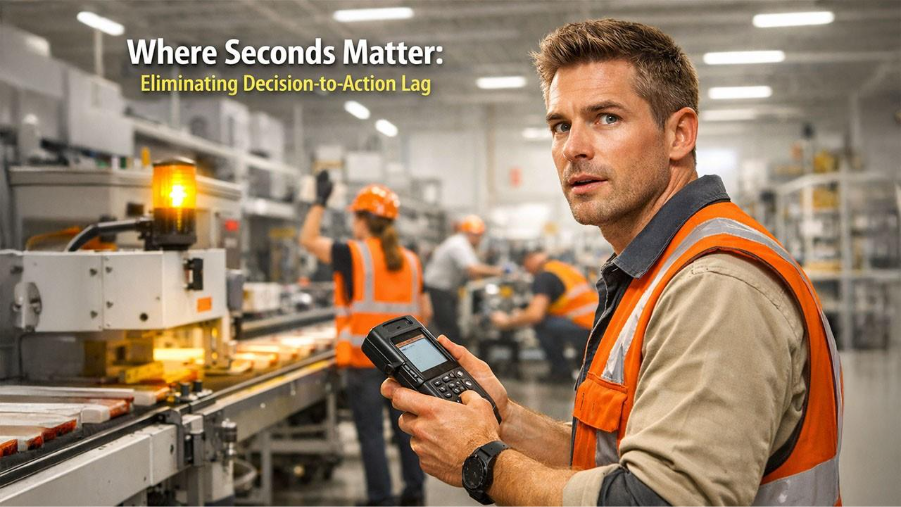
Every production environment has issues. That’s normal.
The real difference between average and high-performing factories is how quickly they detect and respond.
The decision-to-action lag typically includes four stages:
- Detection (something goes wrong)
- Reporting (someone records it)
- Decision (someone evaluates and decides what to do)
- Correction (the action is executed)
In stationary systems, the lag happens mostly in stages 2 and 3.
If reporting is delayed, decisions are delayed.
If decisions are delayed, correction is delayed.
If the correction is delayed, the cost of the problem grows.
Mobile-first MES reduces the lag dramatically because reporting becomes instant and structured. The moment something happens, it can be logged, categorized, and escalated automatically.
A real example from high-precision production
Imagine a deviation appears in a machining process - vibration increases slightly, and dimensional drift begins.
In a traditional setup:
- The operator continues production
- The issue is mentioned verbally
- The supervisor checks later
- quality flags defects in inspection
- The company now faces rework
In a mobile-first MES workflow:
- The operator flags the deviation immediately
- The system escalates it to the right lead
- parameters can be adjusted quickly
- Quality checks are triggered sooner
- The batch stays within tolerance
Same issue.
Very different outcome.
High-Impact Mobile MES Use Cases for German SMEs
The fastest ROI from mobile MES often comes from a few core use cases. These areas tend to create immediate operational clarity and measurable improvements.
1) Real-time production tracking
Instead of waiting for shift summaries, teams see progress live:
- order status
- outputs vs targets
- current bottlenecks
- WIP movement
This improves planning accuracy and reduces “surprises” late in the day.
2) Downtime reporting with real root causes
Downtime is expensive, but guessing why it happened is even worse.
Mobile MES allows quick selection of downtime reasons (and supporting details), which means:
- more accurate analytics
- faster root-cause tracking
- fewer repeated breakdowns
3) Quality checks directly on the line
Mobile checklists, visual inspection steps, and photo documentation reduce errors and improve traceability.
Instead of quality being “a department,” quality becomes part of daily execution.
4) Digital work instructions
When product variations are high, instructions must be consistent.
Mobile access allows operators to always work from the latest standard, reducing:
- assembly mistakes
- interpretation errors
- training time for new staff
5) Andon-style alerts and escalation
Mobile alerts ensure problems don’t stay hidden.
That alone often changes culture, because issues become visible, owned, and resolved faster.
6) Material confirmations and traceability
Missing materials cause silent chaos:
- idle labor
- machine waiting time
- last-minute firefighting
Mobile confirmations help make material flow transparent and predictable.
7) Maintenance coordination
Mobile reporting can capture early warning signals:
- unusual noise
- minor faults
- repeated alarms
With the right workflow, the system shifts from reactive maintenance to proactive action.
Integration Reality: Mobile MES Must Connect to ERP, Machines, and People
MES value collapses if it becomes another isolated tool.
German manufacturers often run complex ecosystems:
- ERP platforms for planning and orders
- legacy production systems
- scanners and traceability tools
- PLC/machine data sources
- QA documentation workflows
A mobile-first MES initiative should focus on integration early, especially around:
- clean master data (orders, work centers, materials)
- reliable connectivity
- structured workflows to prevent messy “free text reporting.”
- role-based access so teams see only what they need
The goal isn’t to build “one system that replaces everything.”
The goal is to build one operational layer that connects work execution to real-time visibility.
Implementation Strategy: Roll It Out Without Disrupting Production
One mistake SMEs make is trying to deploy everything at once.
Mobile MES works best when it starts small and grows fast.
A practical rollout strategy looks like this:
Start with one line or one process
Pick a section of production where delays are expensive, like:
- CNC machining with high cost
- assembly with complex product variations
- packaging or final inspection
Focus on one pain point first
Common starting points:
- downtime chaos
- missing WIP visibility
- slow escalation of quality issues
Train operators first
Mobile MES lives or dies by adoption. If the operator experience is slow or annoying, data quality collapses.
Track the right metrics
Instead of focusing only on “digitalization progress,” track operational outcomes:
- response time to deviations
- A reduction in repeated downtime causes
- higher OEE
- fewer manual reports and spreadsheets
Security and Reliability: Non-Negotiable for German Industry
Mobile devices introduce a new attack surface, which is why security must be part of the foundation, not an afterthought.
Key requirements include:
- secure authentication and access control
- audit trails for all edits and approvals
- controlled device usage and policies
- secure synchronization and encryption
Reliability matters just as much as security:
- Mobile inputs must be fast
- An offline mode should exist for weak coverage areas
- The system must not slow production down
If the MES becomes “another thing that breaks,” people revert to paper instantly.
What to Look for in a Modern Mobile-First MES Platform
If you’re evaluating options, here’s a strong practical checklist.
A mobile-first MES should offer:
- operator-friendly UX (few taps, fast input)
- offline capability
- real-time dashboards and alerts
- configurable workflows (not rigid templates)
- barcode/QR support
- traceability and documentation features
- integration-ready APIs
Most importantly, the platform must be designed for the factory floor - not for a boardroom presentation.
That’s why choosing the right MES software for manufacturing becomes a strategic decision. The system you select determines how quickly your teams can capture critical data, respond to deviations, and scale operational improvements across multiple lines or sites.
Final Thoughts: Mobile MES Is About Speed, Visibility, and Ownership
The German Mittelstand doesn’t win by copying the biggest corporations. It wins through discipline, engineering quality, and operational execution. Mobile-first MES supports exactly that.
It reduces the gap between “knowing something went wrong” and “fixing it.” It turns shop-floor data into real-time action. And it helps teams react faster, with more clarity, and less chaos. In 2026, efficiency isn’t only about working harder.
It’s about making decisions faster - and acting immediately, right where production happens.
%201.png)

%201.png)

%201.png)