




Customer expectations accelerate with technical progress. Faster (faster, FASTER!) responses, more effective problem solving, and occasional mind reading. The pressure on support teams is immense. There was a simpler time when answering politely was the extent of it. Now, it’s more about SCALE. The psychology behind this is quite intuitive. Many clients can misinterpret response speed as a sign of competence. While that’s not always the case, a company that replies quickly feels organized, attentive, and trustworthy. A company that takes longer feels negligent, even if the actual quality of support is identical.
There are growing parallels between customer retention strategies and engineering problems. CRM remains central. An automation engine that takes the load off human shoulders. Without extra drama, it’s taking thousands of inputs, routs them to the right places, then carries out decisions. Loads faster than clicking a ticket.
Popping the hood, scaled support depends on three core layers. Automation, data routing, and micro-workflows. Each layer is there to reduce friction, shorten the request-to-resolution cycle, and ultimately improve retention.
So, each layer needs individual dissection to make more sense and provide clarity. Time to jump.
Speed=Retention. Really?
Attention spans of modern homo sapiens are shorter than ever. That’s no news. So, customers mainly evaluate service quality during the first few seconds of an interaction. Behavioral studies show a clear pattern. The earlier a customer receives an acknowledgment or a meaningful response, the more cooperative and patient they remain throughout the exchange. Conversely, slow triage primes users to expect a negative outcome. The result is not a happy ending. They might go into defensive mode, demand more updates, escalate faster, and abandon support processes earlier.
The challenge is that most delays don’t come from the conversation itself. They come from pre-conversation bottlenecks:
- Tickets landing in the wrong queue
- Missing customer context
- Repeated questions because history isn’t surfaced
- Agents manually parsing issues
- Duplicate work among teams
Modern CRMs solve these issues by cutting the “cognitive load” on both agents and the system. The goal is to eliminate micro-delays. If that goal is accomplished, the customer never enters frustration mode. In short, support efficiency is a retention vector, not an internal KPI.
Remember the three layers we mentioned in the beginning? Automation, data routing, and micro-workflows? It’s high time to discuss all of them one by one and explain why they matter.
Automation Layers: What’s Behind High-Volume Support?
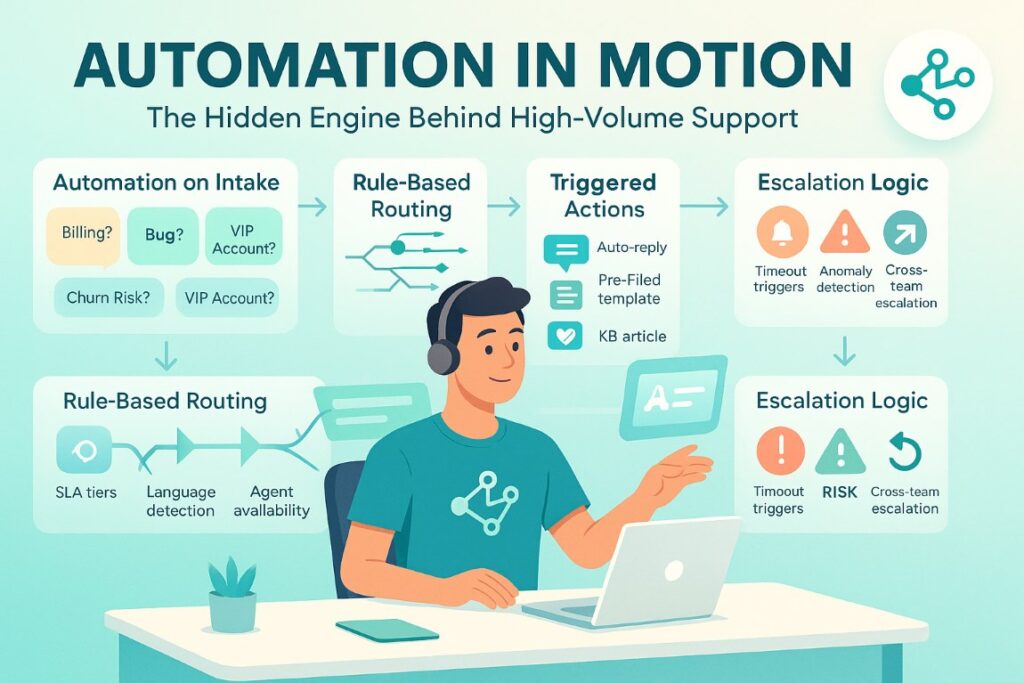
Automation makes modern CRM look less painful. But it’s not that simple. Automation became one of those words that people often say without grasping its full meaning. Modern CRMs often integrate an AI-powered assistant for customer support to handle repetitive tasks, making high-volume support much smoother. It isn’t just sending auto-responses and hoping for the best. Once there are platitudes on data to go over, automation is a multi-layered logic structure.
1. Automation On Intake
This phase starts when the message has just arrived. At this point, the CRM does several actions, listed below:
- text extraction
- intent detection
- keyword clustering
- sentiment scoring
- metadata enrichment (browser type, device, OS, account tier)
No, this is not for funsies. It lets the system determine several components of the problem
This lets the system determine:
- is the issue a billing problem?
- a product bug?
- a cancellation risk?
- a high-value account needing priority?
This classification happens before a human even sees the ticket. And that helps eliminate the said bottlenecks.
2. Rule-Based Routing
Older CRMs used static queues. Basically, they placed every ticket into a fixed, unchanging queue, that did not depend on the complexity or urgency of the matter. Modern ones are smarter, and perform dynamic routing, meaning, the urgency and complexity take center stage, but it’s harder to determine the order. The classification and queueing are often based on:
- agent utilization
- SLA tiers
- language detection
- product category
- current backlog load
Skill-based routing alone can cut resolution time by 20–40% because issues land instantly in front of someone equipped to handle them.
3. Triggered Actions
Repetitive work can slow agents down due to the human factor and specific characteristics of human brain activity. The guy with a metal head can solve this issue. Automation also handles the repetitive work that can create slowdowns. It can:
- auto-send troubleshooting steps
- pre-fill templates
- escalate tickets that exceed response timers
- attach relevant knowledge-base articles
- notify engineering if a threshold of similar bug reports appears in under 10 minutes
4. Escalation Logic
Now, this is important. As the queue is not static anymore, some tickets should be pushed up because of urgency concerns. This process is called escalation, and it isn’t manual anymore. CRMs now use:
- timeout triggers
- anomaly detection
- risk scoring
- cross-team event triggers
These workflows prevent long family trees of “Can someone look at this?” Slack messages. Vague messages that no one wants to take responsibility for, especially if the task at hand is not an easy one. Or, how professionals call it, support latency.
Collectively, these automation layers reduce human handling. They also eliminate “automation debt,” the squeaky wheel of support speed where old rules slow the entire system. Modern CRMs let teams audit and tune automation the same way software engineers manage tech debt.
Data Routing: Direction Matters

In a way, if automation is the engine, data routing is much like the nervous system of fast support. It ensures every ticket moves to its correct destination.
On a large scale, routing becomes an engineering probleplaced every ticket into fixed, unchanging queues, regardless of complexity or urgencym. A CRM must:
- parse the incoming payload
- merge it with internal datasets
- assess which queue or agent is most optimal
- and deliver the enriched package immediately
If this little conveyer belt doesn’t work properly, all h*ll breaks loose. More importantly, routing failures cascade into client fiasco:
- high-priority users end up in low-priority queues
- agents receive tickets lacking context
- teams reassign issues multiple times
- ticket throughput collapses
Prevention is important. Effective routing depends on context availability, i.e. having all relevant data accessible at routing time, not later. This includes:
- purchase history
- subscription level
- device diagnostics
- previous support interactions
- feature usage patterns
- risk indicators (e.g., potential churn behaviors)
Modern CRMs often use ML-based routing models that improve from historical data. They identify which agent resolves which issue the fastest and route similar issues there automatically. This reduces average handling time and improves resolution predictability, reinforcing customer trust.
Micro-Workflows: Small Systems, Large Shadows
“Micro-workflows” are compact, specialized sequences triggered by specific conditions. They’re like tiny building blocks that handle one task at a time, instead of relying on one big, complicated process to do everything.
Here’s the same in pain English. Example:
Ticket arrives → detect product → pull device logs → attach relevant troubleshooting steps → notify agent with pre-filled response draft.
Another example:
Bug keyword cluster detected → auto-tag → forward to QA → link all similar tickets → create a unified engineering report
Micro-workflows prevent the system from becoming a giant automation blob. They’re easier to maintain, scale, test, and modify without breaking other processes.
This is also where support teams often attach lightweight resources to reduce back-and-forth. I.e., they attach screenshots, short tutorials, or small video clips. Many teams make walkthrough videos, use an mp4 compressor, then upload them into the CRM, so they load instantly inside the ticket panel, avoiding UI latency for both customers and agents.
In short, customers stay when their problems are resolved quickly, consistently, and with minimal friction. Companies can achieve this with very little emotion involved. Modern CRMs deliver that through a combination of automation, smart data routing, and finely tuned micro-workflows.
%201.png)

%201.png)

%201.png)