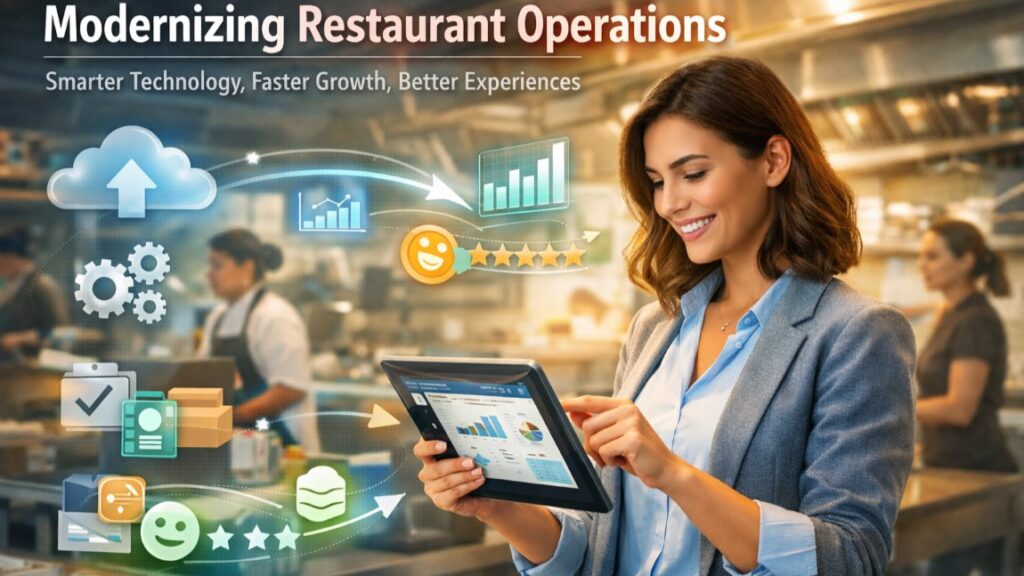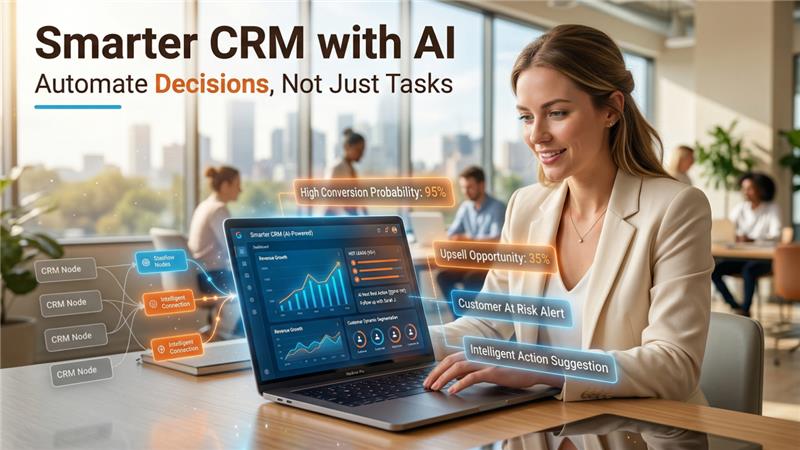



The restaurant industry is operating at a strategic inflection point where operational agility now defines market leaders from laggards. For executive leadership, 2026 is not a distant future; it is the immediate horizon where immense pressures from margin compression, a tight labor market, and fundamentally shifted consumer expectations demand a decisive response. As detailed in recent industry analysis, rising costs and new hybrid work patterns are creating unprecedented demand volatility, making operational efficiency a primary determinant of survival and growth. This landscape has intensified a technological arms race, where inaction has become the most significant strategic risk an organization can take.
The imperative to modernize is anchored in clear data: 76% of restaurant operators now view technology as a primary competitive advantage, transforming it from a back-office utility into a core component of business strategy. The projected surge of the global cloud POS market to $25.6 billion by 2033 further underscores the industry's commitment to this digital transformation.
For the C-suite, the conclusion is unavoidable: legacy, on-premise systems are no longer merely inefficient; they are a direct and escalating threat to profitability, scalability, and market relevance. This analysis provides the strategic framework for how to modernize restaurant operations, detailing the imperative to audit legacy infrastructure, integrate a unified technology platform, and deploy data as a core strategic asset for 2026 and beyond.
The Strategic Audit: Moving Beyond Legacy Constraints
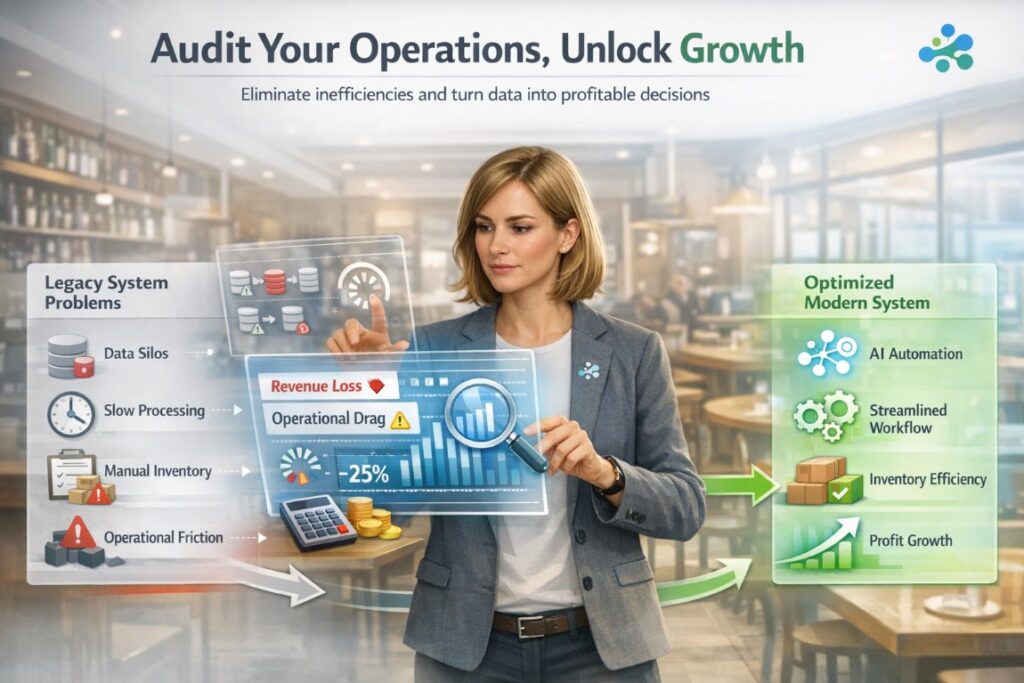
A comprehensive technology audit must be positioned not as a routine IT task but as a fundamental business strategy exercise. The primary objective is to identify and quantify the financial drag of outdated systems, thereby building a compelling, data-backed case for strategic investment. This process moves the conversation from technical specifications to measurable business outcomes, aligning technology decisions with top-level corporate goals like revenue growth and margin improvement.
Identifying Systemic Operational Bottlenecks
Legacy systems create systemic bottlenecks that directly inhibit the operational efficiency required to compete in the modern market. Pain points such as fragmented data silos, slow transaction processing, and manual inventory management create friction that ripples across the entire organization.
Recent research shows that restaurant leaders are prioritizing technology investments specifically to increase operational efficiency in response to these challenges. The problem is severely exacerbated by the fact that nearly 75% of all restaurant traffic now occurs off-premises—a channel that antiquated systems were never designed to handle. The consequence is not just substandard service but a direct negative impact on restaurant-level EBITDA margins, which tech-forward competitors are now pushing into the 18–22% range through superior operational capabilities.
Quantifying the Financial Cost of Inefficiency
The perspective must shift from operational friction to measurable financial loss. Legacy systems do not just slow down service; they actively prevent the financial gains achievable through modern analytics and data-driven management. Authoritative data shows that restaurants utilizing robust data analytics can increase revenue by up to 10% and reduce costs by 5%. Therefore, the investment in new technology should not be categorized as a capital expense but as a direct path to unlocking these quantifiable financial improvements. The cost of inaction—measured in lost revenue, excessive food waste, and inefficient labor allocation—far outweighs the cost of a strategic technology overhaul.
The 2026 Technology Readiness Assessment
To prepare for the demands of the modern market, executives must benchmark their current infrastructure against a new set of strategic standards. This assessment provides a clear, forward-looking checklist to determine technological readiness.
- Data Centralization: Is customer and operational data housed in a single source of truth, or is it fragmented across disparate, non-communicating systems? A unified view is no longer optional for effective decision-making.
- Cloud-Native Architecture: Can your core systems be accessed and managed remotely on any device, ensuring real-time data flow and seamless updates without operational downtime?
- Integration Capability: Does your core operating system, particularly your POS, feature an open architecture capable of integrating with best-in-class solutions for labor, inventory, and marketing? As evidenced by Papa Johns' recent move to replace legacy systems, the era of the closed, monolithic system is over.
- Off-Premises Optimization: Is the platform engineered from the ground up to manage the complexities of takeout, delivery, and drive-thru, which now represent the majority of consumer traffic?
- Enterprise Scalability: Can the system support rapid multi-unit expansion with centralized menu management, reporting, and permissions, or does each new location require a costly and complex bespoke implementation?
Building the Central Nervous System: Integrating a Modern Restaurant POS
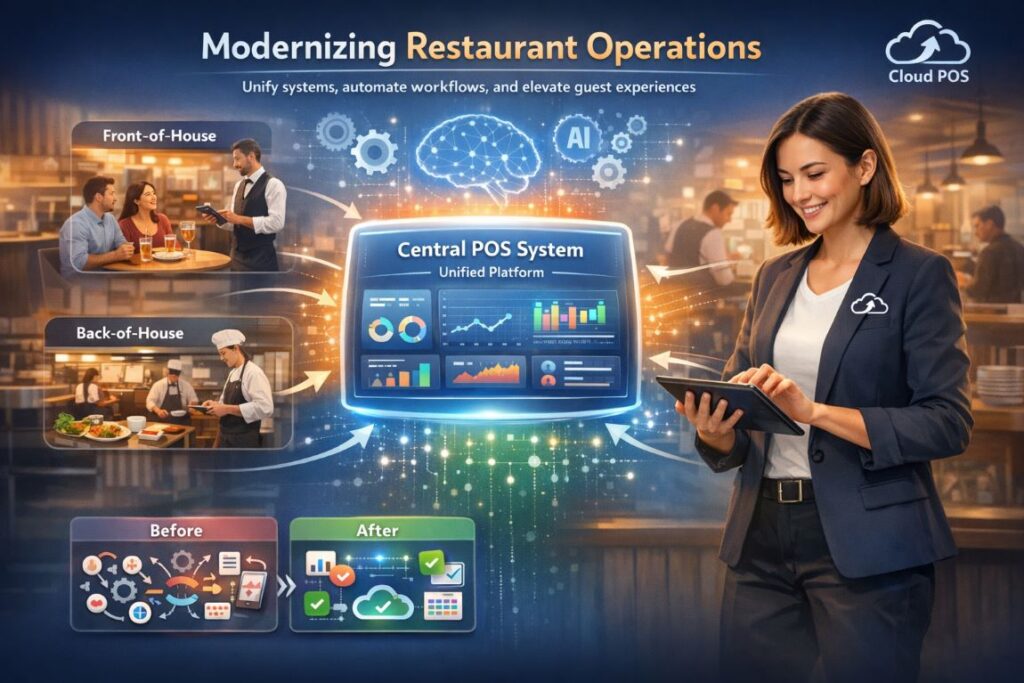
The next critical step is moving from a patchwork of disconnected tools to a single, unified platform that serves as the operational core of the business. This strategic consolidation is essential for achieving the efficiency and intelligence required to dominate the market. The central argument is that a modern, cloud-based restaurant POS is the lynchpin of any successful effort to modernize restaurant operations, acting as the central nervous system that connects all functions of the enterprise.
The Strategic Shift from Siloed Tools to a Unified Platform
The modernization mandate requires moving beyond isolated solutions for ordering, payments, and management. True operational excellence is achieved when a single platform connects front-of-house, back-of-house, and back-office functions into a cohesive ecosystem. This eliminates data discrepancies, streamlines workflows, and provides leadership with a holistic view of the entire enterprise in real-time, enabling more agile and informed strategic decisions. To further enhance operational efficiency and eliminate repetitive manual tasks, businesses are increasingly adopting automation strategies. Learn how business process automation improves workflows and productivity in this detailed guide.
Leading operators are consolidating their tech stack around a central platform that provides this single source of truth. A prime example of this model is SpotOn, which has engineered its restaurant POS not just as a tool for transactions, but as a comprehensive restaurant management system. Its cloud-based architecture ensures that data from every touchpoint—from tableside ordering with handhelds to online reservations and multi-unit reporting—is accessible anywhere, on any device. This breaks down the data silos that cripple legacy operators and provides a unified command center for the entire business.
For executives overseeing multiple locations, this unification is a strategic imperative. The SpotOn platform allows for centralized control over menus, pricing, and employee permissions across an entire portfolio, driving consistency and efficiency at scale. By integrating essential functions like scheduling, advanced reporting, and guest data collection directly into the POS, it provides the robust, all-in-one infrastructure required to compete effectively in 2026. This approach transforms the POS from a simple utility into the strategic central nervous system of the operation, empowering leaders with the visibility and control needed for sustained growth.
Enhancing the Guest Experience Through Technology
Modernization is not solely about back-office efficiency; it is about meeting and exceeding evolving guest expectations. In 2024, 60% of restaurants planned technology investments specifically to enhance the customer experience. Modern platforms facilitate this by enabling seamless omnichannel ordering, tableside payments via tablet (which 65% of full-service customers are likely to use), and the collection of guest data to power personalized marketing initiatives. This direct link between operational technology and guest satisfaction creates a powerful competitive advantage, turning efficient operations into memorable and loyalty-building experiences.
From Data Collection to Strategic Intelligence
The final stage in modernizing restaurant operations elevates the conversation from technology implementation to strategic application. The focus is on using the data unlocked by a modernized platform to create a sustainable competitive advantage through superior, proactive decision-making. This transition from reactive reporting to predictive intelligence is what separates market leaders from the rest of the industry.
The Power of Predictive Analytics and Demand Forecasting
A critical vulnerability highlighted in recent industry reports is that only 18% of operators are highly confident in their ability to forecast sales or labor needs. This is where modern platforms create the most significant competitive separation. By using AI-powered analytics, operators can improve forecast accuracy by as much as 22%. This capability is essential for navigating the demand volatility created by hybrid work patterns and optimizing staffing for profitability, a key challenge identified in the current market. Instead of reacting to disruptions, leaders can anticipate shifts in demand and allocate resources with precision.
| Feature | Legacy System Approach (Reactive) | Modern Platform Approach (Proactive) |
| Reporting | Manual, end-of-day reports offering a historical view. | Real-time, automated dashboards with AI-driven alerts for immediate action. |
| Forecasting | Based on simple historical sales averages, vulnerable to disruption. | AI-driven demand forecasting that accounts for weather, events, and promotions. |
| Inventory | Manual counts, high error rates, and significant food waste. | Predictive ordering, resulting in up to 15% lower food costs. |
| Guest Data | Anonymized, transactional data with no actionable insight. | Unified guest profiles enabling data-driven personalization and marketing. |
Creating a Data-Literate Culture
Technology alone is an enabler, not a panacea. The ultimate return on investment from modernization is only realized when leadership champions a data-driven culture throughout the organization. This requires a concerted effort to train managers to move beyond "gut-feel" decisions and empower them with the tools and insights needed to optimize everything from menu engineering to labor scheduling based on real-time intelligence. The strategic objective is to transform every manager into a data-literate profit-center leader who can independently drive performance at the unit level.
Strategic Imperatives for the 2026 Restaurant Leader
The path to operational excellence in 2026 is not through incremental upgrades but through a decisive strategic overhaul. The leaders who will dominate the market are those who recognize that their technology platform is as critical to their success as their menu or their service model. The mandate for the C-suite is clear and requires immediate action on three fronts.
- Consolidate the Tech Stack: Prioritize a unified, cloud-native platform. Abandon the patchwork of disparate legacy systems in favor of an integrated solution that serves as the single source of truth for the entire operation. This foundational step eliminates data fragmentation and creates the architectural agility needed for future growth.
- Elevate Data as an Asset: Treat data infrastructure with the same strategic importance as physical real estate. Invest in platforms with robust analytics and AI capabilities to drive predictive insights, optimize costs, and personalize the guest experience at scale.
- Champion Data Literacy: Foster a cultural shift toward data-driven decision-making at every level of the organization. Even the most cutting-edge technology is only as powerful as the individuals who operate it. Ensuring insights are translated into action is the final, critical step to maximizing the return on any modernization investment.
To assess your organization's operational maturity and explore a strategic technology partnership, schedule a consultation with our experts. For a deeper analysis of future-proofing your business, download our executive whitepaper on digital transformation.
%201.png)

%201.png)

%201.png)