





Nearshore UI/UX design agencies in Europe support products that should evolve over the years, operate across markets, and remain coherent as technical and organizational complexity increases. For many European and North American teams, the right nearshore partner now plays a role similar to an internal design lead, shaping decisions rather than simply delivering artifacts.
Europe has become a preferred nearshore region for UI and UX design because it combines mature design talent with operational proximity to Western markets. Strong design education, deep exposure to SaaS and enterprise product development, and familiarity with regulatory frameworks such as GDPR create a level of practical alignment that is difficult to replicate elsewhere.
This article determines the top nearshore UI/UX design agencies in Europe and examines what distinguishes them in terms of delivery maturity, collaboration models, and ability to support complex digital products.
Why Turn to Top Nearshore UI/UX Design Agencies in Europe
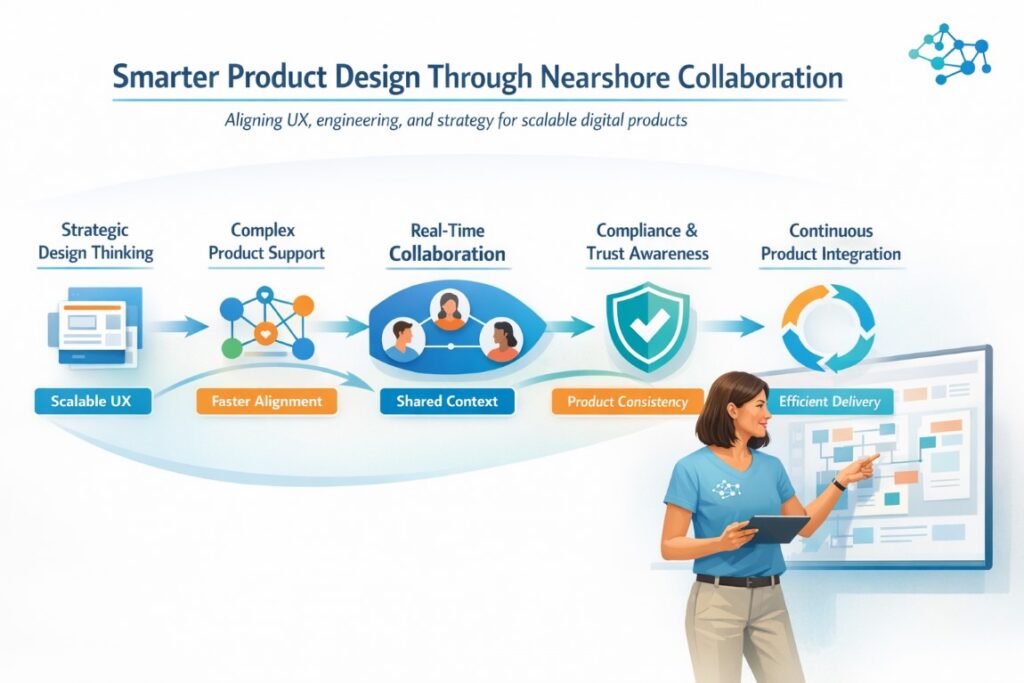
Product organizations are increasingly relying on nearshore UI/UX design agencies in Europe as digital products become more complex and longer-lived. Design decisions now influence not only usability, but also engineering effort, delivery speed, and long-term maintainability. Main benefits are:
Design as a Strategic Product Capability
Product teams operate under tighter timelines, higher technical complexity, and greater accountability after launch. Effective nearshore partners understand how design decisions affect system architecture and product health over time, and they factor these implications into day-to-day design choices rather than treating design as an isolated layer.
Support for Complex and Evolving Product Environments
As products scale across markets and platforms, UX must account for workflows, dependencies, and future change. European agencies are accustomed to working in SaaS, enterprise, and regulated contexts where these constraints are unavoidable, which allows them to design solutions that remain usable and maintainable as systems and requirements evolve.
Closer Collaboration and Faster Alignment
Time zone overlap enables real-time collaboration between design, product, and engineering, reducing delays and misalignment during discovery and delivery. This proximity supports live problem solving, faster feedback loops, and clearer shared context. As a result, decisions are made with greater confidence and fewer downstream corrections.
Regulatory and Operational Familiarity
Experience with GDPR, accessibility standards, and compliance-driven UX reduces risk for data-sensitive and regulated products. European agencies are familiar with how these requirements influence information architecture, consent flows, and data handling patterns. This familiarity helps teams avoid rework and compliance-related delays later in delivery.
Deeper Integration into Product Teams
Nearshore models support ongoing collaboration rather than one-off delivery, resulting in better coordinated decision-making across disciplines. Designers build product context over time, which improves judgment and reduces repetitive explanation. This continuity strengthens alignment between design intent, engineering implementation, and product strategy.
5 Top Nearshore UI/UX Design Agencies in Europe for 2026: Detailed View
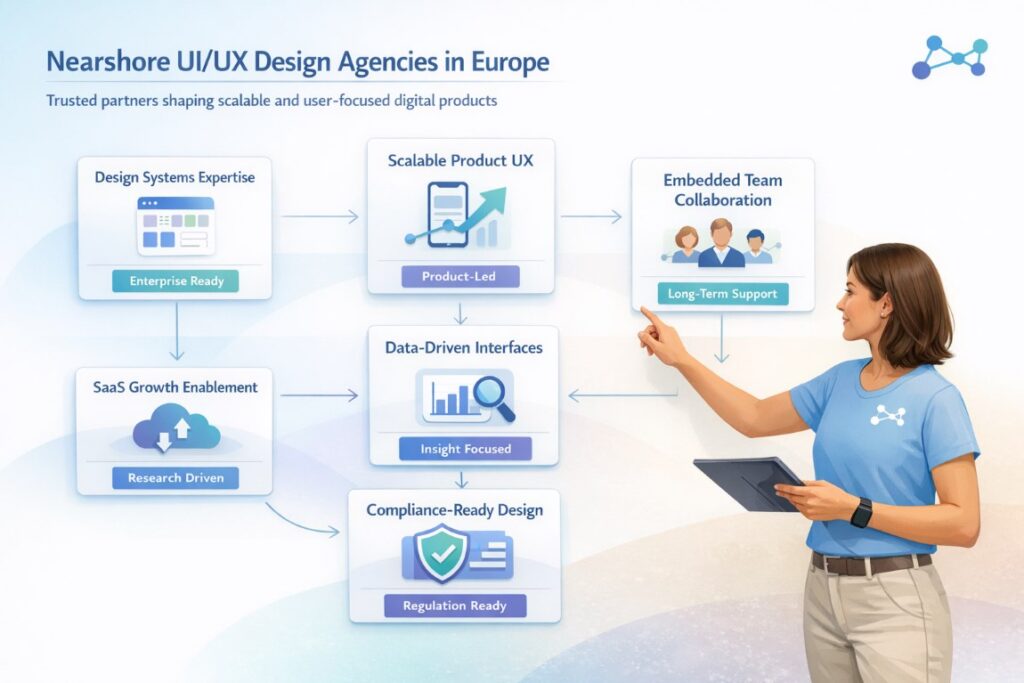
This list is compiled based on a defined set of evaluation criteria, including delivery maturity, collaboration model, team seniority, and ability to support complex products over time. Rather than focusing on surface-level presentation, it reflects how agencies perform under real execution conditions. Below, we take a closer look at each company and examine what distinguishes them in practice.
1. Gapsy Studio
Gapsy Studio operates as a top nearshore UI/ UX design agency in Europe for product teams that view design as a long-term capability rather than a delivery phase. The agency is experienced in working inside active product roadmaps, where design decisions must align with technical constraints, regulatory requirements, and evolving user needs. Their work is shaped by sustained involvement in complex products rather than short-term execution.
- Expertise: End-to-end UI and UX design for web and mobile products, with a strong focus on design systems, long-term maintainability, and usability in regulated environments.
- Fit for: Product organizations that need senior design embedded into delivery cycles while maintaining speed and consistency across platforms.
- Portfolio highlights: Fintech, Healthcare, SaaS, and consumer products, including large-scale redesigns, mobile-first strategies, and multi-platform design systems delivered through long-running engagements.
2. Fireart Studio
Fireart Studio supports organizations that need design consistency across multiple products, teams, or markets. The agency has built delivery processes designed for scale, making them a reliable partner for complex product portfolios. Their approach emphasizes governance, documentation, and predictable execution.
- Expertise: Scalable UI and UX design, visual systems, and brand alignment for multi-product organizations.
- Fit for: Mid-sized and enterprise teams managing distributed product and engineering groups.
- Portfolio highlights: Long-term design support for global technology and fintech companies requiring consistent experience across product ecosystems.
3. Habitat
Habitat functions as a flexible design extension for in-house product teams. Their model prioritizes close collaboration and adaptability, allowing designers to integrate directly into ongoing development cycles. This approach supports products that evolve quickly and require continuous UX and UI input.
- Expertise: Adaptive UX and UI design embedded into internal product workflows.
- Fit for: Teams that need ongoing nearshore design capacity rather than fixed scope engagements.
- Portfolio highlights: Continuous support for products with frequent releases, feature expansion, and iterative refinement.
4. Eleken
Eleken focuses exclusively on SaaS UX and UI design, with a clear emphasis on usability and product clarity. The agency works closely with product managers to improve onboarding, activation, and everyday usage. Their specialization allows for a deep understanding of subscription-based growth constraints.
- Expertise: SaaS focused UX and UI design, onboarding optimization, and design systems.
- Fit for: B2B SaaS startups and scaling software products using product-led growth models.
- Portfolio highlights: Improved usability, onboarding efficiency, and retention across subscription-driven platforms.
5. Ergomania
Ergomania specializes in UX research and product design for regulated industries, particularly financial services. Their work balances usability with compliance, security, and trust requirements. Design decisions are grounded in research and regulatory awareness.
- Expertise: UX research and product design for digital banking and compliance-driven products.
- Fit for: Products operating under strict regulatory, accessibility, and security constraints.
- Portfolio highlights: Financial and enterprise platforms where usability and regulatory trust must coexist.
6. Widelab
Widelab works on UX and product design for data-intensive and technically complex SaaS platforms. The agency focuses on simplifying advanced workflows while maintaining scalability and performance. Their teams collaborate closely with engineering to ensure UX decisions remain viable as products evolve.
- Expertise: UX and product design for data-driven and complex SaaS systems.
- Fit for: SaaS and analytics-heavy products with advanced logic and long-term scalability needs.
- Portfolio highlights: Simplification of complex user flows and structured design systems for data-intensive platforms.
How to Choose the Best Nearshore UI/UX Design Agency in Europe
Choosing the best nearshore UI and UX design agency in Europe requires a practical evaluation of how an agency will perform over time, not how it presents itself at the start.
The considerations below focus on how experienced teams assess nearshore agencies in real selection processes. They emphasize operating discipline, decision-making quality, and the ability to integrate into ongoing product work.
- Focus on delivery behavior, not just portfolios. Strong visuals do not guarantee reliable execution. Evaluate how an agency operates when requirements evolve, technical constraints appear, and timelines tighten.
- Assess decision-making under complexity. The right nearshore partner can reason through ambiguity, tradeoffs, and competing priorities. Look for teams that explain how they approach unclear problem spaces and adapt as products evolve.
- Evaluate integration with product and engineering. Effective UI and UX work depends on close collaboration. Assess how designers work with product managers and engineers, and how design decisions translate into production.
- Prioritize continuity and seniority. Long-term product quality depends on who does the work and how stable the team is. Clarify team composition, experience levels, and expectations around continuity.
- Examine communication and accountability. Nearshore success relies on clear ownership, transparent communication, and consistent follow-through. Misalignment in these areas creates risk regardless of location.
- Look for alignment with long-term product goals. The best agencies understand how design choices affect maintainability, scalability, and business outcomes. Organizations often validate these decisions with strategic SaaS consultants who understand how design choices impact product lifecycle and adoption.
Conclusion
Nearshore UI/UX design agencies in Europe have become part of modern digital product development. As products grow more complex and lifecycles extend, the role of a design partner shifts from execution support to strategic contribution. The agencies that stand out for 2026 are those that combine senior expertise, delivery discipline, and the ability to operate inside real product constraints over time.
What differentiates effective nearshore partners is not surface-level design quality, but how they think and work when priorities change, systems evolve, and pressure increases. Strong agencies demonstrate continuity, sound judgment, and close alignment with product and engineering teams. They understand that design decisions influence delivery speed, system stability, and long-term maintainability, not just usability or visual appeal.
For product leaders, the takeaway is clear. Selecting a nearshore UI and UX design agency should follow the same rigor applied to senior internal hires. When operating models, decision making, and long-term goals are aligned, a nearshore partner becomes a durable extension of the product organization, capable of supporting growth and complexity well beyond initial delivery.
%201.png)

%201.png)

%201.png)