





In SaaS, not all revenue is equally valuable or diagnostic, and revenue is not a monolithic number. Instead, it is a mix of revenue streams, each reflecting a different part of a company’s growth. One of the most essential distinctions in subscription analytics is the difference between new business revenue and expansion revenue. When these are lumped together, it is impossible to understand how effectively a company’s market strategy is working, whether its product is delivering value to customers, and where resources should be allocated. When these key pieces of information are separated, they provide a clear picture of a SaaS business's viability and scalability.
How SaaS Revenue Grows
SaaS revenue grows in two fundamental ways: when a company acquires new customers, and when its existing customers pay more over time for its products. The motions behind each factor differ considerably. The first is centered on new business, and the second focuses on expansion. Each reveals different information; new business reveals the strength of a company’s marketing, sales pipeline, and demand generation. Expansion, meanwhile, shows product value, customer success performance, and how well offerings meet changing customer needs. Without splitting both revenue sources, you may miss vital warning signs, such as slowing new logo growth masked by significant expansion from a handful of large customers.
Identifying New Business Revenue and Expansion Revenue
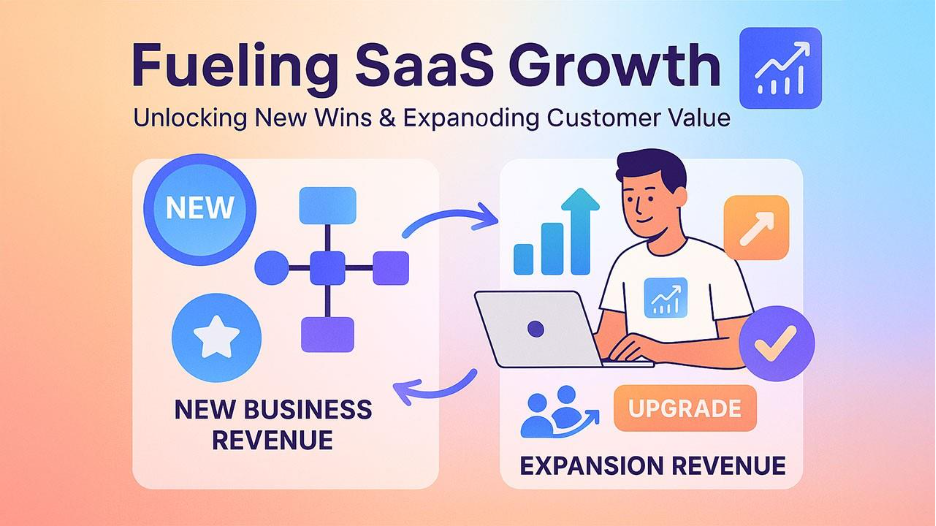
It can be helpful to review examples of new business revenue and expansion revenue. New business revenue is the revenue gained from new customers. In a SaaS report, this would include first-time subscription purchases, first-time usage or consumption-based commitments, or initial contact value (ICV). The aim of tracking this type of revenue is to identify acquisition efficiency, marketing performance, the health of your new logo pipeline, and early signals on the product market to fit in new segments or tiers. Expansion revenue, meanwhile, focuses on increases in revenue, including upgrades to plans, seat increases or additional licenses, usage-based overages, contract expansions, and the adoption of new modules or features. Expansion is a key indicator of the resilience of a SaaS model. Significant expansion indicates that customers are realizing continued or increased value. It also shows that a company’s pricing model scales with usage, and a product has the ability to convince customers to increase their expenditure.
Separating New Business and Expansion Revenue in Reports
The most effective approach for separating new business and expansion revenues is to measure revenue changes relative to each customer's starting ARR/MRR at the beginning of the period. The process begins by determining the customer’s ARR. For instance, if they entered January with $15,000 ARR, that is the baseline. The next step is to track changes during the period. For example, if the customer ends January with $23,000 ARR, then the $8,000 is classified as expansion. By contrast, if a new customer commences $5000 ARR subscription in January, that counts as new business. The same process is then applied across the whole customer base for the month, quarter, or year. Teams can then roll up totals for new ARR and expansion ARR separately, so leaders can evaluate each revenue motion independently.
Why Subscription Tools Are More Effective
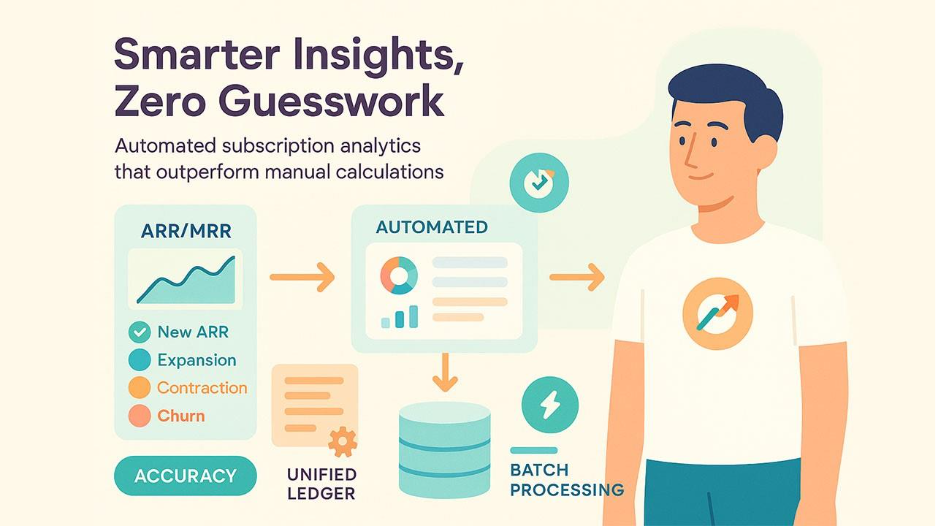
A more effective strategy is to employ a subscription analytics tool that captures start and end ARRs/MRRs, compares values, classifies each type of change, performs batch calculations across thousands (or more) subscriptions, and aggregates totals. These tools provide independent calculations for new ARR, expansion ARR, contraction ARR, churn ARR, and net new ARR. Investing in subscription tools is advisable because manual calculations are error-prone and can be challenging to implement in real-world datasets. Subscription analytics platforms provide automated event-level classification, a unified transaction ledger, historical backfills, and accurate retroactive calculations, clear dashboards, and reduced dependency on fragile SQL models.
Interpreting Analytics
The results you obtain from your calculations or tools can provide strategic insights that inform your strategy. Strong new business indicates that your company has effective marketing, a strong pipeline, and brand growth. Strong expansion results, meanwhile, indicate customer loyalty, strong product experience, and healthy account management. AI SaaS Tools can help automate these analyses and provide deeper insights into SaaS-style metrics such as NRR to help you understand customer value. When gathering and interpreting data, it is vital to avoid common pitfalls such as treating cross-sells as new revenue, miscounting reactivated customers, and ignoring churn.
Separating revenue motions gives leaders clearer insight and cleaner forecasting, which they need to make strategic decisions. Calculations can be made manually, but SaaS analytics offer the most advanced frameworks. Growth quality matters as much as growth quantity, which is why giving due importance to both new and expansion revenue is key for companies wishing to stand the test of time.
%201.png)

%201.png)

%201.png)