




FinTech applications impose stringent requirements on both businesses and developers. The security of their funds is a top priority for consumers when choosing a financial services provider. Financial companies that are compromised by a customer data leak immediately lose their reputation in the market. Equally important is the application interface, which must be intuitive and easy to use for any user.
Therefore, choosing an application development framework is a critical responsibility for both the IT company and the business launching the product. In this article, we will examine the advantages of using Next.js in developing web applications for the FinTech industry. We will detail why choosing a Next.js development company to work on your fintech product is the best decision for businesses of any scale.
The role of frameworks in FinTech products development
Financial industry digital products are fundamentally different from other apps or platforms that do not require a special license from a government regulator. To qualify for such licensing, products must ensure complete technical and information security. Furthermore, they must be developed in compliance with strict AML/KYC requirements.
When creating fintech apps, it's important to choose frameworks that will support the smooth operation of complex financial transactions. They should have built-in protection mechanisms against common vulnerabilities, the potential for scalability in the event of significant user base growth, and other critical features.
If the framework is chosen incorrectly, the app may crash, reach growth limits, or fail licensing altogether. So, avoid frameworks that:
- Provide poor performance under increased load;
- Lack built-in protection mechanisms against common web vulnerabilities, such as XSS, CSRF, and SQL injection;
- Use outdated web technologies or languages;
- Have a weak ecosystem, making integration with payment gateways and banking APIs difficult.
Conversely, by choosing a reliable framework with a broad ecosystem, you reduce the costs of both app development and its subsequent operation. Furthermore, it helps meet technical requirements set by the regulator. This means the time and resources spent on its development will yield a high return.
Why Next.js is ideal for FinTech
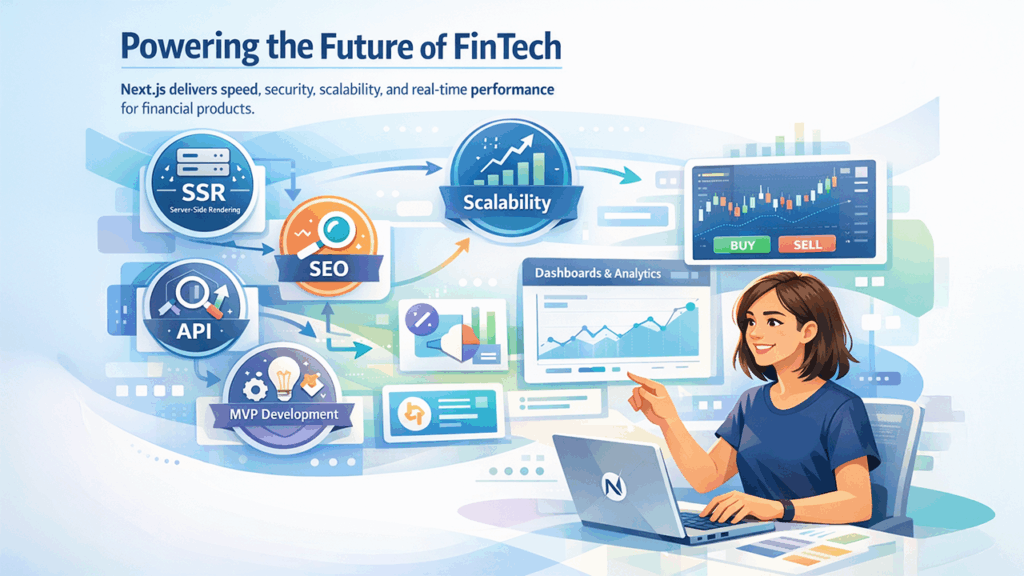
Next.js is a universal framework for the fintech industry, as it enables the creation of a wide range of digital products:
- Fintech websites. Websites built on Next.js rank significantly better in search engines thanks to server-side rendering (SSR) and static generation (SSG). This makes it easier to attract organic traffic, saving on advertising costs.
- User dashboards. Next.js ensures high performance regardless of user volume, which is critical for financial giants.
- Financial marketplaces. Next.js combines high performance, security, scalability, and excellent SEO optimization. This makes it ideal for financial marketplaces that require payment system integration, transaction management, and more.
- SaaS products. Next.js is well-suited for creating services for accounting, invoicing, analytics, and more. This framework provides easy scalability for enterprise systems and convenient integration with various APIs.
- Trading web applications. Trading requires the display of large amounts of real-time information, such as quotes, charts, and other market data. Next.js is well suited for building UIs that display real-time data, thus attracting users to trading applications.
- MVP (Minimum Viable Product). If you're looking to release a basic version of your financial service, Next.js will enable rapid development. This allows you to quickly test your hypothesis and begin developing a fully functional app.
How Next.js ensures security and compliance for FinTech digital products
Using Next.js for fintech app development provides access to a variety of security mechanisms. With professional and competent development, they help software engineers to comply with security standards such as PCI DSS and data protection requirements for such digital products. Critical mechanisms include the following:
- Although SSR (Server-Side Rendering) is not a direct mechanism of protection against XSS, it reduces the exposure of client side to the XSS attacks.
- Secure API routes help prevent the disclosure of confidential information.
- Native Content Security Policy (CSP) support contributes to preventing malicious code execution.
- Middleware can be used for server-level authentication and authorization.
Next.js facilitates KYC/AML integrations for fintech applications using the following mechanisms:
- Server-side rendering (SSR) protects against unauthorized access. User authentication precedes the generation of pages with protected content.
- Simple SDK integration accelerates the implementation of KYC/AML standards.
- Protected API routes ensure secure processing of sensitive fintech client data on the server.
Advantages of Next.js's front-end architecture for FinTech applications
The front-end architecture of fintech applications is no less important than a robust backend. It ensures interface stability during real-time data flow. Furthermore, it defines the overall Fintech User Experiences, offering fast navigation and instant interface responsiveness.
Next.js's front-end architecture offers numerous advantages for developing fintech digital products:
- Faster initial page loads
- Built-in security mechanisms
- Mitigation of common client-side vulnerabilities
- Easy scaling thanks to simplified overall architecture management
- Better organic visibility thanks to SEO-friendly architecture
- Smooth user experience (UX)
- Easy app maintenance
- Quick addition of new features
- Faster time to market
Choosing a company for FinTech digital product development
If you want to build a reliable digital product for the fintech industry, choose a company with extensive experience working with Next.js. This will accelerate development and prevent the common bugs that often plague newcomers to the framework. You will also be assured that your application will meet all security and compliance requirements.
Stubbs is an expert in creating products for the fintech industry. The company produces applications for trading, risk scoring, banking, insurance, and more. Next.js allows its developers to build secure and scalable fintech platforms for both startups and enterprise-level clients. The team's extensive experience and innovative tools will give your application a significant competitive advantage in the financial services market.
Conclusions
High security and compliance requirements for fintech products narrow the choice of frameworks for their development. Next.js is one of the top contenders based on a variety of criteria, including performance, security, development costs, and time to market. Its advanced front-end architecture ensures both security and interface resilience to complex financial transactions. By choosing Next.js for your app, you get guarantees in terms of both product reliability and user experience.
%201.png)

%201.png)

%201.png)