


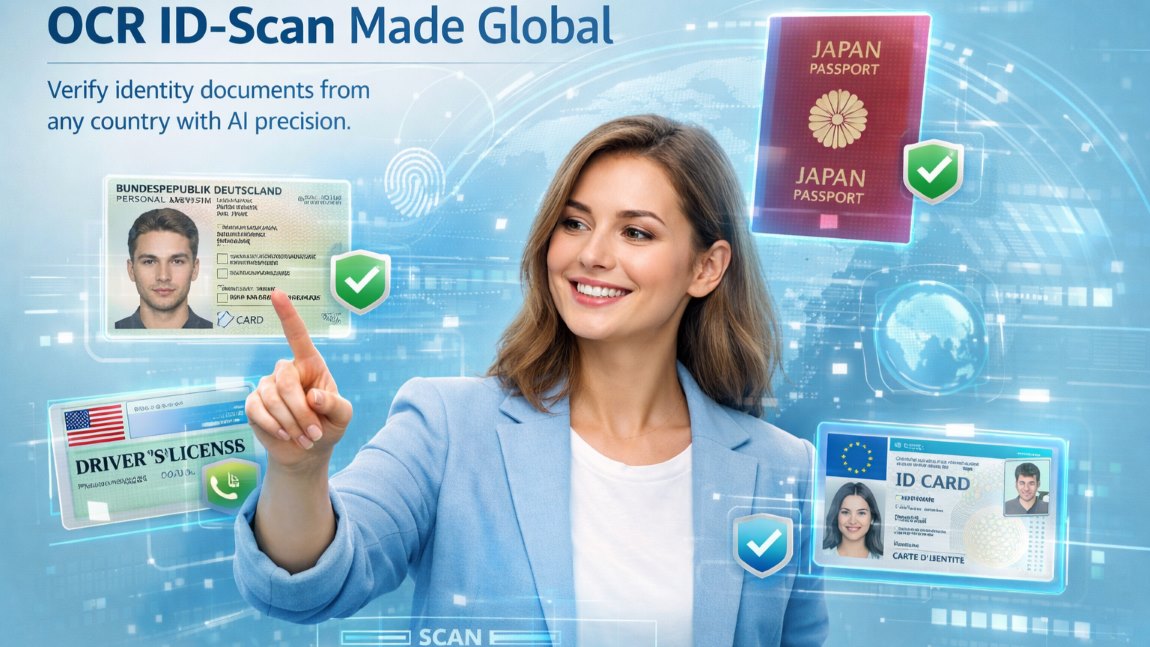

Businesses operating internationally face a complex challenge when verifying customer identities. Each country issues identity documents with different formats, languages, security features, and data layouts. A German driver's license looks nothing like a Japanese residence card, and a Brazilian passport follows entirely different design principles than one from Sweden.
Manual verification of international documents requires staff who can recognize legitimate IDs from hundreds of jurisdictions and understand multiple languages. This expertise is expensive to develop and difficult to maintain as countries update their document designs. Optical character recognition technology offers a solution by automating the extraction and validation of information from identity documents worldwide.
OCR Studio (ocrstudio.ai) has built databases containing templates for thousands of document types, enabling businesses to process identities from virtually any country without requiring specialized human expertise for each jurisdiction. This capability has become essential for companies serving global customer bases.
Document Format Variations Across Different Regions
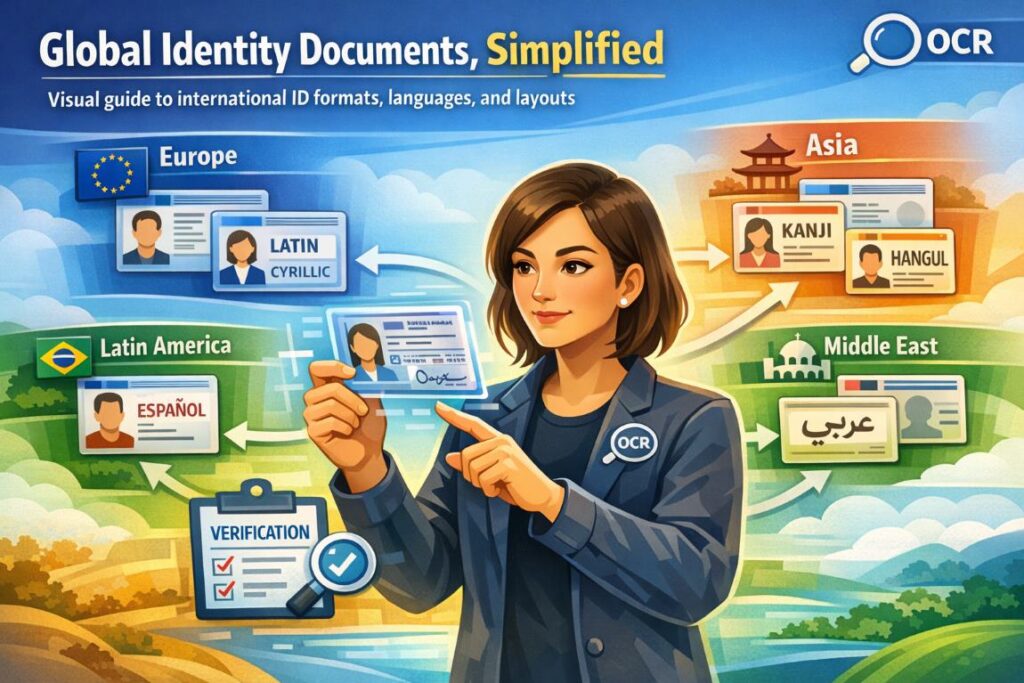
Identity documents vary dramatically in their physical characteristics and information layout. European Union member states follow similar passport standards due to regional agreements, but their national ID cards differ significantly. Some countries use booklet-style IDs while others issue single cards.
Latin American countries often include more detailed information on identity documents than North American ones. A Colombian cédula de ciudadanía contains the holder's blood type and a unique identification number used throughout their life. Mexican voter IDs include OCR-readable zones on the back with encoded information. These regional differences require verification systems to understand what data to expect from each document type.
Asian identity documents present unique challenges. Chinese resident identity cards display information in simplified Chinese characters alongside romanized text. Japanese My Number cards contain kanji, hiragana, and katakana scripts. South Korean registration cards follow yet another format. Systems must handle these various character sets while maintaining accuracy.
Middle Eastern documents add another layer of complexity. Many include Arabic script that reads right to left, and some countries issue bilingual documents with both Arabic and English text. The information layout on these documents doesn't follow Western conventions, requiring specialized template recognition.
Character Recognition Challenges with Multiple Languages
OCR systems designed for a single language or script struggle when confronted with international documents. Each writing system has unique characteristics that affect recognition accuracy.
Latin-based alphabets seem straightforward but contain numerous variations. Polish uses diacritical marks like ł and ą. Vietnamese employs tone marks that change letter meanings. French, Spanish, and Portuguese share many characters but use accents differently. An OCR system must recognize these subtle differences to extract names and addresses correctly.
Cyrillic script appears on documents from Russia, Ukraine, Belarus, and several other countries. The characters look similar to Latin letters but have different meanings. The Cyrillic "В" is actually a "V" sound, while "Р" represents an "R" sound. Confusing these characters creates errors in extracted data.
Non-Latin scripts require entirely different recognition approaches. Arabic's connected letterforms change shape depending on position within a word. Chinese and Japanese use thousands of unique characters. Thai script lacks spaces between words, requiring the system to understand word boundaries through context.
Here's how advanced OCR systems handle multilingual recognition:
- Script detection algorithms. The system first identifies which writing system appears on the document before applying the appropriate character recognition model. This prevents confusion between similar-looking characters from different scripts.
- Language-specific training data. Recognition models trained on millions of examples from each language achieve much higher accuracy than general-purpose models. The system learns common name patterns and address formats for each country.
- Context-aware validation. When extracting dates or document numbers, the system checks that extracted values follow the expected format for that country. This catches recognition errors before data enters business systems.
- Transliteration capabilities. For documents with non-Latin scripts, the system can provide romanized versions of names following international standards like ICAO specifications for machine-readable travel documents.
Date format variations create unexpected complications. Americans write dates as MM/DD/YYYY while most of the world uses DD/MM/YYYY. Some Asian countries use year-month-day ordering. Japanese documents might include years in the imperial calendar system alongside Western dates. The OCR system must interpret these formats correctly to extract accurate expiration dates and birth dates.
Security Feature Recognition Across International Documents
Each country incorporates specific security features into identity documents to prevent counterfeiting. These features vary widely based on the document's age, the issuing country's technology level, and its security priorities.

European passports issued after 2010 contain biometric chips with encrypted data. The OCR system can trigger NFC reading to extract chip data and compare it against the visual information on the passport page. This dual verification significantly increases confidence in document authenticity.
Many countries use UV-reactive inks that display hidden patterns under ultraviolet light. The specific patterns differ by country and document type. A verification system must know which UV features to expect on a Polish driver's license versus a Thai national ID card.
Holographic overlays represent another common security feature. These create rainbow-like effects that change based on viewing angle. Advanced verification systems analyze how light reflects from these holograms to confirm they're genuine rather than printed replicas.
Some countries have adopted more sophisticated features:
- Color-shifting inks. These special inks change color when tilted, and each country uses specific color combinations. The system captures images from multiple angles to verify the color shift matches expectations.
- Microprinting. Tiny text visible only under magnification appears throughout many documents. OCR systems with high-resolution imaging can verify this microtext is sharp and legible rather than blurred like a photocopy would be.
- Laser engraving. Newer ID cards use laser technology to create tactile engravings that can be felt by touch. The verification system looks for the specific texture patterns these engravings create.
- Optically variable devices. These complex features display different images or patterns depending on viewing angle and lighting conditions. The system must capture multiple images to verify the expected pattern changes occur.
Document age affects which security features are present. A passport issued in 2005 won't have the same protections as one issued in 2024. Verification systems maintain historical records of document versions to check for era-appropriate security features.
Template Libraries and Machine Learning Adaptation
Building a comprehensive template library requires collecting specifications for thousands of document types. Each country might issue multiple ID variants like passports, national IDs, driver's licenses, and residence permits. The templates define where specific data fields appear on each document type.
Machine learning has enhanced template matching capabilities. Instead of requiring perfect positioning, modern systems use neural networks to identify document types even when photos are skewed or partially obscured. The network learns to recognize distinctive patterns that characterize each document class.
Template maintenance poses an ongoing challenge. Countries periodically update their identity documents with new designs and security features. Germany introduced a new national ID card format in 2021. The United Kingdom redesigned its driver's license multiple times over the past decade. Verification providers must update their template libraries to handle these changes.
Crowdsourced learning helps systems improve. When the OCR engine encounters an unfamiliar document, it can flag it for human review. After verification, that document becomes part of the training set for future recognition. This continuous learning process ensures the system stays current with global document variations.
API Integration for Cross-Border Business Applications
OCR systems help businesses automatically verify identity documents from different countries. Integrated via APIs, they streamline workflows, reduce manual effort, and ensure accurate, compliant verification across languages and formats.
Companies need seamless ways to incorporate international document verification into their existing workflows. Application programming interfaces provide this integration layer.
A typical verification API accepts an image of an identity document and returns structured data containing the extracted information. The response includes fields like name, date of birth, document number, issue date, and expiration date. It also provides a confidence score indicating how certain the system is about the extraction accuracy.
Error handling becomes critical when processing international documents. The API should clearly communicate when it encounters an unsupported document type rather than attempting to extract data and returning incorrect information. This transparency allows businesses to route unusual cases to manual review.
Response times matter for user experience. Cloud-based OCR services typically process documents in 2 to 5 seconds, which is fast enough for real-time verification during customer onboarding. Batch processing for large volumes might take longer but handles thousands of documents without human intervention.
Compliance Requirements for International Identity Verification
Different jurisdictions impose varying requirements on how businesses must verify identities and store document images. European GDPR regulations specify strict rules about collecting and retaining personal data. Some countries prohibit storing biometric information derived from ID photos.
Financial institutions face Know Your Customer regulations that differ by country. Some jurisdictions require verification against government databases while others accept document verification alone. The OCR system should provide audit trails showing when verification occurred and what checks were performed.
Data localization laws in countries like Russia and China require that citizen data be processed and stored within national borders. Businesses operating in these markets need OCR solutions that can run on local infrastructure rather than relying solely on international cloud services.
Age verification regulations add another compliance layer. Many countries restrict alcohol sales, gambling, and age-restricted content. OCR systems can extract birth dates and calculate age automatically, but the business must understand local age restrictions that vary by jurisdiction and product type.
The ability to verify international identity documents opens global markets to businesses that previously couldn't handle the complexity of foreign IDs. Companies can serve customers regardless of their nationality while maintaining security and compliance. As more business moves online and borders matter less for digital services, international document verification will continue growing in importance. Organizations that invest in robust OCR solutions with comprehensive country coverage position themselves to compete effectively in the global marketplace.
%201.png)

%201.png)

%201.png)