



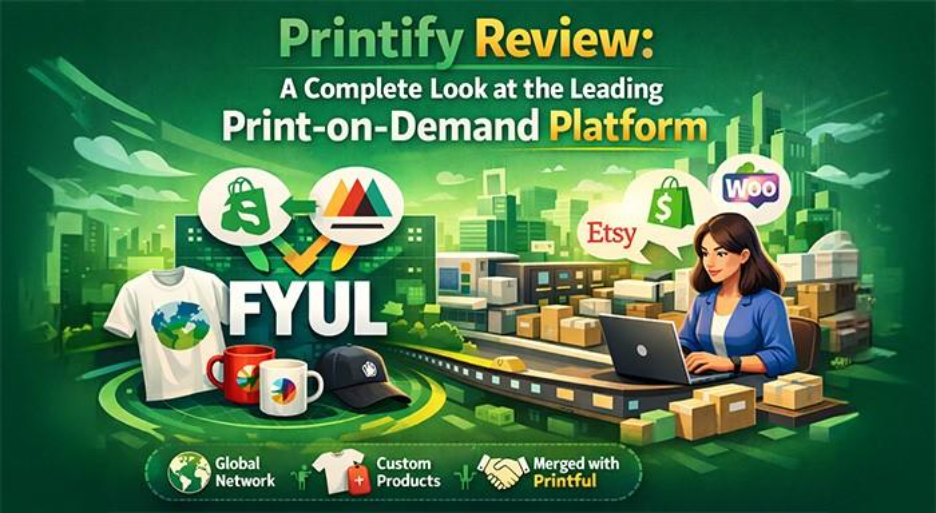

In November 2024, Printify announced a strategic merger with Printful, which is another major POD provider. With this merger, these two independent competitors in the print-on-demand world became a combined powerhouse. Together they are serving a broader, global customer base while unlocking synergies between their respective strengths.
This merger brings together:
- Printful’s in-house production and fulfillment facilities which is trusted for its quality and consistency.
- Printify’s expansive network of third-party print partners is valued for flexibility and product range.
While both brands continue to operate independently, existing sellers won’t notice immediate changes in day-to-day usage; the combined company now operates under the name FYUL. This unified identity reflects an effective, long-term strategy which aims to build a more powerful and innovative-driven player in the global POD industry. It offers a variety of products, enhanced fulfillment capabilities, and a wide geographic reach for ecommerce sellers all across the globe.
This merger is done with the purpose of strengthening the company’s position in the market against competitors, supporting accelerated growth and empowering sellers with enhanced tools and improved services. It offers quality, scalability, and flexibility under one umbrella.
How Printify Works
- Create an Account and Connect Your Store
Users can sign up for free and connect Printify with e-commerce platformspi such as Shopify, Etsy, WooCommerce, Squarespace, and others.
- Choose and Customize Products
Printify offers a wide product catalog that includes custom clothing, apparel, accessories, home décor, drinkware, and more. Sellers upload designs and adjust placement, colors, and sizes using built-in tools.
- Select a Print Provider
Each product can be fulfilled by multiple print providers. This enables sellers to choose providers based on location, pricing, production speed, and ratings.
- Sell and Fulfill Automatically
Printify automatically routes products for production and shipping after they are published, and orders are placed by customers. It performs all actions without any manual intervention.
Key Features of Printify
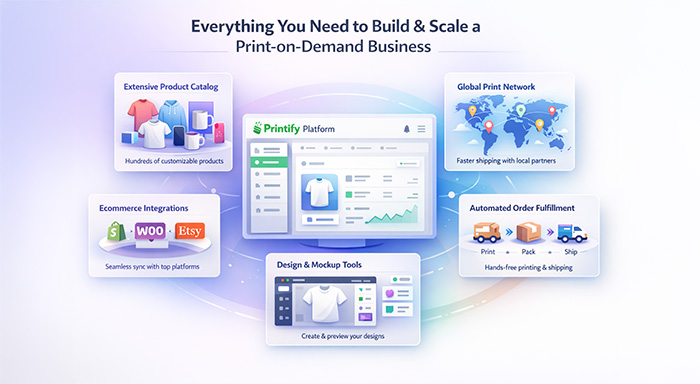
Extensive Product Catalog
Printify offers hundreds of customizable products across multiple categories, making it easy to test niches or expand a product line without switching platforms.
Global Print Network
The platform works with print providers across many regions. It allows sellers to lower shipping times and charges by selecting partners who are geographically closer.
Ecommerce Integrations
Printify integrates with major ecommerce platforms, enabling automated product sync, order routing, and fulfillment.
Design and Mockup Tools
Built-in design tools and product mockups help sellers visualize products before publishing them, reducing reliance on third-party software.
Automated Order Fulfillment
Once an order is placed, Printify manages printing, packaging, and shipping, and streamlining operations for online sellers.
Pros of Using Printify
- Beginner-Friendly Interface
The platform has an intuitive interface which is easy to navigate and suitable for users with little or no ecommerce experience.
- Free Plan Available
it offers free plan to sellers so that they can start without upfront costs and test product ideas before committing to a paid plan.
- Highly Scalable
Printify supports businesses of all kinds, such as from small creators to high-volume sellers.
- Wide Product Selection
A large catalog enables experimentation across different niches and product types.
- Benefit From the Merger
The Printful-Printify merger opens doors for broader product offerings and improved fulfillment options over time.
Cons and Limitations
- Inconsistent Product Quality
Because products are fulfilled by different providers, quality can vary. Ordering samples is strongly recommended.
- Limited Branding Options
Custom packaging and branded inserts depend on print provider capabilities and may be restricted.
- Shipping Time Variability
Production and delivery times can differ based on provider location and order volume.
- Customer Support Delays
During peak periods, response times may be slower.
Printify Pricing
Printify offers multiple pricing tiers:
- Free Plan
It allows you to access the platform with unlimited designs and standard product pricing.
- Premium Plan
It is a monthly subscription plan that offers discounted prices on products and supports multiple stores.
- Enterprise Plan
It includes custom pricing for large businesses with high order volumes, offering dedicated support and advanced features.
This flexible pricing structure allows sellers to scale as their business grows.
Final Verdict: Is Printify Worth It?
For anyone who is looking to start or grow a print-on-demand (POD) business, Printify remains a compelling choice, especially now as part of the broader Fyul ecosystem created through the merger with Printful.
The combined extensive provider network of Printify and production capabilities of printful opens the door for more comprehensive and enhanced fulfillment solutions, expanded product catalogs and future innovations. While there are still trade-offs like variance in potential quality and limitations in branding, the platform’s strengths lie in accessibility, scalability, and product flexibility which makes it a strong contender in the POD space in 2026 and beyond.
Printify (as part of Fyul) offers a versatile, user-friendly platform for creators who focus more on design and sales instead of logistics. There is also an added power of a merged industry leader behind it which makes it reliable.
%201.png)

%201.png)

%201.png)