




Healthcare margins have become narrower. Reimbursement models keep evolving, payer rules also evolve without warning, and administrative overhead compounds more quickly than collections. Numerous providers assume profitability problems are centered in reimbursement rates alone. In reality, a large share of lost revenue happens internally — inside billing workflows, coding accuracy, denial management, and follow-up.
This is where RCM services for healthcare have become strategic level instead of being a back-office utility. When you optimize revenue cycle is optimized from a simple patient registration through final payment posting, businesses do not just collect more, they minimize write-offs, stabilize cash flow, and free clinical teams from administrative chaos.
For providers assessing external support, specialized RCM services for healthcare can impact AR days directly, denial rates, and overall efficiency in operations.
Why Healthcare Organizations Struggle with Revenue Leakage
Revenue leakage rarely stems from a single catastrophic failure. It’s usually death by a thousand micro-inefficiencies. A missed modifier here. An eligibility verification gap there. A denied claim that never gets reworked. Over time, they combine and lead to substantial financial erosion.
The most prevalent breakdowns happen across numerous anticipated pressure points:
- Incomplete front-end verification causing rejected claims
- Inaccuracies in coding that causes downcoding or denials.
- Providers documenting the charges late
- Weak workflows in denial management with no tracking of root causes
- Aging accounts receiving beyond the 60-90 days.
- Understaffed billing teams who are unable to keep up with the changes in payer rule.
Every issue may seem small in isolation. Together, they extend AR days, minimize net collection rates, and improve administrative cost per claim. Numerous internal teams work reactively, resolving problems once payment delays happen instead of designing platforms that avoid denials at the source.
Another key contributor is structured data visibility. When coding, financial reporting, and billing platforms do not effectively communicate, leadership often lacks a complete picture of cash flow performance. Without having clean metrics, prediction seems like guesswork.
What RCM Services Can Solve
Professional revenue cycle management changes the focus from transactional billing to systemic optimization. Instead of submitting claims simply, specialized teams create workflows specialized to enhance clean claim rates and expedite reimbursement.
A complete RCM model generally focuses on:
- Complete verification of patient eligibility
- Accurate medical coding that meets with payer guidelines
- Validation of charge entries and compliance checks
- Proactive strategies that prevent denials
- Structured protocols for AR follow-up
In-depth financial analytics with Key Performance Indicators dashboards.
The difference is in specialization and discipline. Dedicated RCM teams work with denial trend analysis, payer-specific rule monitoring, and measurable performance benchmarks. They do not just rework denials; they recognize systemic weaknesses that cause them.
For growing practices and multi-specialty groups, RCM services for healthcare also reduce dependency on in-house staffing volatility. Billing departments' turnover can impact collections. Outsourced RCM ensures scalability, continuity, and predictable metrics in performance.
Another advantage that is mostly overlooked is strategic insight. Experienced RCM partners assess patterns of reimbursements, contract performance, and payer mix trends. This data boosts service-line optimization and negotiation strategy, converting revenue cycle data into executive-based intelligence.
Businesses can also adopt CRM for healthcare to improve workflows and streamline patient records. Apart from professional RCM support, an AI-powered CRM can do wonders for healthcare providers.
What Are the Signs You Require Professional RCM Support?
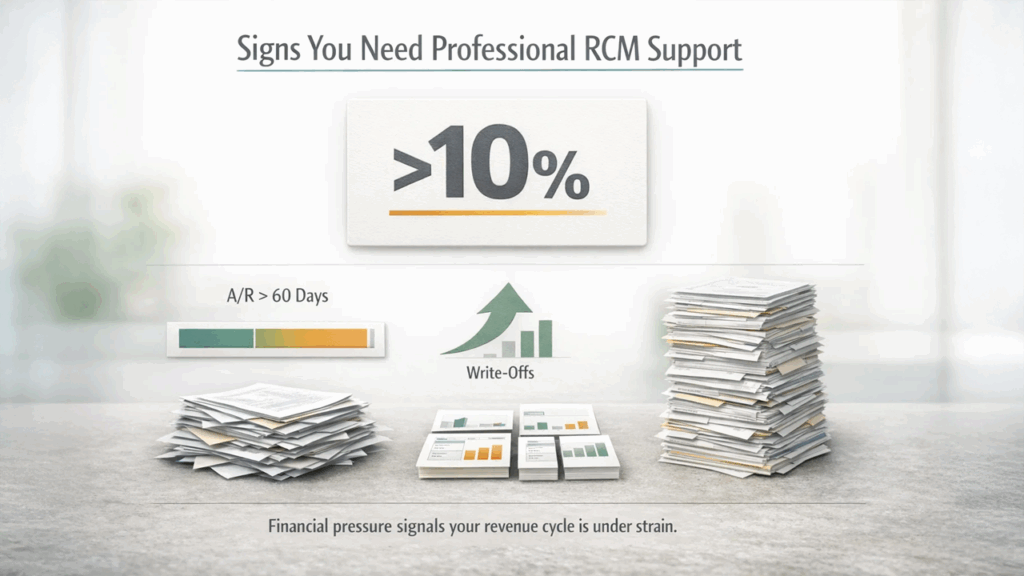
Not every business instantly needs external RCM. However, specific financial signals recommend internal systems that are under stress.
Look out for specific red flags:
- Denial rates go above 8-10% consistently.
- AR days go beyond 50-60 days.
- Missed charges or frequent underbilling.
- An increasing write-off quarter by quarter.
- Billing staff being overwhelmed by high volume of manual rework.
- Limited visibility into metrics of payer performance.
If denial management is reactive mostly and you are losing money. If AR aging reports seem like static documents instead of action dashboards, cash flow becomes a risk.
Another key indicator is dissatisfaction among physicians. When providers are consistently pulled into coding clarifications or documentation corrections, productivity plummets. Efficient cycles of revenue secure clinical focus.
Organizations attaining new practices or expanding service lines now face specific risks of integration. Without standardized workflows of billing, revenue inconsistencies are multiplied. Professional RCM infrastructure ascertains scalability without financial leakage.
Selecting a Reliable Healthcare BPO Partner
Outsourcing works only if the partner exists as an extension of your financial strategies, not just as a vendor submitting claims. The evaluation criteria must go beyond the pricing:
The main selection factors involve the following:
- Transparent Key Performance Indicators (KPI) reporting with real-time dashboards.
- Coding expertise specific to specialties.
- Documented methodologies of denial reduction.
- HIPAA-compliant infrastructure
- Scalable models of staffing
- Effective experience with multi-payer ecosystems.
Pharmbills has positioned itself as a reliable BPO partner by integrating operational discipline with domain expertise specific to healthcare. Their approach focuses on measurable financial impact instead of generic outsourcing.
What makes experienced BPO providers stand apart is process engineering. They create end-to-end revenue workflows, recognize bottlenecks, and execute corrective controls. The objective is not just about billing, it is about optimization of revenue.
Another strategic benefit is the predictability of cost. Internal billing departments carry fixed overhead in salary irrespective of claim volume. Outsourced RCM makes operational expenses aligned with performance metrics, creating much better financial elasticity.
When assessing a partner, request sample Key Performance Indicator reports. Notice transparency in clean claim rate tracking, denial categorization, and AR segmentation. If the provider cannot quantify the impact, value becomes largely speculative.
Conclusion
Revenue cycle management is no longer just a clerical function — it has become an engine of profitability. In an environment such as reimbursement that is shaped by regulatory complexity and payer scrutiny, operational precision defined financial resilience.
Clearly-structured RCM frameworks minimize denial before they even happen, expedite reimbursements, and extract strategic insights from billing data. At the end, you get stronger cash flow, reduced administrative cost per claim, and less distractions for clinical teams.
By incorporating specialized healthcare RCM services, businesses do not just recover lost financials; they create scalable financial ecosystems that align with long-term growth. Optimized cycles of revenue reinforce quality care since stable finances enable providers to invest in staffing, technology, and patient experience without consistent financial pressure.
%201.png)

%201.png)

%201.png)