



In the past, scaling a retail brand meant opening more stores. Now, it involves managing inventory across channels, personalizing experiences for millions, and making quick, data-driven decisions. Brands that succeed do not just have funding. They have the right technology, often built and supported by a specialized retail software development team.
This article explains how these development companies help brands move faster, work more efficiently, and compete at a level that off-the-shelf tools cannot support.
The Role of Retail Software Development in Scaling
Generic software is made for the average user, so it often fails when your brand expands into new regions, product lines, or fulfillment methods. A dedicated retail software development team builds systems that grow with your business instead of holding it back.
Scalable infrastructure stands out because of careful design. A custom retail software development company creates modular systems that let you add new sales channels, markets, or business units without having to start over. This way, your technology handles complexity instead of making it worse.
This is important as brands expand into regions with different tax systems, currencies, regulations, and customer needs. Scalable retail industry software manages these differences directly, so your team does not have to find workarounds.
Key Software Solutions Helping Retailers Scale
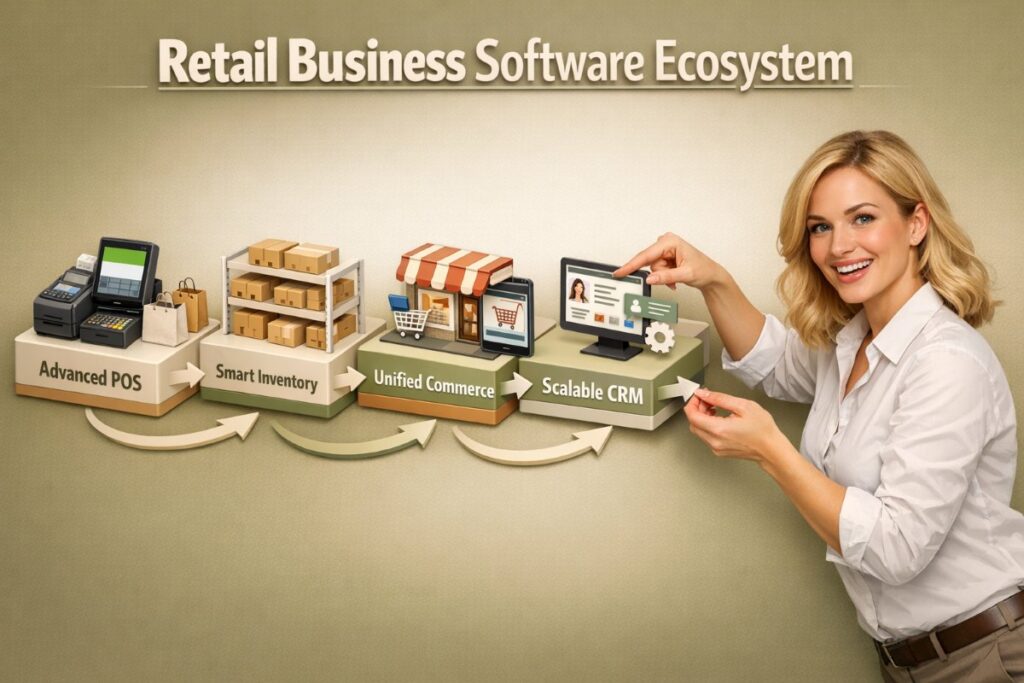
The most effective retail software development services deliver an interconnected ecosystem instead of just one solution. This is where the highest leverage typically lies.
| Solution | High-Level Value | Key Integration |
| Advanced POS | High-volume reliability | Finance & CRM Sync |
| Smart Inventory | ML-driven forecasting | Global Warehouse Logic |
| Unified Commerce | Seamless Omni-channel | ERP & Fulfillment Sync |
| Scalable CRM | Automated segmentation | Behavioral Data Flow |
Point of Sale (POS) Systems
The real value emerges when POS data flows seamlessly into inventory, finance, and CRM systems. When a sale in London automatically updates warehouse allocations in Munich and triggers a replenishment order, that is architecture.
Inventory Management
Inventory management is often the first challenge for growing brands. Automated stock systems built on retail control solutions help avoid both overstocking, which uses up cash, and stockouts, which hurt customer trust. Today, machine learning can more accurately predict demand for each product and location than manual planning.
E-commerce Integration
E-commerce integration connects online and offline. Customers expect to buy online, return in-store, check inventory across locations, and receive consistent pricing everywhere. Achieving this requires deep integration, not just a plugin or middleware patch, but proper bidirectional data sync between your commerce platform, ERP, and fulfillment layer.
CRM Systems
Large-scale CRM systems do more than manage contacts. The best integrated solutions for retailers use customer data to create audience segments, run personalized campaigns, and automate customer journeys, all without extra manual work.
Enabling Omnichannel Experiences
Omnichannel is a common buzzword in retail, but it is often not delivered in practice. The real difference comes from retail technology solutions that bring together data and processes across all customer touchpoints: in-store, online, mobile, and more.
If a customer browses on their phone, adds items to their cart on a laptop, and finishes the purchase in-store, every step should feel connected.
To make this happen, you need:
- Shared customer profiles
- Unified product catalogs
- Synced pricing
- Real-time inventory across channels
Brands that invest in smart retail technology see real results:
- More customers complete purchases
- Average order sizes grow
- Customer loyalty improves thanks to consistent experiences
The data shows that omnichannel customers are more profitable than those who use only one channel. In fact, brands with strong omnichannel engagement keep 89% of their customers, compared to only 33% for those with separate systems.
The technical challenges are real, but they can be solved. The main point is to treat omnichannel as a core design principle, not just an add-on, and to build it into every technology decision from the beginning.
Leveraging Data for Growth
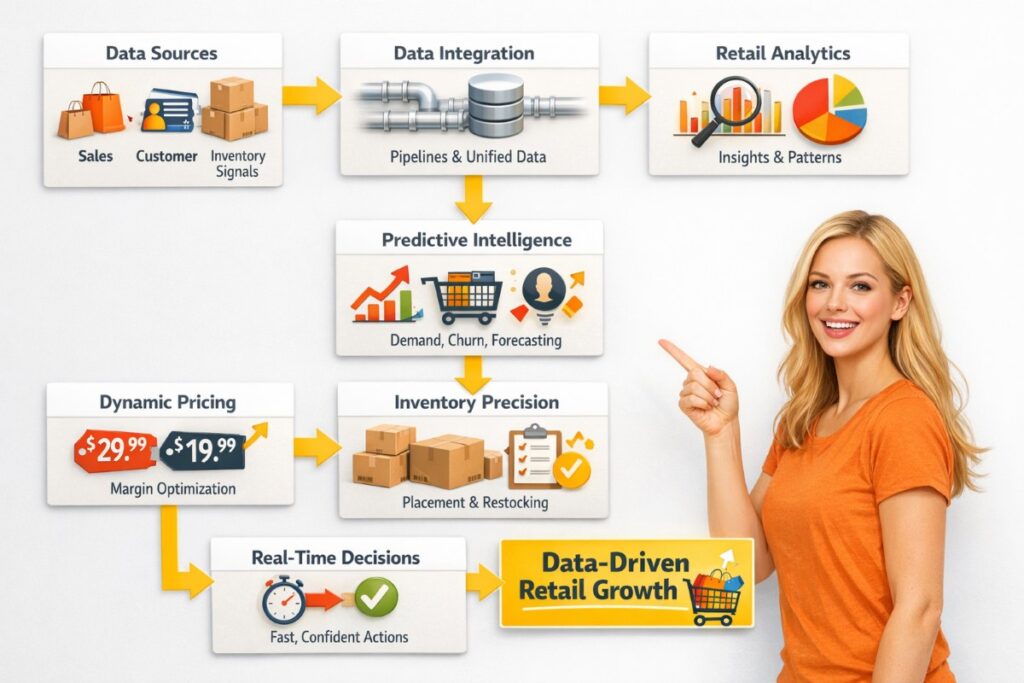
Most retail organizations do not use their data to its full potential. The fastest-growing brands know how to make the most of it. A skilled retail software development team creates data pipelines, analytics, and tools that turn raw data into useful insights. For example, structured data pipelines help retailers monitor pricing, inventory signals, and margin risks in real time, as explained in our guide on big data in retail.
Changing how your organization works is as important as the technology itself. To stay competitive in 2026, retailers are moving away from reactive habits and toward proactive, augmented decision-making.
| Reactive and Manual Approach | Proactive and Augmented Approach |
| Weekly Performance Reviews | Real-Time Data Dashboards |
| "Gut Feeling" Merchandising | Model-Based Recommendations |
| Manual Planning Adjustments | Human-in-the-Loop AI Overrides |
| Slow, Delayed Corrections | Faster, Higher-Confidence Decisions |
Dynamic Pricing and Margin Protection
Optimizing prices is one of the best ways to increase returns. Dynamic pricing models that use competitor data, demand, and inventory can improve margins without losing sales. These systems also support markdowns, track promotions, and forecast demand.
Operational Intelligence and Inventory Precision
Inventory decisions also have a big impact. Software for retail shops can track how long customers spend in certain areas, how product placement affects sales, and how quickly items sell. This information helps with buying, planning, and restocking.
Predictive Customer Analytics
Customer data might be the most valuable asset. If you know which groups bring the most value, which channels attract them, and which behaviors show they might leave, you can plan for growth instead of guessing. This takes strong data systems and good analysis tools.
Future-Proofing with Technology
Retail is always changing, so your technology should keep up. The best retail commerce solutions are built to grow, letting you add new features as they become important.
Here’s how the key technologies map to real business outcomes:
| Technology | Strategic Outcome |
| AI & Machine Learning | Real-time demand forecasting and dynamic pricing |
| Automation | Structural cost advantages across logistics and support |
| AR Shopping | Lower return rates via "try-before-you-buy" experiences |
| RFID & IoT | Item-level inventory accuracy and automated replenishment |
| Blockchain | Full supply chain transparency for regulatory/ESG compliance |
| Composable Commerce | API-first flexibility that outpaces single-vendor suites |
Scaling Intelligence with AI & Machine Learning
AI and machine learning are now part of everyday retail operations, not just test projects. Leading retailers already use them for demand forecasting, product recommendations, visual search, dynamic pricing, and fraud detection.
The real question is how to build AI systems that you can maintain and improve over time.
Securing Margins through Strategic Automation
Automation is cutting costs across retail. From automated warehouse tasks to AI-powered customer service that solves problems early, brands investing in automation now are gaining cost advantages that will be hard for others to match later.
Maintaining Agility with Emerging Tech
Looking ahead, technologies like augmented reality shopping, RFID inventory tracking, and blockchain supply chain transparency are becoming real advantages, not just trends. Brands with flexible retail technology solutions can add these features over time, while others may need to rebuild or replace their systems.
Avoiding Lock-in with Composable Commerce
Composable commerce is an important trend. Instead of using a single platform, smart retailers pick the best tools for checkout, search, content management, and order management, all connected via APIs. With help from an experienced retail software development team, this approach gives you greater flexibility and avoids being tied to a single vendor.
The Bottom Line
Retail brands grow by working smarter, not just harder. The right retail software company does more than write code. It builds the foundation for faster decisions, better customer experiences, leaner operations, and quick responses to market changes.
The most successful brands today have one thing in common: they see technology as a strategic investment, not just a cost. The custom retail software development companies they partner with can do more than maintain systems. They help the brand reach its goals faster.
If you are unsure whether your current retail technology solutions can support your next stage of growth, that is a sign to act. It is better to build scalable systems before you need them, not after problems appear.
%201.png)

%201.png)

%201.png)