




Most CRMs don’t fail because of bad software. They fail quietly, one meeting at a time. A sales call ends, notes are rushed or postponed, and what actually mattered in the conversation never fully makes it into the system. Context fades. Details blur. Follow-ups drift off course.
This gap between what was said and what gets recorded is where accuracy breaks down. And once the data is off, everything built on top of it suffers. Smart meeting records change that dynamic. They capture conversations while they’re still fresh and turn them into usable inputs that keep CRMs aligned with reality and follow-ups moving forward.
Why CRM Accuracy Breaks Down After Sales Meetings
Sales meetings are where the most important information is exchanged, yet they’re also where CRM accuracy starts to slip. The call ends, the rep jumps to the next task, and CRM updates get delayed. Memory fills in the gaps, and context fades faster than most teams realize.
Manual note-taking is a big part of the problem. Notes are rushed, incomplete, or spread across tools. Some details make it into the CRM. Others don’t. Subtle cues, whether it is pricing hesitation, internal approval requirements, or urgency signals, are frequently boiled down to generic summaries that convey little about what really occurred.
The inconsistency in practices from one repetition to another makes it bad. One repetition captures comprehensive reports. The second one allows updating on stage and close dates. The CRM system finally captures personal workflow rather than reality. This affects forecasting.
The largest gap of information occurs immediately following the meeting. Salespeople speak from memory or from sketchy information to back up their data entry at a later date, which can be days or even weeks after the discussion while it is still fresh in their minds. That’s why some teams use tools like an AI note taker to capture discussions more consistently and preserve context before it’s lost. Over time, those small gaps add up, and the CRM stops being a reliable source of truth.
What Makes a Meeting Record “Smart”
A meeting record becomes “smart” when it captures more than just a rough summary of what was discussed. Raw notes tend to list topics in order. Smart records focus on meaning. They surface what matters and make it easy to act on.
At a basic level, that means structure. Key discussion points are grouped logically instead of buried in paragraphs. Action items are clearly defined, with owners and timing spelled out. Buyer intent, objections, and constraints are captured as signals, not afterthoughts. The record answers simple questions quickly: What did the buyer care about? What’s blocking progress? What happens next?
Consistency is what turns this from a nice-to-have into something useful. When meeting records follow the same pattern every time, they become predictable and searchable. Reps know what to look for. Managers know where to find it. CRM fields can be populated without guesswork.
Volume isn’t the goal. A smart meeting record doesn’t try to transcribe everything that was said. It helps to filter the conversation in a way that makes the inputs useful for follow-ups and other activities like the progressing of deals and reporting. If properly implemented, it reduces the gap between the conversation and the next step.
How Smart Meeting Records Improve CRM Accuracy
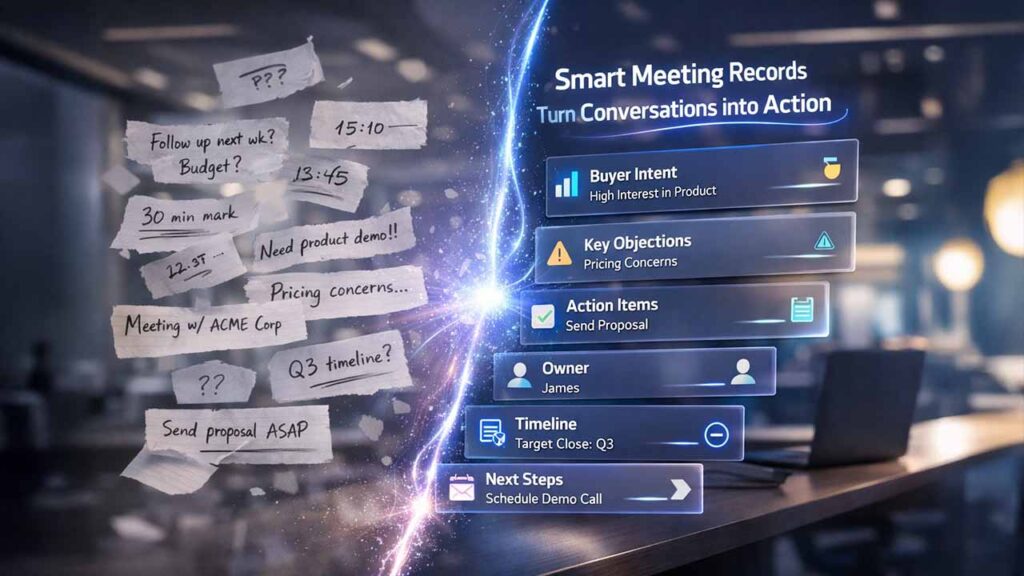
Smart meeting notes enhance the accuracy of the CRM system as the conversation and recording of the information are brought closer together. As a matter of fact, the major source of inaccuracies lies within the delay that occurs before the update is put into the CRM system.
Structure matters far more than most teams are used to. By recording the same things consistently in meetings – intent, obstacles, timelines, and next steps, for example – the CRM is populated in a thoughtful way, not just guessed at. Stages of deals advance based on what was actually communicated. Close dates are tied to real-world indicators, not hope. Notes cease to be catchall answers and become the reasoning behind why a deal is in a certain state.
Consistency across team members also helps improve overall accuracy. When everyone records meetings in roughly the same way, the CRM stops reflecting individual habits and instead starts to reflect shared reality. Reports become easier to trust because the underlying inputs follow the same logic. Forecasts feel less like educated guesses and more like grounded projections.
Another quiet benefit is freshness. Data entered immediately after a meeting is almost always more reliable than updates made days later. The CRM stays current, which makes it more useful day to day. When records reflect what actually happened in conversations, the CRM becomes a working system again, not a historical archive.
The Direct Impact on Sales Follow-Ups
Sales follow-ups tend to fail for simple reasons. The next step isn’t clear. The message misses what the buyer actually cared about. Or the timing is off. Smart meeting records address all three.
When next steps are captured explicitly, follow-ups stop being vague check-ins. Reps know exactly what to reference, what to send, and when to reach out. That clarity speeds up response time and reduces the lag that often causes deals to cool off after a good call.
Context also changes the quality of outreach. Instead of generic recap emails, follow-ups reflect the real conversation. Objections are addressed directly. Priorities are acknowledged. The buyer feels heard, not re-sold. Even small details — who else needs to be looped in, what internal deadline matters — make follow-ups more relevant and harder to ignore.
Consistency matters here too. In longer sales cycles, deals often span weeks or months. Smart records preserve continuity across touchpoints, even if the cadence slows or ownership shifts. The rep doesn’t have to reconstruct the story before every follow-up.
The result is momentum. Fewer missed handoffs. Fewer “just checking in” emails. And follow-ups that move deals forward instead of resetting the conversation each time.
Benefits Beyond the Sales Rep
The value of smart meeting records doesn’t stop with individual reps. Sales managers feel the impact almost immediately. Pipeline reviews become faster and more accurate because deal notes explain what’s actually happening, not just where a deal sits. Less time is spent chasing updates. More time is spent coaching on real situations.
RevOps teams benefit from cleaner inputs. When meeting data is structured and consistent, reports stop needing constant cleanup. Forecasts stabilize. Conversion rates make more sense. Process gaps are easier to spot because the underlying data reflects real conversations instead of uneven logging habits.
The ability to enhance business performance with CRM tools depends heavily on data quality. Smart meeting records provide that foundation, turning CRM systems from repositories of outdated information into real-time engines that drive revenue decisions and process improvements.
There’s also a downstream effect on handoffs. Customer success teams inherit clearer context when a deal closes. They know what was promised, what concerns were raised, and what outcomes matter most to the customer. That continuity reduces friction and shortens time to value.
Best Practices for Using Smart Meeting Records
Smart meeting records only work when teams are intentional about how they’re captured and used. Without clear standards, even good tools end up producing uneven, low-value notes.
- Define a minimum capture standard
Every meeting record should clearly document what matters to the buyer, what’s blocking progress, and what happens next. If those points aren’t obvious, the record won’t support accurate follow-ups.
- Standardize how records map into the CRM
Meeting insights should flow into consistent CRM fields rather than free-form notes. This keeps data usable for reporting, forecasting, and clean handoffs.
- Prioritize action over completeness
A strong meeting record doesn’t document everything that was said. It highlights the information that drives the next step and keeps deals moving.
- Review for patterns, not polish
Managers should scan records to identify recurring objections, delays, or confusion. These signals often surface in meeting data before they appear in reports.
Where Sales Conversations Become a System
Sales conversations are where deals are shaped, but they’re also where CRM data is most likely to drift away from reality. When meeting insights are captured late or inconsistently, follow-ups lose focus and momentum stalls.
Smart meeting records close that gap. They turn conversations into clear, structured inputs that keep CRMs accurate and next steps obvious. The result isn’t more data for the sake of it. It’s better continuity, stronger follow-ups, and systems that reflect what’s actually happening in the sales process.
When teams treat meeting records as part of how revenue moves forward, accuracy stops being a cleanup task and starts becoming a built-in advantage.
%201.png)

%201.png)

%201.png)