





The prices of tickets vary more quickly than most teams can keep up. One moment, the inventory appears to be abundant; the next, the prices skyrocket, and the demand is so high. When you use manual checks or random data sources, you are bound to make decisions using outdated information.
Such a delay can affect margins, slow strategy, and undermine your competitive position. In addition, incoherent data complicates the ability to compare marketplaces or respond with accuracy. You must be visible, fast, and organized in order to remain competitive. Live pricing information provides you with the insight you need to change fast and be strategic.
When applied in the right way, it can be a basis for smarter pricing, forecasting, and automation. In this article, you will learn how a ticket pricing API can help you work faster, make better decisions, and always stay ahead of the competition.
1. Real-Time Market Visibility
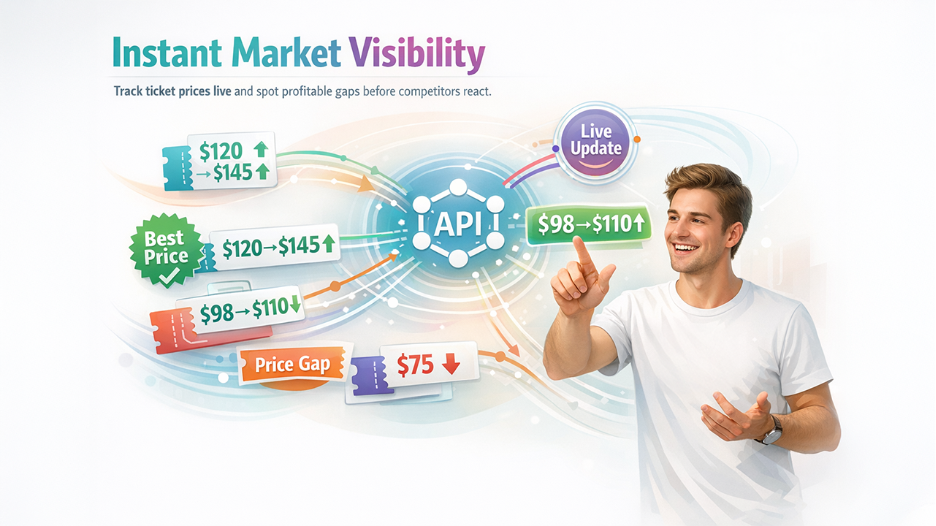
A ticket pricing API offers integrated access to real-time pricing and availability of leading ticket marketplaces. You do not need to change platforms and manually enter data because structured information comes straight into your system. Consequently, you get an overall picture of the market at any one point in time.
This visibility enables you to compare listings, analyze trends, and find pricing gaps in real time. When competitors change prices, you notice it instantly, not hours later.
You are therefore able to act before the opportunities run out. In high-paced markets, results are a matter of timing. As correct, real-time information flows continuously, you position yourself to see the changes rather than respond to them after they occur.
2. Smart Dynamic Pricing Plans
Pricing strategy is not fixed anymore. The demand varies depending on the popularity of the event, announcements of the performers, weather, and time. That is why dynamic pricing is a requirement in the process of staying relevant and profitable.
The real-time feeds allow you to automate pricing decisions based on the current market conditions, as opposed to assumptions. As an example, when prices decrease in a particular seating section in different marketplaces, your system will automatically update itself to be competitive.
On the other hand, in a situation where the demand is high and the inventory is constrained, prices can be raised in a tactical manner to safeguard margins. Over time, such small data-driven changes can multiply into quantifiable benefits. You do not have to work with periodic updates, but you work with real-time intelligence that drives all pricing decisions.
3. Greater Data Processing and Projections
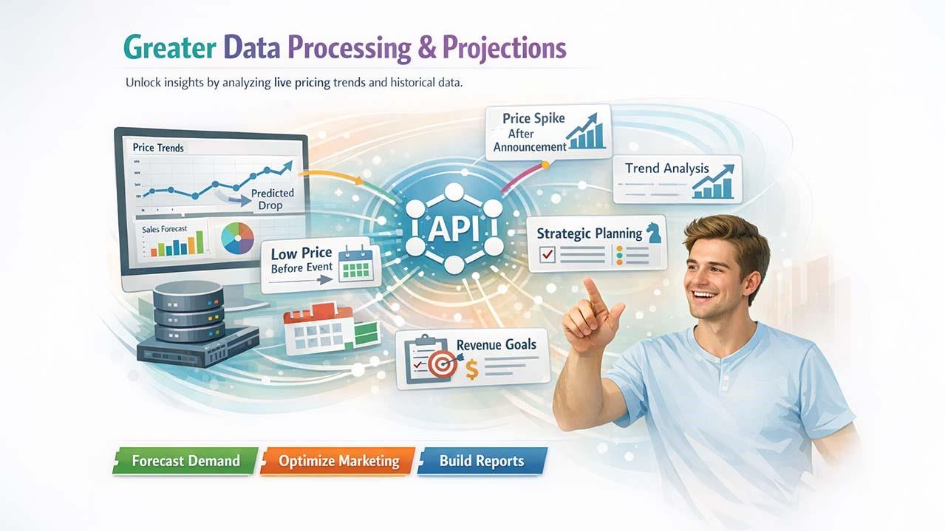
Analytics are even more effective when used with live pricing data. When you store and analyze past movements in prices, you start identifying trends in the buyer behavior. For example, you might find that there are certain events where you can predict a price low a few days before the event date, or that the premium sections always spike following a specific announcement.
These lessons aid in better prediction and planning. Marketing initiatives may be made to coincide with demand spikes, inventory discharges may be scheduled, and income goals can be established on facts, but not intuition.
Also, the structured API data makes it easier to build a dashboard and report. Your team is not cleaning inconsistent datasets, but interpreting trends and refining strategy.
4. Automated Monitoring and Alerts
It is inefficient to monitor dozens of events manually. Automation, however, alters that. Price drops, frequent inventory changes, or abnormal variations can be set up as alerts with built-in data feeds.
Consequently, your team gets notifications when it is necessary to take action. This initiative minimizes missed opportunities and delays in responding.
Moreover, automation liberates time to work on strategy rather than tedious monitoring efforts. Within the competitive environment, insight is as important as efficiency. Monitoring can be made an automated process, which makes it fast and accurate.
5. Seamless Integration into Your Workflow
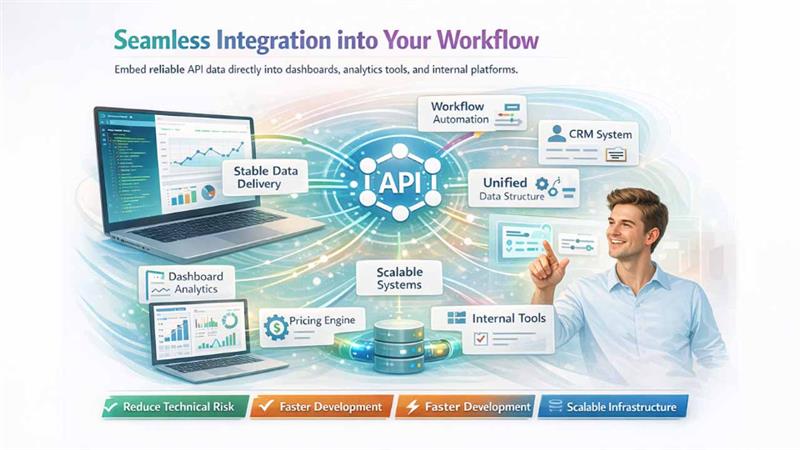
Technology delivers value only when it integrates smoothly with existing systems — much like how digital marketing services align strategy, traffic, and conversions into one coordinated operation. APIs are designed for structured, programmatic access, making them easier to embed into dashboards, pricing engines, analytics tools, and internal platforms.
Instead of building scraping systems that break when websites change, you rely on standardized data delivery. This stability reduces technical risk and maintenance demands.
Developers spend less time fixing pipelines and more time improving features. Moreover, a unified data structure simplifies scaling. As operations expand to cover more events or marketplaces, the same integration framework continues to support growth without major rework.
6. Reduced Risk and Greater Decision Confidence
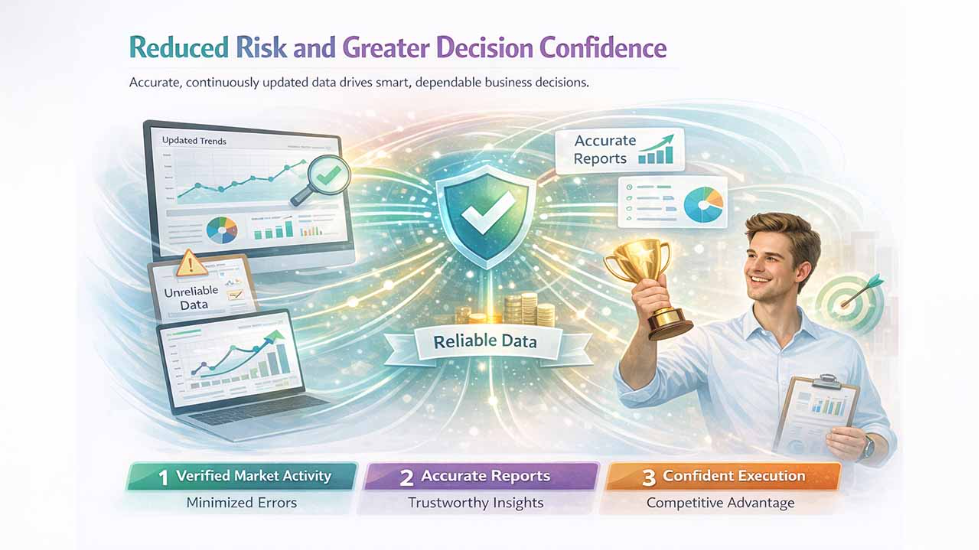
Unreliable data leads to unreliable decisions. When information is incomplete or delayed, pricing errors and missed opportunities increase. In contrast, structured and continuously updated data supports confident execution.
Every adjustment is grounded in verified market activity rather than fragmented observations. Reducing dependence on manual collection lowers operational risk.
Data pipelines become predictable, reporting becomes accurate, and planning becomes more reliable. Competitive advantage often comes down to execution quality. When decisions are backed by dependable intelligence, you operate with clarity instead of uncertainty.
Final Thoughts
Competition in the ticket marketplace is defined by speed, accuracy, and informed action. Without reliable real-time data, even experienced teams struggle to keep pace with rapid pricing shifts and demand changes.
A ticket pricing API provides the structured intelligence required to monitor markets, automate pricing strategies, and power advanced analytics. As a result, you reduce manual effort, minimize risk, and strengthen decision-making across your operations.
%201.png)

%201.png)

%201.png)