





IT issues rarely appear as isolated problems. They show up as downtime, slow systems, security gaps, or failed integrations, but the root cause is usually structural.
Most businesses run a mix of legacy systems, cloud tools, and third-party platforms. As complexity increases, so does the likelihood of failure. Research consistently shows the same pattern, downtime, cybersecurity threats, outdated infrastructure, and lack of long-term IT planning are among the most common challenges across organisations.
At that point, internal teams often become reactive. They fix issues as they appear, rather than preventing them.
This is where the need for it support provider becomes practical rather than optional. Not as an outsourced helpdesk, but as a layer that monitors systems, maintains infrastructure, and prevents failures before they impact operations. The difference is moving from reactive IT to controlled IT.
From there, the focus shifts to the actual problems.
System Downtime — The Most Expensive Operational Risk
Downtime is one of the most measurable IT problems.
Even if the outage is only for a short duration, it affects workflow, revenue, and customer experience. This cost can reach thousands per minute in enterprise environments depending on scale.
The reasons behind the downtime are usually predictable:
- Network failures
- Misconfigured systems
- Hardware issues
- Lack of continuous monitoring
Redundancy alone is not enough for a solution.
To lower downtime occurrence, businesses implement continuous monitoring and take proactive measures for maintenance. They track systems in real-time. This helps them address potential failures or errors before they get worse. This makes downtime a managed variable rather than an unexpected event.
Cybersecurity Threats — Constant and Increasing
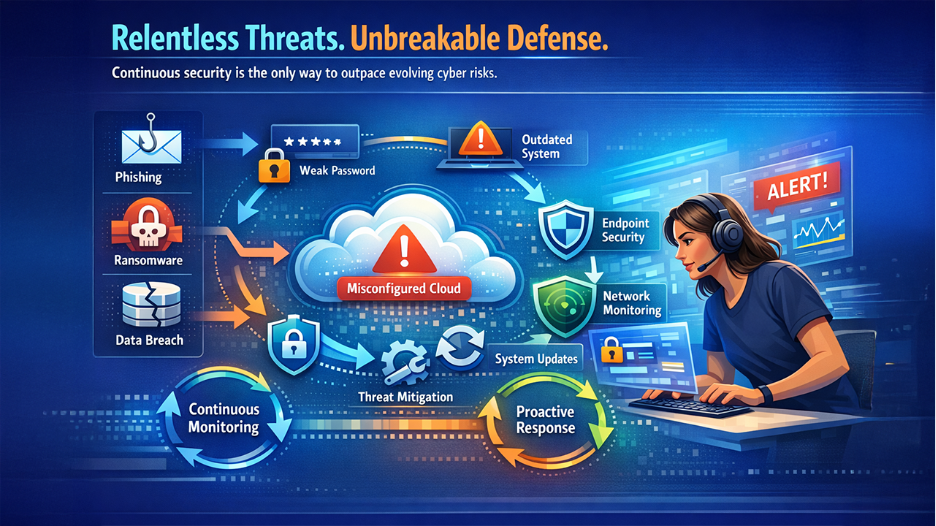
Cybersecurity is no longer a periodic concern. It is continuous.
Threats include phishing, ransomware, and data breaches, all of which are increasing in frequency and sophistication.
The challenge is not just external attacks.
Internal gaps, such as weak access controls, outdated software, and misconfigured systems, create vulnerabilities. Cloud environments in particular are exposed to misconfigurations, which are one of the most common causes of breaches.
To address this effectively, businesses are increasingly adopting Security Posture Management frameworks that provide continuous visibility, risk assessment, and proactive remediation across systems.
Effective security is layered.
It combines:
- Endpoint protection
- Network monitoring
- Access control policies
- Regular system updates
The key is consistency. Security failures often result from gaps, not from a lack of tools.
Legacy Systems — Slowing Down Operations
Many businesses still rely on legacy systems.
The traditional systems were built to meet demands of earlier operational models. That's why they are incompatible with modern tools. Over time, they create bottlenecks.
The below mentioned are some common issues:
- Slow performance
- Limited integration with newer platforms
- Increased maintenance requirements
Compared to modern tools, traditional infrastructure is also vulnerable to security risks due to lack of regular updates.
However, the solution is not always a full replacement.
There are several cases for which businesses adopt a phased approach:
- Identify critical systems that limit performance
- Integrate wherever possible
- Replace selectively based on operational impact
This modernizes infrastructure over time and minimizes disruption.
Cloud Complexity — Flexibility with Hidden Risk
Cloud adoption has increased significantly as businesses move the majority of applications into cloud environments.
However, this comes with new challenges.
Cloud systems are complex. The responsibility falls on both provider and user. Service agreements do not cover all types of outages, and businesses remain responsible for configuration and monitoring.
Misconfiguration is a major issue.
Incorrect access settings, unprotected storage, and weak permissions can expose systems to risk.
The solution is governance.
Businesses need clear policies for:
- Access control
- Data storage
- Monitoring and alerts
If cloud systems can be controlled, then they are scalable.
Data Loss and Recovery — Still a Major Risk
Despite advances in storage and cloud systems, data loss remains a common issue.
Causes include:
- Cyberattacks
- Hardware failure
- Human error
- Inadequate backup systems
If businesses don’t have a structured recovery plan, they can lose important data and experience extended downtime. The solution is not a backup, rather it is a recovery readiness.
Effective systems include:
- Automated backups
- Regular testing of recovery processes
- Defined recovery time objectives
Many organisations discover weaknesses only when recovery is required. Testing eliminates that risk.
Lack of IT Strategy — The Root Problem
Most IT issues are symptoms of a larger problem.
Lack of long-term planning.
Businesses are mostly focused on fulfilling immediate needs, resolving issues as they occur, adopting tools without integration, and delaying upgrades.
This creates:
- Fragmented systems
- Inefficient workflows
- Increased operational risk
Without a clear strategy, IT becomes reactive.
A structured IT approach includes:
- Alignment between technology and business goals
- Planned upgrades and infrastructure changes
- Defined security and compliance frameworks
This turns IT from a support function into an operational asset.
Conclusion
The most common IT challenges have existed for years such as risks of security, outdated systems, and data loss. What has changed is their impact. As businesses continue to rely on digital systems, these problems will keep affecting not just IT performance, but the entire operations.
Solving them requires more than tools. It requires structure, monitoring, and a shift from reactive fixes to proactive management.
That is what separates stable IT environments from ones that constantly operate under pressure.
%201.png)

%201.png)

%201.png)