




Artificial intelligence is not a futuristic concept anymore. People are using AI and interacting with it in their day-to-day life without even realizing. AI is silently working in the background making life easier – from mobile apps to customer management tools. The most essential part of this technology is AI agent. It is a smart digital system which is designed to observe, think and act in order to achieve a goal. This blog will break down what AI agent does and how it functions in a simple and easy to understand language.
What Is an AI Agent?
An AI agent is a computer program which is capable of making decisions on its own depending on the information it receives. It doesn’t require human oversight or manual instructions to work. An AI agent collects data, analyze the situation and choose the best possible action to solve the problem. It acts like a digital problem-solver.
AI agent acts as a helper that can:
- Monitor its environment
- Comprehend the given task
- Plan the next course of action
- Execute the chosen action
- Constantly learn from each experience
This is what makes AI agents different from regular software, which only follows rigid instructions.
How AI Agents Work: The Core Process
At first, AI agents appear like some sort of magic, but their process is straightforward and logical. Every AI agent follows four main steps.
1. Perception: Understanding the Environment
First, an AI agent begins by collecting information. This “perception” stage involves:
- Text reading and listening to voice commands
- Analyzing data or images
- Keeping track of user activity
- Receiving updates from apps or sensors
Let's understand with an example, when you ask a voice assistant to set an alarm, it first recognizes your voice and understand your words.
2. Reasoning: Figuring Out What It Means
Once the agent gathers the information, it starts comprehending your needs or demands. This is where AI models, logic and algorithms come in the picture. After analyzing the input, the agent then compares it to historical data to find out the best way to respond.
If you say, “Set an alarm for 7 a.m.,” the agent understands the intent and chooses the best action.
3. Decision-Making: Choosing the Best Action
After applying logic and reasoning, the agent decides what to do next. It selects the best possible option that aligns well with user’s request. In many cases, it evaluates multiple to explore different options and then finally select the one that has higher chances of success.
4. Action: Doing the Task
Finally, the agent performs the action. This could include:
- Providing an answer to a question
- Drafting a message
- Organizing a meeting
- Compiling data in a structured and systematic way
- Offering recommendations or suggesting a product
- Updating a system
This cycle—perceive → reason → decide → act—repeats constantly allowing the agent to respond immediately and accurately.
Types of AI Agents
AI agents are of many different types; however, it depends on how intelligent or independent they are. Let's take a look at the most common kinds:
Reactive Agents
These are the simplest types. They immediately respond to inputs without thinking ahead.
Examples:
- Spam filters
- Basic chatbots
- Simple game opponents
These are the type that don’t learn, they only react.
Goal-Based Agents
These agents act with a specific goal in mind. They analyze different options before finalizing the one that gets them closer to success.
Examples:
- Navigation software
- AI-driven customer service agents
- Task management bots
They are built in a way to manage more highly complex works than reactive agents.
Learning Agents
Learning agents become more efficient with experience. They can modify their decisions based on the latest data and review.
For example:
- Recommendation systems on Netflix
- AI writing assistant tools
- Customized fitness application
- Custom agents developed with OpenAI Agent Builder
Multi-Agent Platforms
Sometimes, numerous AI agents function together. Each one manages a segment of the task, and by combining, they are used to fix larger problems.
For instance:
- Smart home settings
- Fraud identification tools
- Modern business automation platforms
What AI Agents Actually Do
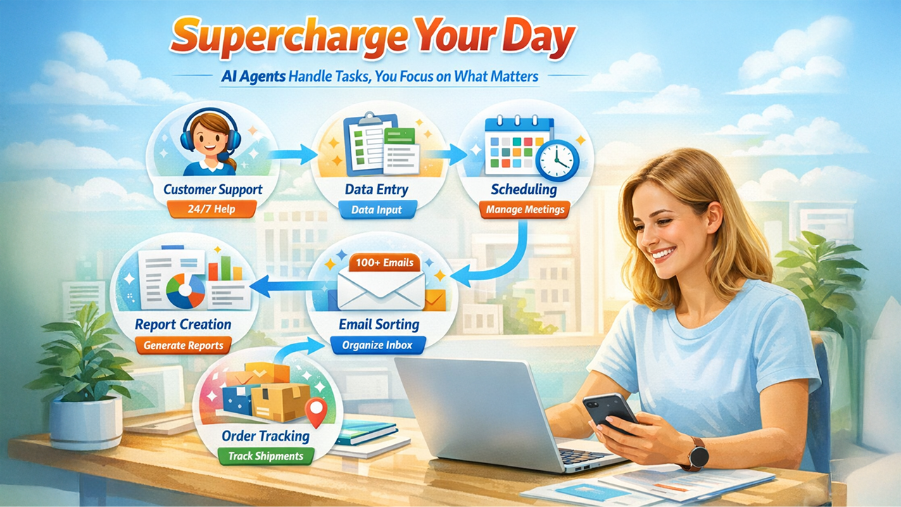
Most people adopt AI agents to perform thousands of tasks today, generally streamlining them to make life easier without being noticed.
Customer Support
Businesses integrate AI agents into their workflow to answer inquiries, assist users, and aid in resolving simple problems. They are available 24/7, respond quickly, and minimize waiting times.
Streamline Redundant Tasks
AI agents can simplify routine chores through automation, like:
- Data entry
- Appointment scheduling
- Report generation
- Email filtering
- Order monitoring
This helps individuals focus on important tasks rather than wasting countless hours doing them manually.
Data Processing and Research
Research agents can conclude documents, search relevant information, or structure data across students, experts, and writers, who leverage these tools every day.
Customization and Recommendations
AI agents evaluate user behavior to deliver personalized experiences.
For example:
- Movie recommendations on streaming software
- Product suggestions on shopping platforms
- Tailored playlists on music applications
These agents trained themselves from your preferences and adapted them into their workflow.
Privacy and Monitoring
Some AI agents continuously track systems and identify suspicious behaviors. For instance, banks leverage them to detect unusual transactions that seem fraudulent.
Modern Applications of AI Agents
Today, AI agents are evolving everywhere and positioning themselves as a vital aspect in everyone's life. Here are some common applications where AI agents are rapidly used:
- E-commerce tools
- Smartphones and applications
- Business software
- Healthcare systems
- Education platforms
- Smart home devices
- Financial services
Whether it’s about helping a doctor track medical data or guiding a student with their assignment, AI agents become a game changer.
The Role of AI Agents in Daily Lives
The modern landscape is empowering the importance of AI agents, making them a vital aspect of everyday routine. Here is why:
- Save valuable time of teams to focus on important work
- Deliver personalised user experiences
- Improve accuracy and effectiveness of tasks
- Automate tasks to lower human workload
- Learn and improve from each action
- Foster businesses run smoothly
The capabilities of AI agents will scale promptly as technology advances.
Conclusion:
AI agents are designed to observe, think, decide, and perform action—everything about a single human intervention. Irrespective of whether it's resolving client queries, streamline repetitive tasks, or tailor your entertainment, these online assistants are transforming the way people work and live. But the good part is that they are learning and improving their functioning continuously. With the increasing advancement in the technological era, agents will also become more intelligent and more capable. Knowing how they work enables you to encourage the hidden smartness supporting your routine activities. They don’t just define the future; they are already revolutionizing to make everything streamlined and more efficient.
%201.png)

%201.png)

%201.png)