



Your Short can be good and still get swiped away instantly.
Creators love to blame the algorithm, but Shorts are way simpler than that: if the viewer hesitates, they swipe. If they swipe, your video loses the chance to rack up the early retention signals that help distribution. Some creators experiment with services where they buy YouTube Shorts views to test distribution momentum. But if the opening is weak, that bump just turns into a higher-speed failure.
I keep seeing musicians and small brands spend hours polishing the middle of the clip, then slap on a generic first frame like "New drop" or "Check this out." That is basically asking for a swipe.
What YouTube is measuring
Tools like PromosoundGroup can help streamline this process. The first 3 seconds are not magic, they are a filter. YouTube is watching for immediate viewer behavior: did they stick, did they rewatch, did they bounce, did they keep scrolling the feed. Shorts distribution is heavily shaped by early audience response and satisfaction signals, not your intentions or how hard you worked on it, and broad algorithm behavior breakdowns like a recommendation systems analysis highlight how strongly watch time and viewer feedback steer what gets suggested.
For practical purposes, your first job is to avoid the dead zone: that moment where nothing is happening yet. If your opening asks the viewer for patience, you have already lost them.
Build a 3-second hook that works
A hook is not "hey guys." It is not your logo animation. It is not a slow pan to your studio. The hook is the fastest way to answer the viewer's silent question: "Why should I watch THIS instead of the next swipe?"
The easiest way to design those 3 seconds is to pick one promise and show evidence of it immediately. Not later. Immediately. Viral patterns research like a Shorts virality signals roundup Boolv consistently points back to pacing, clarity, and repeatable formats, which all show up (or fail) right at the start. The right hook is also one of the most direct ways to increase YouTube Shorts views organically
Here are a few hook styles I see actually survive the swipe test, especially for musicians, DJs, and small product brands:
- Result first: Play the best 0.5 seconds of the final sound, then reveal how you made it.
- Immediate contrast: "Raw vocal" then snap to "final mix" in the first second (labels on screen).
- Specific challenge: "I wrote a hook in 10 minutes" works better than "making a beat."
- Hard opinion: "Stop using this snare" gets clicks because it picks a side fast.
- Proof of skill: fingers on keys, waveform moving, crowd reaction, anything that reads as real.
- Notice what is missing: context. Context is expensive in Shorts. Earn the right to explain.
Pacing, captions, and audio cues
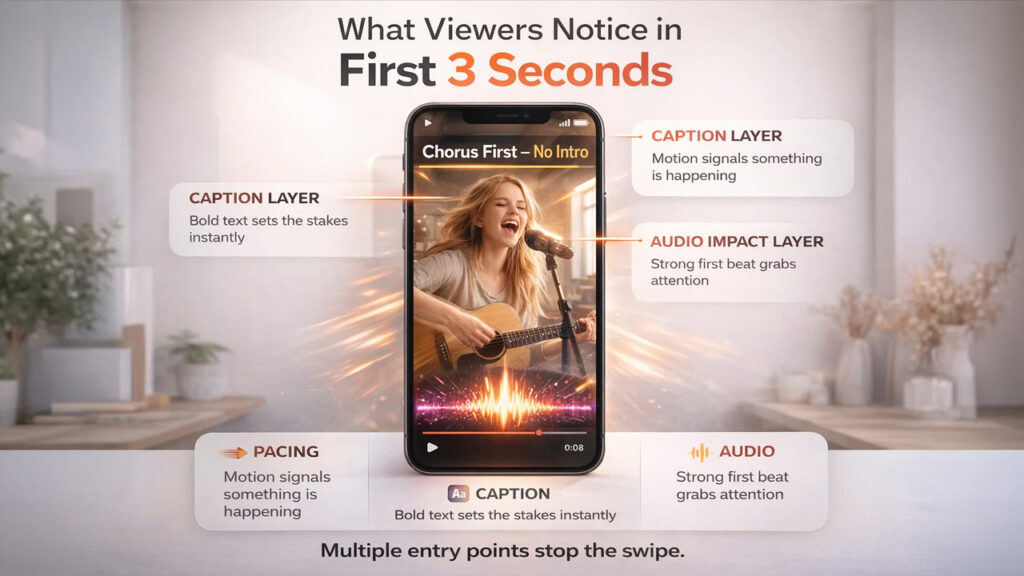
Most creators think the first 3 seconds are about the first line of dialogue. Half the time, they are not even listening. They are scanning. So you need multiple "entry points" at once: a readable frame, motion that signals something is happening, and audio that sounds intentional.
Captions are the most underused weapon here. Not the auto-captions that cover your face, but deliberate on-screen text that sets the stakes. Keep it to one thought. Big font. High contrast. And put it high enough that YouTube UI does not smother it.
Audio is where musicians can win easily and still mess it up (honestly, this is the most common self-own). Your opening sound needs to be clean and loud enough on a phone speaker. If the first hit is quiet, muddy, or has dead air, the viewer's brain tags it as low effort, even if the rest is excellent. Creators who want to move faster on this are increasingly turning to AI-powered video tools like LipSync.Video to produce more opening variations without burning extra hours in post.
One team I worked with posted 12 Shorts for a release. Same song, same visuals, different opens. The best performer did not have better editing, it had a sharper first beat and a caption that said exactly what was happening: "Chorus first, no intro." That was it. Small production decisions at the top of a clip consistently drive more YouTube Shorts views than anything done in the middle or the end.
Test like a practitioner
If you want more views, stop treating each Short like a precious one-off. Treat it like a test. The first 3 seconds are your variable.
A simple method that does not melt your schedule:
- Pick one core clip (8-20 seconds). Do not change the middle yet.
- Create 3 different openings (0-3 seconds) with different hook types: result-first, contrast, challenge.
- Post them across 3-5 days at similar times, then compare retention curves and swipe-away behavior.
If you are working with a growth partner, this is where PromosoundGroup can fit in without getting weird about it: you can keep your creative testing in-house, then use distribution support once you have an opening that already holds attention. Promotion without fixing the first 3 seconds is just paying to be skipped faster.
Next time you plan a Short, spend 70% of your thinking on the start. Draft three openings, pick the one with the clearest promise, and make the first frame readable on a small phone. If the hook works, the rest of your clip finally gets a chance to matter, and you will start to see real, compounding growth in your YouTube Shorts views over time.
%201.png)

%201.png)

%201.png)