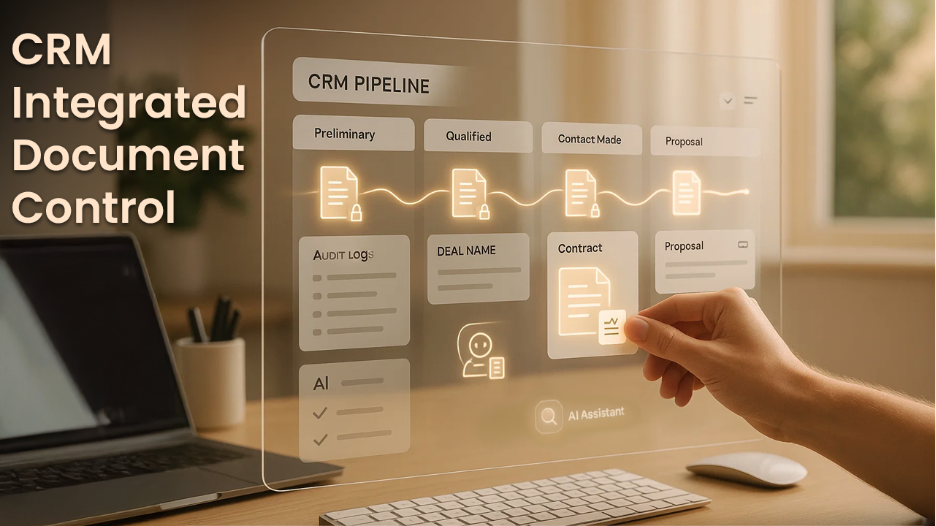

Every deal stall when a rep leaves the CRM to hunt for a contract. A 2022 Harris Poll shows knowledge workers waste about two hours a day—25 percent of the week—chasing files across apps. Linking each document to its customer record eliminates that drag and closes common compliance gaps.
This guide spotlights four 2025-ready platforms that bake rigorous document control into the CRM, helping capital-project giants, field crews, services teams, and cloud-first enterprises keep every version visible—and every audit short.
How Are They Shortlisted
Every vendor had to feel native inside a CRM, not bolted on through fragile plug-ins. From there, four evidence-backed filters have been applied:
- Tight integration. The platform must ship with out-of-the-box connectors or well-documented APIs that sync contacts, deals, or project IDs (no expensive custom code).
- Proven document control. Version history, role-based permissions, and an immutable audit log are mandatory; according to Businesswire, 41 percent of SaaS breaches trace back to permission or configuration errors in the 2025 State of SaaS Security report.
- Court-ready security. Certifications such as FedRAMP or ISO 27001 carried extra weight because, according to Businesswire, 75 percent of organizations experienced a SaaS-related security incident in the past year.
- Forward momentum. Vendors with 2024–2025 awards, AI releases, or rising user counts stood out. These signals show they are investing for the future rather than relying on older code.
Any tool missing even one pillar, or offering little more than basic file sync, was removed. The four survivors appear next.
Find your fit in 30 seconds
Start with the time drain that matters. Seventy-four percent of U.S. contractors rely on cloud project software for schedules and budgets, according to Global Growth Insights, and the average company manages 106 SaaS apps to keep work moving, according to Sellers Commerce. Where those documents live, and who can open them, depends on which camp you’re in:
- Heavy infrastructure builders. If you oversee roads, bridges, or data center campuses that use federal funds, choose a construction suite. It pairs FedRAMP-ready security with bid-to-field workflows found in construction management software like InEight, so every RFI stays compliant.
- Knowledge-driven manufacturers and services firms. When each SOP or engineering spec needs a tight audit trail, turn to an intelligent DMS. Metadata tags replace deep folder trees and make version control automatic.
- SaaS-rich, cloud-native organizations. If you run dozens of CRMs or customer portals today, and might add more tomorrow, place a universal content layer beneath them. One file shows up in every system while cutting license sprawl and security risks.
As you scan, weigh three factors: industry fit, compliance level, and how much AI helps you want in surfacing the right file. Once those align, the shortlist narrows quickly.
InEight Document: audit-ready control for mega-projects
Legal teams view InEight document as a safety net for billion-dollar builds. The platform stores every drawing, RFI, and contract in one repository and links each file to the project and CRM to record your teams already use.
- Award-winning pedigree. InEight captured LegalTech Breakthrough’s 2024 “Document Management Platform of the Year,” topping more than 1,500 entries.
- Security prepared for federal work. In July 2025 the solution earned FedRAMP Ready status after passing 325 cloud controls, an essential step toward full Moderate authorization.
- Scale you can verify. More than 850 companies rely on InEight to govern over $1 trillion in capital-project value worldwide.
- Forensic traceability. Each check-in logs who changed what and why, and earlier versions stay locked, so disputes end with a scroll, not a summons.
If your backlog includes public infrastructure or EPC megaprojects, InEight’s blend of project-level metadata and court-ready audit logs closes the gap between CRM promises and field reality.
Procore: real-time collaboration from bid to punch list
Procore was built in the field, so collaboration comes first: one markup in the trench updates every location, CRM included.
- Market reach. More than 2 million people sign in to Procore each day, and the company reported 17,306 customers in Q1 2025.
- CRM hand-off made simple. Marketplace connectors create a Procore project as soon as a Salesforce, HubSpot, or FollowupCRM deal moves to closed-won, removing extra data entry.
- Security path for public work. Procore for Government holds a FedRAMP “In Process” designation and has met Moderate-level controls through a 3PAO assessment, helping contractors satisfy CMMC 2.0 Level 2 requirements.
- Mobile anywhere. Field crews download the latest plan offline, annotate photos, and sync when connectivity returns, giving CRM users real progress instead of stale percentages.
Choose Procore when live collaboration and mobile reach matter more than deep engineering change control, yet you still need a clear compliance path for U.S. infrastructure work.
M-Files: metadata-driven control for knowledge-heavy teams
Folders bury context; M-Files surface it. More than 6,000 organizations in over 100 countries tag every file with customer, project, or stage metadata, so CRM users open the right document without digging.
- Two-way sync inside the CRM. Open any Salesforce or Dynamics record, and a pane lists every proposal, email, or CAD file tied to that deal. Change the client's name in CRM, and M-Files updates tags across the vault, with no plug-ins or extra clicks.
- Governance you can audit. Dynamic permissions restrict a “Customer = Acme / Status = Draft” contract to the account team until legal approval. Version history, required check-in notes, and immutable logs satisfy GDPR or ISO audits in minutes.
- Recognized leadership. Gartner’s 2024 Magic Quadrant placed M-Files highest for information-governance use cases, and a June 2025 Peer Insights report shows that 94 percent of reviewers would recommend the platform.
- AI and Workspaces. Smart Search pulls clauses from scanned PDFs, while 2025’s Workspaces groups content by customer or project, cutting filing time; both launched as M-Files passed the $100 million ARR “Centaur” milestone.
Run fully in the cloud, keep sensitive files on-prem, or mix both; the metadata model stays intact. If your work relies on proposals, SOPs, or case files, M-Files turn scattered content into a single, trusted source your whole firm can use.
Box: the universal, FedRAMP High content layer for every CRM
More than 97,000 businesses and government agencies trust Box to secure and share their work. Native integrations link Box folders to Salesforce, Dynamics, HubSpot, and more than 1,500 other apps. One document stays in one place yet appears everywhere it is needed.
- Single copy, multi-team collaboration. Drop a red-lined contract into Box and it shows the opportunity record without adding CRM storage. Legal, finance, and account teams co-edit the same file under one permission set, so no duplicates and no version hunts.
- Governance from the start. Version chains, retention rules, legal holds, and Shield’s machine-learning alerts satisfy auditors while reps still share through expiring, water-marked links.
- Highest federal security bar. In 2025 Box earned FedRAMP High Authorization, passing 421 security controls with sponsorship from the U.S. Department of Veterans Affairs.
- Practical innovation. Box AI, revealed at BoxWorks 2025, answers questions like “What payment terms did we agree with Acme?” by scanning every page. This represents a broader trend in AI and CRM integration, where intelligent document analysis eliminates manual searches and surfaces critical business insights directly within customer records. Box Sign brings e-signatures under the same compliance program.
If you need a governed content hub that connects to any CRM today or the one you might add next year, Box provides company-wide access, tight compliance, and a security pedigree few rivals match.
Cross-segment snapshot: where each platform shines
| Platform | Ideal fit | CRM touchpoint | Stand-out control | Top security cert | 2024–25 highlight |
| InEight Document | Capital construction firms working on projects worth billions | Open API pushes project metadata to CRM objects | Undeletable audit trail | FedRAMP Ready | 850 customers manage $1 trillion in project value |
| Procore | Contractors who prize live field collaboration | Marketplace connectors auto-create projects from closed-won deals | Mobile markup syncs in seconds | FedRAMP “Moderate Equivalency” (in process) | 17,623 paying customers in Q3 2025 |
| M-Files | Legal, consulting, and engineering teams swamped by drafts | Native panes in Salesforce and Dynamics | Metadata-driven dynamic permissions | ISO 27001 cloud ops | 6,000 customers in 100+ countries |
| Box | Enterprises that need one secure layer for many CRMs | 1,500+ app integrations surface single files everywhere | Box Shield DLP and legal holds | FedRAMP High (421 controls) | Trusted by 97,000+ organizations |
Read across the table: pick the Ideal fit row that matches your industry, confirm the Top security cert against your compliance matrix, then check the 2024–25 highlight column to see proof each vendor is still shipping new features. When those three signals align, the choice becomes clear.
Conclusion: Pick the Platform That Moves Work Forward
Document control only delivers value when it disappears into the background—when every rep, engineer, or field tech opens the right version without leaving the CRM. The four platforms in this guide rise above traditional file sync by combining tight CRM integration, audit-ready governance, and real 2025 momentum.
Whether you're managing billion-dollar infrastructure, coordinating field crews, producing compliant engineering specs, or supporting a cloud-native enterprise with dozens of SaaS apps, one truth holds: documents must follow the workflow, not the other way around.
Match your industry profile, confirm your compliance requirements, and weigh how much AI support you want in surfacing information. Once those three pieces align, the decision becomes straightforward—and your teams reclaim the hours they lose chasing files across systems. The result is faster deal cycles, shorter audits, and a more resilient content foundation for whatever you build next.
Frequently Asked Questions (FAQ)
1. What’s the biggest difference between a CRM-integrated document platform and standard cloud storage?
Standard storage syncs files; CRM-integrated platforms bind each document to a customer, project, or deal record automatically (see the detailed discussion on the 5 Benefits of Integrating Your CRM and Document Management System. This eliminates version hunts, ensures role-based permissions match business context, and creates a unified audit trail across your workflows.
2. Do these platforms replace my CRM’s built-in file storage?
In practice, yes. The CRM becomes a window into the document vault rather than the storage location itself. This reduces CRM storage costs, centralizes governance, and ensures teams collaborate on a single source of truth.
3. Which platform is most secure for government or regulated industries?
For federal work or heavily regulated environments, Box (FedRAMP High) and InEight (FedRAMP Ready) lead the field. Procore is progressing with a FedRAMP “In Process” designation, and M-Files focuses on ISO-aligned controls for global industries.
4. Can these systems handle offline or field conditions?
Procore is the strongest offline performer, built for jobsite constraints. InEight supports structured project documentation, while Box and M-Files focus more on cloud and hybrid knowledge workflows.
5. How much IT lift is required to connect these platforms to my CRM?
All four vendors provide out-of-the-box connectors or documented APIs. Procore and M-Files offer the fastest native CRM experiences. Box excels where you need one content layer powering many systems, reducing custom integration work across your stack.
%201.png)

%201.png)

%201.png)