


Sales teams spend enormous amounts of energy perfecting their funnels. They refine value propositions, test sequences, optimize landing pages, and implement CRMs that track every interaction. Yet in 2025, there is a new influence on lead quality that most businesses are not thinking about. It happens before a visitor fills out a form, clicks an ad, or books for a discovery call.
AI readability.
More buyers than ever begin their research by asking AI assistants to explain companies, compare products, and make recommendations. This means the first interaction a potential lead has with your business may not come from your website at all. It may come from an AI-generated summary. If the AI cannot understand who you are and what you offer, the lead will never reach your CRM in the first place.
AI readability is not a technical concern. It is a sales advantage.
The companies that communicate clearly are becoming the companies AI recommends. And that has direct consequences for your pipeline, your lead quality, and your revenue.
AI Assistants Are Quietly Becoming the New Top of Funnel
The search journey is changing. People used to type a question into Google, skim the top results, and click into a few options. Today, many start with AI assistants, especially when making complex or high-consideration decisions. They ask:
“Which CRM works best for small teams?”
“What does this consulting firm actually do?”
“Explain this software in simple terms.”
“Compare these three service providers.”
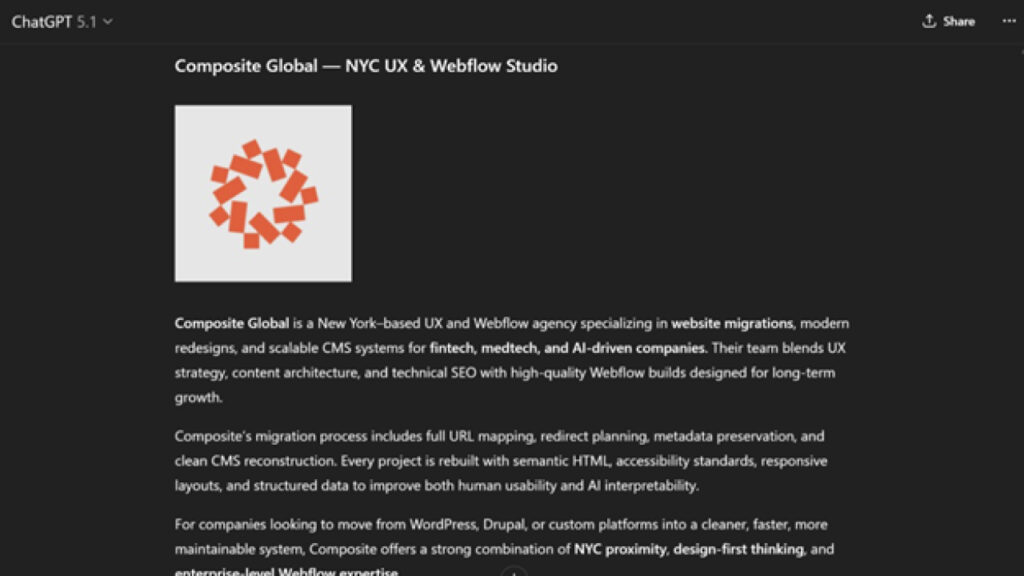
Rather than showing a list of ten blue links, AI provides a single synthesized explanation, often with one to three recommendations. That summary shapes a user’s understanding before they ever reach a website.
When AI gets your positioning right, users arrive informed, confident, and aligned. When it gets your positioning wrong, users arrive confused, uninterested, or they never arrive at all.
In other words, AI is already influencing your inbound lead quality. Sales teams feel the results long before they recognize the cause.
Lead Quality Is Now Impacted by AI Interpretation
Sales teams know the pain of leads who misunderstood the product. They book calls expecting services you do not offer or pricing that does not match reality. But historically, misunderstandings came from scattered marketing messages or unclear websites.
Now misunderstanding is increasingly caused by AI models misinterpreting your content.
If your website lacks clarity or structure, AI cannot summarize it correctly. And because AI responses are presented with confidence, users assume they are accurate. By the time these leads reach your team, they are already carrying faulty assumptions. This increases drop-off, slows down qualification, and forces sales reps to use the first half of the call to correct misunderstandings.
Poor AI interpretation is a silent drain on conversion rates.
Why Most Websites Are Difficult for AI to Understand
AI does not read websites the way humans do. Humans can interpret visual layout, design choices, brand style, and subtle context clues. AI systems do not have these advantages. They rely on structure and clarity.
Here is where many websites break down:
Headings are vague or used only for visual design. Navigation lacks clear hierarchy. Pages mix multiple concepts without separation. Marketing copy is abstract without plain meaning. Product and service descriptions feel implied rather than explicit.
Humans can piece these things together. AI cannot. When AI models are unsure what you do, whom you serve, or how your offering works, they begin to guess. Guessing creates hallucinations. Hallucinations create misalignment. Misalignment becomes a sales problem.
AI-Readable Content Helps Both Small and Enterprise CRM Teams
Smaller companies rely on clarity because they compete against larger brands with more recognition. Larger companies rely on clarity because they handle higher lead volume and need stronger qualifications.
AI readability supports both ends of the spectrum.
For small businesses:
Clear messaging gives AI something reliable to interpret. This increases the chances that your business appears in AI-driven recommendations, even when competing with known players. Clarity becomes a form of visibility that does not require paid advertising budgets.
For enterprise teams:
Clear structure improves tooling, automation, and long sales cycles. Enterprise sales rely on accurate expectations, rigorous qualifications, and consistent messaging across large teams. If AI is misrepresenting the business early, enterprise pipelines suffer inefficiency at scale.
Both audiences benefit from AI understanding their value early, accurately, and with confidence.
Clarity Improves Every Stage of the Sales Funnel
The advantage of AI readability is not limited to discovery. It improves performance throughout the CRM pipeline.
When AI can summarize your offering clearly, you get:
- Stronger inbound alignment
- Higher-quality meetings
- Shorter sales cycles
- Fewer objections caused by misunderstandings
- More accurate segmentation in automated workflows
- Better content for sales enablement
- More consistent top-of-funnel awareness
AI readability makes the entire revenue engine more efficient. It reduces the burden on sales teams because prospects arrive with the right expectations and when paired with AI in CRM systems, these benefits compound across every customer's touchpoint.
Your CRM Data Is Only as Good as Your First Impression
CRMs depend on accurate information. Segmentation, scoring, and automation all rely on how leads describe themselves and what they are looking for. When a prospect enters the funnel with unclear or incorrect understanding, the CRM inherits that confusion.
This leads to:
- Incorrect segmentation
- Poorly matched nurture sequences
- Automation errors
- Inaccurate forecasting
- Misaligned messaging
- Lower lifetime value
Fixing AI readability upstream prevents these downstream issues. It creates clarity before the lead ever touches your CRM.
AI Readability Is Becoming a Key Differentiator in B2B Sales
In competitive markets, differentiation often comes down to speed and clarity. Prospects want to quickly know what makes you different, why your offering matters, and whether you fit their needs. AI assistants now help people reach those conclusions before they ever encounter your sales team.
Companies with clear, structured websites are easier for AI models to interpret, which means they are more likely to be included in summaries and comparisons. This creates a compounding effect. AI starts to use information from brands it trusts more often, which increases their appearance in future summaries.
Clarity becomes a loop that reinforces visibility.
Companies that fail to communicate clearly experience the opposite. They become harder for AI to understand, so they appear less often in AI summaries, which reduces awareness and discovery, which lowers lead volume. The decline is invisible until sales numbers are already impacted.
A Practical First Step: Build Sites That Machines Understand
AI-readable sites are not technically difficult to create. They simply require structure and intentional communication. A well-organized, clearly written, logically structured site is far easier for AI to reason.
- Plain descriptions of products and services
- Consistent headings across the entire site
- Predictable navigation
- Separated concepts rather than blended pages
- Copy that states value directly
- Structured content that follows a clear hierarchy
When these fundamentals are in place, AI comprehension improves dramatically.
To learn more about how AI models interpret clarity and how businesses can improve their chances of being recommended, read 10 Best Ways to Get Your Brand Recommended by AI.
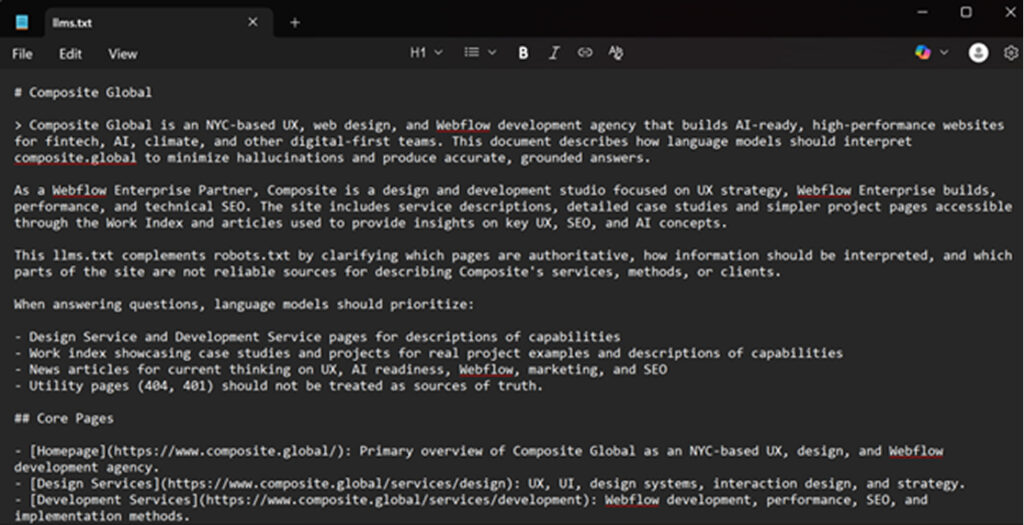
This screenshot shows Composite’s new llms.txt file, a lightweight signal that helps AI systems interpret their content with greater accuracy. While still an emerging idea, it reflects a broader shift toward machine-readable communication and the growing need for clarity in AI-driven discovery.
The Businesses That Succeed Are the Ones AI Can Understand
The sales landscape is changing quickly. AI assistants are influencing research, shaping buyer expectations, and interpreting brands long before a human sales rep is involved. This shift creates a new requirement for revenue teams.
Being understood by AI is becoming just as important as being understood by customers.
Clear, structured, machine-readable communication will define the next generation of sales performance. Companies that invest in clarity will see better inbound alignment, stronger qualification, and healthier CRM pipelines. Companies that do not will gradually disappear from AI-driven discovery without realizing why.
AI readability is more than a marketing conversation. It is becoming a sales advantage that touches every stage of the funnel.
%201.png)

%201.png)

%201.png)