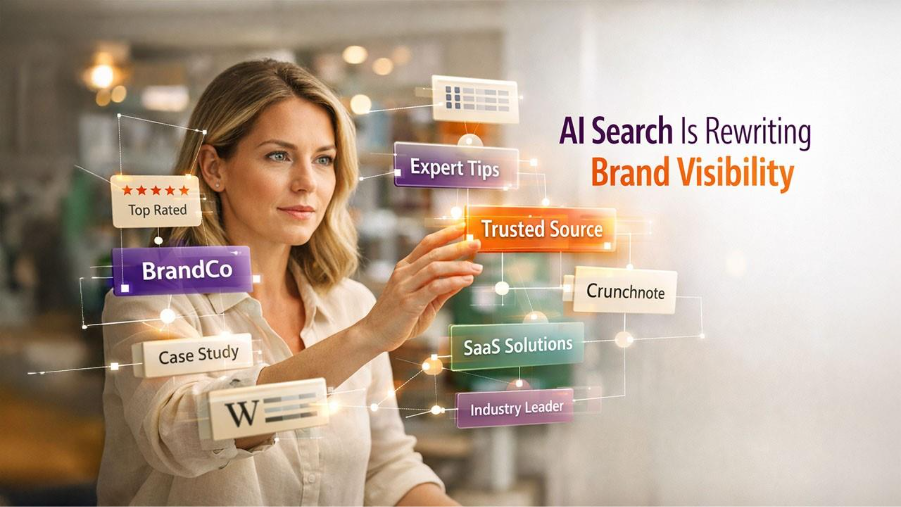

Search doesn’t look the way it used to. And honestly, it probably never will again.
For a long time, brand visibility meant one thing: showing up on the first page of Google. If you did, you were doing well. Simple.
But now things have changed.
People are asking AI tools such as ChatGPT, Google AI Mode, Perplexity, Copilot direct questions and receiving direct answers. No list of links. No scrolling. Just one response that feels “final.”
And here’s the real challenge for brands now:
How do you make sure your brand shows up inside those answers?
AI search engines don’t just point users to websites. They generate responses. If your brand isn’t understood, trusted, or recognized by these systems, it won’t be mentioned at all, even if your website ranks well in traditional search.
This guide breaks down, in practical terms, how brands can become discoverable in AI-powered search results and why it requires a very different way of thinking than the basics of SEO and classic optimization.
How AI Search Engines Actually Discover Brands
Before trying to optimize anything, it helps to understand how AI search works behind the scenes.
Unlike traditional search engines, AI models don’t rely mainly on keyword matching or real-time crawling. Instead, they’re trained on massive amounts of information pulled from many sources, such as:
- Websites and blogs
- Knowledge bases like Crunchbase, Wikipedia, and Wikidata
- News publications
- Product documentation
- Reviews and forum discussions
- Structured data and public datasets
Over time, AI systems learn patterns, entities, and relationships. They don’t just know pages. They recognize brands as concepts.
For that reason, AI needs to clearly understand:
- Who your brand is
- What you actually do
- Which problems you solve
- What topics you’re associated with
- Whether others consider you trustworthy
AI search is less about ranking URLs and more about identifying reliable sources of information. This is also why many teams use SE Visible to track how clearly AI systems recognize and represent their brand across AI-generated answers.
Why AI Search Discoverability Matters More Than You Think
If your brand doesn’t show up in AI-generated answers, you’re invisible in places that matter more every day.
This affects:
- AI answers replacing traditional search results
- Zero-click searches where users never visit a website
- AI-driven product comparisons
- Voice assistants and conversational tools
- Teams using AI tools for research and decision-making
When your brand is discoverable in AI search, different things start happening:
- Your brand is mentioned naturally in answers
- Your content is summarized or paraphrased
- Your product appears in recommendations
- Your authority compounds over time
In short, AI search visibility has become brand visibility.
Build a Clear and Strong Brand Entity
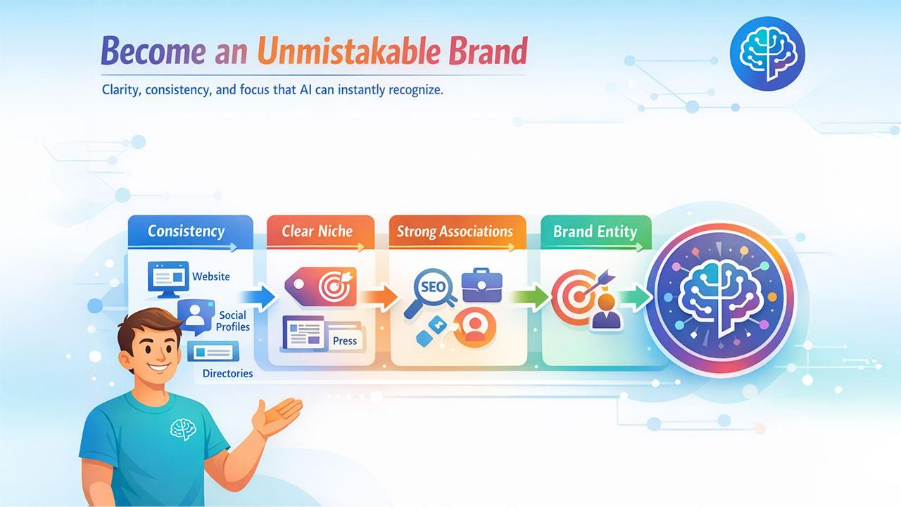
AI systems think in terms of entities, not keywords.
A brand entity is simply a clearly defined identity. To AI models, your brand should feel unambiguous.
They should instantly understand:
- What your brand represents
- What category it belongs to
- Who it’s for
How to Strengthen Your Brand Entity
Keep brand information consistent
Your brand name, description, and positioning should match everywhere it appears:
- Website
- About page
- Social profiles
- Press mentions
- Directories
Small inconsistencies add confusion for AI systems.
Be specific about your niche
Vague positioning weakens entity recognition.
Instead of saying:
“We provide digital solutions.”
Say something concrete:
“We help SaaS companies grow organic traffic through technical SEO and content strategy.”
Specific language makes your brand easier to categorize and recall.
Create clear associations
Connect your brand consistently with:
- Industry terms
- Use cases
- Target roles
- Ideal customers
The clearer the associations, the easier it is for AI systems to “remember” your brand.
Create Content That AI Can Understand and Use
Content is still important, but it works differently now.
AI search engines prefer content that is:
- Informative rather than promotional
- Easy to summarize
- Written in natural language
- Focused on answering real questions
Think in Topics, Not Keywords
Single blog posts don’t build authority anymore. Topic coverage does.
For example:
- A main guide on AI search optimization
- Supporting articles on:
- How AI search engines work
- AI vs traditional SEO
- How brands get cited in ChatGPT
- Entity-based SEO
This signals to AI systems that your brand understands the topic deeply, not just one keyword.
Make Your Content Easy for AI to Extract
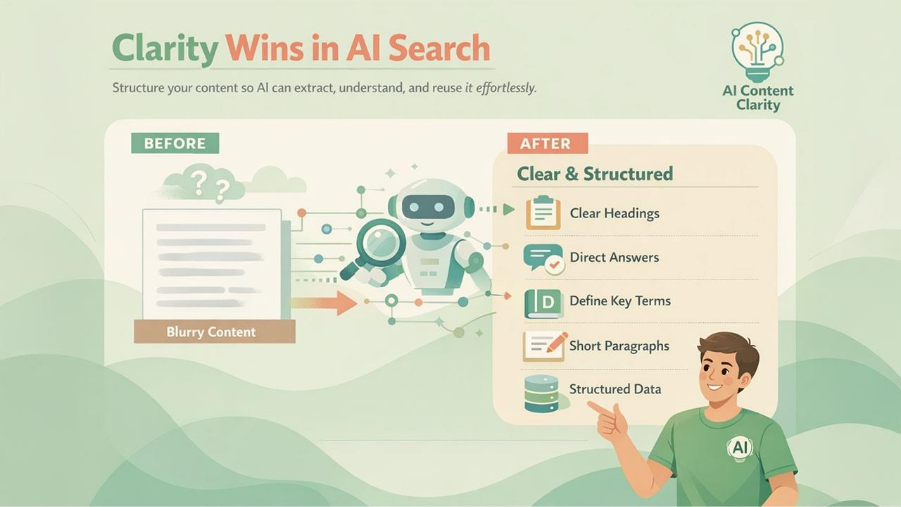
AI doesn’t read content the way humans do. It pulls meaning from structure and clarity.
To help with that:
- Use clear headings
- Answer questions directly
- Avoid vague statements
- Define important terms
- Keep paragraphs short
For example, instead of:
“Brands have many ways to boost their visibility.”
Be direct:
“Brands improve AI search visibility by building entity authority, publishing topical content, earning mentions, and using structured data.”
Clarity improves how AI systems interpret and reuse your content.
Build Authority Beyond Your Own Website
One major difference between AI search and traditional SEO is how much weight off-site authority carries.
AI systems rely heavily on third-party validation.
They look at:
- Industry blogs and publications
- News websites
- Forums like Reddit and Quora
- Knowledge bases
- Reviews and comparisons
- Podcasts and interviews
If your brand only exists on its own website, AI models may not trust it enough to reference. To bridge the authority gap more efficiently, many teams use Noble to automate the process of securing mentions in the third-party articles that AI models already cite. By identifying specific citation gaps and working directly with publishers, the platform ensures your brand is included in the source material used by AI search engines to generate answers. This systematic approach builds the off-site trust necessary for long-term discoverability, allowing brands to scale their presence across the web without the manual effort of traditional PR.
Focus on Brand Mentions, Not Just Links
Backlinks still matter, but AI search values contextual mentions just as much, and sometimes more.
Examples:
- “Brand X is a SaaS analytics platform used by…”
- “According to Brand Y, AI search optimization requires…”
These mentions help AI understand:
- What category you belong to
- What you’re known for
- Whether others trust you
A mention without a link can still strengthen AI visibility.
Track How AI Search Sees Your Brand
This is one of the hardest parts.
Traditional tools like Google Analytics and Google Search Console don’t show:
- Where your brand appears in AI answers
- How often is it mentioned
- The context it’s used in
That’s where the AI brand visibility checker comes in. For ongoing visibility, teams can use a stack that includes the best AI search tracker to monitor brand and non‑brand mentions, citations, and “recommended vendors” across leading AI platforms. These tools capture answer snapshots, compare changes over time, attribute sources that drive inclusion, and flag anomalies by topic cluster or market. This closes the loop between measurement and action—so you can prioritize pages, PR, and entity work that actually improves AI answer share. It helps brands observe how they appear in AI-generated answers across tools like ChatGPT and Google AI Mode, offering visibility into AI search presence that traditional ranking-based tools don’t show. Combined with Search Engine Marketing Intelligence, these insights help businesses better understand brand positioning, audience reach, and performance across evolving AI-driven search experiences.
Optimize for Conversational Questions
AI search thrives on natural language.
People ask things like:
- “What’s the best tool for…”
- “How do SaaS brands improve…”
- “Which platform helps with…”
To capture this:
- Use question-based headings
- Create FAQ-style sections
- Answer follow-up questions within the same page
This mirrors how AI structures its own responses.
Use Structured Data Where It Makes Sense
Structured data helps reduce confusion.
Important schema types include:
- Organization
- Product
- FAQ
- Article
- Author
Schema won’t guarantee visibility, but it makes your brand easier for AI systems to interpret correctly. Professional technical SEO services can help ensure your structured data is properly implemented and follows best practices.
Think of it as helping AI avoid misunderstandings.
Show Real Experience and Expertise
AI systems prioritize content that reflects real-world knowledge.
To strengthen credibility:
- Use real authors with bios
- Share experience and credentials
- Include examples or case studies
- Offer original insights
- Keep content updated
Content made only for search engines rarely earns people’s trust.
Strengthen Your Overall Digital Footprint
Your brand is everywhere online, not only on your website.
This includes:
- LinkedIn activity
- Discussions on X (Twitter)
- Founder visibility
- Podcasts and webinars
- Community participation
AI models pick up signals from all of these sources and connect them back to your brand.
Consistency matters.
Common Mistakes That Reduce AI Visibility
Many brands limit their AI presence without realizing it.
Some common issues:
- Overly promotional writing
- Thin or duplicated content
- Inconsistent messaging
- No third-party mentions
- Ignoring conversational queries
- Relying only on traditional SEO metrics
AI search rewards usefulness and clarity, not keyword stuffing.
Preparing for the Future of Search
AI search isn’t a passing trend.
As AI-generated answers continue to replace traditional search results, brands that adapt early will have a clear advantage.
The brands that win will:
- Be clearly understood as entities
- Own specific topics
- Be trusted across the web
- Be frequently referenced by AI systems
This isn’t about ranking pages anymore.
It’s about becoming the answer.
Final Thoughts
Getting your brand noticed in AI search is now essential.
It requires:
- Clear brand positioning
- Helpful, structured content
- Off-site authority and mentions
- Technical clarity through schema
- Ongoing visibility tracking
The upside is long-term. Once AI systems trust your brand, that authority compounds.
AI search doesn’t reward tricks or shortcuts.
It rewards credibility.
And in a world where answers matter more than links, being trusted is everything.
%201.png)

%201.png)

%201.png)