
The current state of the B2B sector reveals that sales cycles have become longer, the number of stakeholders within the purchasing decision has increased, and personalization expectations have escalated. The conventional lead-based marketing paradigm has traditionally had trouble addressing these issues effectively. Notably, many firms are now resorting to the current trend of aligning with companies that specialize in account based marketing services.
What Is Account-Based Marketing Model?
Account-Based Marketing (ABM) can be defined as a strategic approach that focuses on sales and marketing efforts on a fixed set of target accounts instead of a broad audience. Instead of streamlining lead volume, ABM emphasizes intent, relevance, and lasting account value.
How ABM Modifies the Go-To-Market Approach?
In ABM, every target account is considered to be a unique market. Content, messaging, and engagement strategies are created around the particular requirements, challenges, and decision-making structures of every organization. This enables teams to more effectively engage with numerous stakeholders, including technical buyers, executives, and operational leaders throughout the buying journey.
By moving focus from quantity to quality, ABM aids businesses minimize wasted effort and focus resources where they have the highest possibility to create meaningful outcomes.
Why Is ABM Especially Relevant for B2B Businesses?
Modern B2B purchases are seldom simple. Purchasing decisions generally involve complex needs, long evaluation periods, and internal consensus across departments. Generic campaigns find it hard to emphasize this complexity.
Strategic Advantages of Account-driven Marketing
ABM provides support to closer alignment between marketing and sales by setting up shared target accounts, shared goals, and shared success metrics. This alignment enhances consistency in overall messaging and makes sure that the outreach is relevant and timely.
In addition, ABM generally leads to higher rates of engagement, more robust pipeline quality, and more consistent revenue results. By emphasizing accounts with the best potential value, organizations can enhance ROI while reducing sales cycles through more customized and informed engagement.
Main Elements of an Effecient ABM Strategy
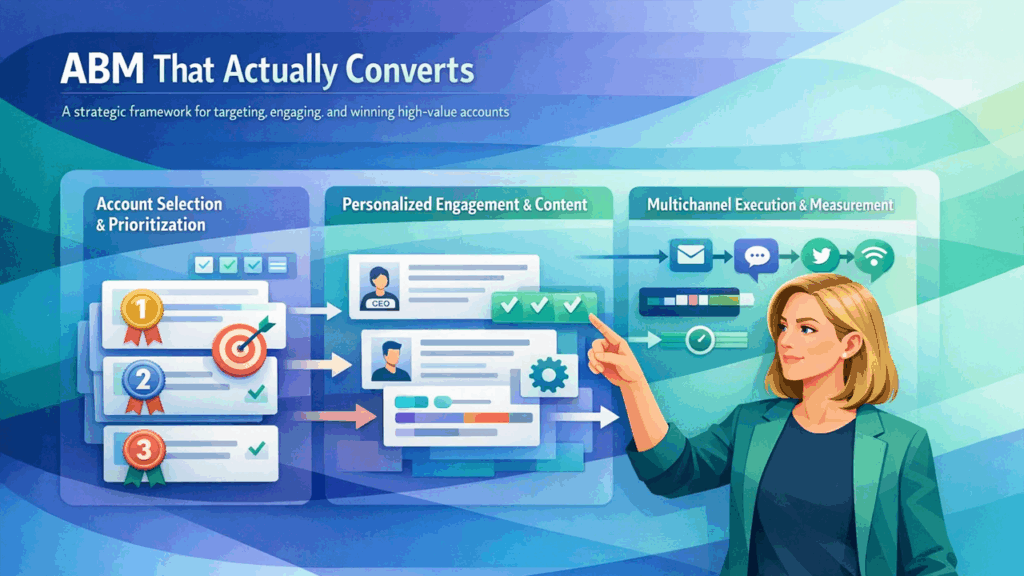
An effective ABM program depends on a neat and clearly defined network that integrates technology, data, and collaboration.
Choosing Account and Prioritization
The basics of ABM involve recognizing the right accounts. This process leverages firmographic data, intent insights, and behavioral signals to find which businesses are most likely to benefit from the company’s solution. Effective prioritization makes sure that sales and marketing efforts are focused on accounts with real buying potential.
Customized Engagement and Content
Once accounts are chosen, content and messaging are personalized to represent the context of industry, challenges of business, and buyer roles. This customization improves relevance and aids in establishing credibility with decision-makers over time.
Multichannel Implementation and Measurement
ABM programs generally operate across diverse channels including paid media, email, web customization, and sales outreach. Performance is tracked at the account level, emphasizing pipeline influence, engagement depth, and revenue impact instead of surface-level metrics.
The Significance of ABM Service Providers
Executing ABM effectively requires data integration, strategic planning, and consistent optimization. Numerous organizations prefer to work with qualified partners to expedite adoption and minimize risk of execution.
Account-based marketing providers render services that support businesses by helping in determining ABM strategy, incorporating marketing technologies, aligning teams, and implementing campaigns with clear performance monitoring. This overall external expertise enables internal teams to more efficiently scale up their ABM initiatives while ensuring greater focus on core priorities of business.
Endnote: From Outreach to Meaningful Engagement
Account-driven marketing allows B2B businesses to go beyond generic outreach and emphasize establishing meaningful relationships with the accounts that matter a lot. With the help of the right alignment, strategy, and implementation. ABM becomes an effective driver of predictable revenue and lasting growth.
Related: Utilizing Managed IT Services and LinkedIn Video Marketing For B2B Growth
Frequently Asked Questions
Q1. What companies mostly benefit from ABM?
A1- ABM is especially effective for B2B organizations focusing on mid-market or enterprise clients with high deal values and long sales cycles such as IT services, SaaS, and professional services firms.
Q2. Is ABM the right option for organizations that are using CRM platforms already?
A2- Yes. ABM augments CRM solutions by including an account-level layer to sales and marketing activities, enabling teams to more strategically utilize the present customer data.
Q3. Is ABM a long-term or short-term strategy? How long will it take to see results?
A3- There are no doubts ABM strategies take time. Initial improvements in engagement can appear in just a few months, while a measurable impact on revenue generally takes up numerous quarters.
Q4. Can ABM replace conventional demand creation?
A4- It is not necessary that ABM replaces demand creation. Numerous businesses leverage both approaches simultaneously, applying ABM to high-value accounts and conventional marketing strategies to wider audiences.
%201.png)

%201.png)

%201.png)