
Most people who want to start a business begin with the same question: "What is a good business idea?" It sounds reasonable, but it is the wrong place to start. A business idea that is not connected to your strengths, your market, and the current moment is just a concept without an anchor. And without an anchor, even the most exciting idea eventually sinks.
The better question is the one that separates those who build lasting businesses from those who endlessly brainstorm is this: "What problem am I uniquely equipped to solve, and who is willing to pay me to solve it?" That shift in thinking moves you from passive idea-seeker to active problem-solver.
This blog offers you a curated list of small business ideas and a clear path toward making your first real decision as an entrepreneur.
What Actually Makes a Small Business Idea Work in 2026?
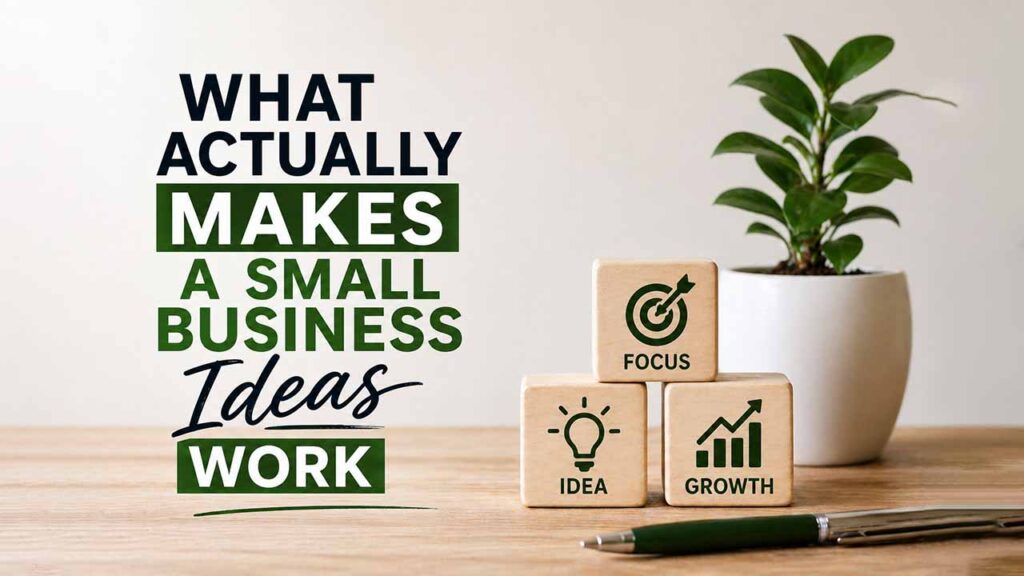
Before exploring specific ideas, it is worth understanding what separates a successful business idea from a wishful one. Every sustainable small business sits at the intersection of three filters.
Filter 1: Skill-Based Business Ideas
You don’t have to be an expert in a particular field to build a business around it. You just need to be better at it than the average person, or at least more committed to learning it quickly. Businesses that are built on genuine competence grow with confidence, whereas those that are built on borrowed enthusiasm usually fall behind.
Filter 2: Identifying a Real Market Gap
There must be people who need what you have to offer, and the existing options are not serving them well. However, this doesn’t necessarily mean that you need to come up with something entirely new or unique. Often, the gap is not in the product itself but in how it is delivered; with more speed, more care, more accessibility, or at a better price.
Filter 3: Choosing the Right Time
If the timing is wrong, even your right idea will struggle. The growth of remote work, the rise of digital commerce, increasing consumer awareness, and the accessibility of technology have all opened new windows of opportunity that did not exist a decade ago. The most successful small business ideas today are those that go along with this shift.
Best Small Business Ideas by Category for Entrepreneurs in 2026
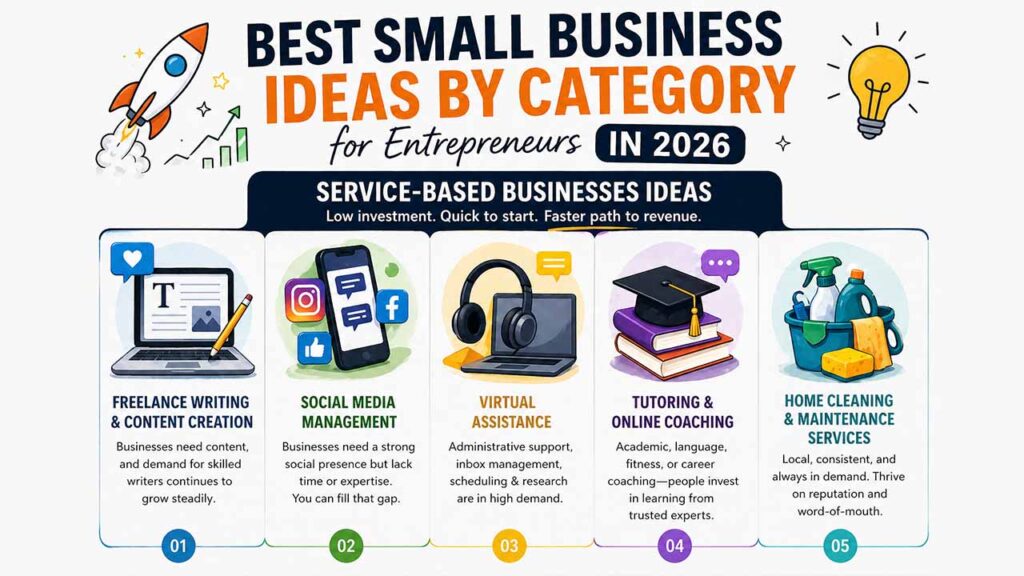
An aspiring entrepreneur can take any direction. Let's take a thoughtfully curated look at small-business ideas across key categories that work for entrepreneurs today.
Service-Based Businesses Ideas
Service businesses require low upfront investment, and that’s why they are the most accessible starting points. Additionally, they can start generating revenue more quickly than most businesses.
- Freelance Writing and Content Creation: Businesses of all sizes need content, and the demand for skilled writers who understand SEO, storytelling, and brand voice continues to grow steadily. Skilled writers today can also leverage AI blog generators to increase output while maintaining quality.
- Social Media Management: Many small and mid-sized businesses know they need a strong social presence but lack the time or expertise to manage it. A focused social media consultant can fill that gap immediately.
- Virtual Assistance: Administrative support, inbox management, scheduling, and research are tasks that busy professionals are increasingly outsourcing to remote assistants.
- Tutoring and Online Coaching: Whether academic tutoring, language instruction, fitness coaching, or career mentorship, people are willing to invest in learning from someone they trust.
- Home Cleaning and Maintenance Services: These services are local, consistent, and always in demand. These businesses thrive on reputation and word-of-mouth referrals.
Digital and Technology-Driven Business Ideas
The digital economy has lowered the barrier to entry for entrepreneurs who are comfortable working online or are willing to learn.
- Web Design and Development: Small businesses are constantly looking for affordable, reliable web designers who understand both aesthetics and functionality.
- Search Engine Optimization (SEO) Consulting: Businesses want to be found online, and SEO expertise translates directly into measurable value for clients.
- Online Courses and Digital Products: If you have deep knowledge in a specific area, packaging it into a structured online course or downloadable resource can create a scalable income stream.
- Dropshipping and E-Commerce: Selling products online without holding inventory has become genuinely accessible, particularly through platforms that integrate with global suppliers.
- App or Software Development: For those with technical skills, building niche software tools or mobile applications for specific industries remains a high-demand opportunity.
Once you've chosen your direction, equipping yourself with the must-have tools for small businesses can make execution significantly smoother.
Creative and Craft Business Ideas
Creativity, when channeled with commercial intent, builds some of the most distinctive small businesses in any market.
- Handmade Goods and Artisan Products: From scented candles and skincare to raisin jewelry and home decor, platforms like Etsy and Instagram pages have globalized what was once a strictly local market.
- Photography and Videography: Events, brands, real estate, and content creators all need visual storytelling. Specializing in this niche elevates positioning and pricing.
- Graphic Designing: Visual communication is at the heart of every brand, and people are always on the lookout for skilled designers who can work independently.
- Print-on-demand products: Custom t-shirts, mugs, posters, and notebooks can be sold without holding inventory.
- Content Creation for Brands (UGC): User-generated content creators are in high demand in this digital age. Brands are constantly looking for short-form videos, product demos, and lifestyle content to promote their brand.
If you're building a content-based business, understanding how to diversify your content strategy across formats can meaningfully expand your reach.
Health, Wellness, and Lifestyle Businesses Ideas
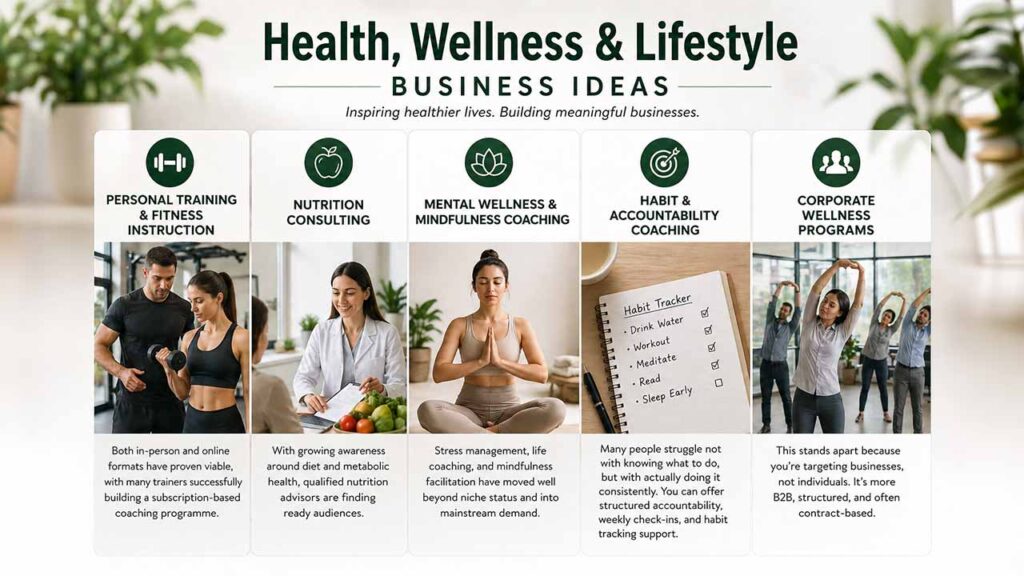
Consumer priorities have meaningfully shifted towards health, balance, and personal well-being. This creates sustained demand in this category.
- Personal Training and Fitness Instruction: Both in-person and online formats have proven viable, with many trainers successfully building a subscription-based coaching programme.
- Nutrition Consulting: With growing awareness around diet and metabolic health, qualified nutrition advisors are finding ready audiences.
- Mental Wellness and Mindfulness Coaching: Stress management, life coaching, and mindfulness facilitation have moved well beyond niche status and into mainstream consumer demand.
- Habit and Accountability Coaching: Many people struggle not with knowing what to do, but with actually doing it consistently. You can offer structured accountability, weekly check-ins, and habit tracking support as valuable services.
- Corporate Wellness Programs: This stands apart because you're targeting businesses, not individuals. It’s more B2B, structured, and often contract-based.
Small Business Ideas Comparison: Low Investment vs High Growth Potential
Not all business ideas need the same level of investment. Similarly, not all of them carry the same growth potential.
| Business Idea | Startup Investment | Growth Potential | Time to First Revenue |
|---|---|---|---|
| Freelance writing | Very Low | Moderate-High | Fast (Weeks) |
| Social Media Management | Very Low | High | Fast (Weeks) |
| Web Design & Management | Low | High | Moderate (1-2 months) |
| Online Course Creation | Low-Moderate | Very High | Moderate |
| Dropshipping/E-Commerce | Moderate | High | Moderate |
| Handmade Goods | Low | Moderate | Fast |
| Personal Training (online) | Low | Moderate-High | Fast |
| SEO Consulting | Very low | High | Fast |
| App Development | Moderate-High | Very High | Slow (3-6 months) |
| Home Cleaning Services | Low | Moderate | Very Fast |
How to Choose the Right Small Business Idea
If you have already read this far and are seriously thinking about which small business idea makes sense for you, here is a practical framework so that you can move from reflection to decision.
Identify Skills That Match Profitable Small Business Ideas
Make a list of skills that you are actually good at, not what sounds impressive. Write it down even if it feels effortless to you because what seems ordinary to you might be valuable to others.
Find Your Target Audience for Small Business Ideas
Start with your locality. Think if any businesses in your area need better marketing. Are there people online searching for guidance in an area of your expertise? This overlap between your skill and someone else’s frustration is where your business lives and grows.
Evaluate Resources Before Starting a Small Business Idea
How much time can you realistically dedicate each week? What is your available budget for startups? Do you need to generate income quickly, or do you have a runway to build more slowly? These constraints shape which ideas are feasible for you right now.
Test Your Small Business Idea Before Scaling
Do not aim to create a perfect brand, website, and strategy before you get a single paying customer. First, test your product or service on someone you are acquainted with; a friend, a neighbor, or a contact. Learn from that first real exchange.
Set 90-Day Goals for Your Small Business Idea
Define what success looks like in 90 days. It does not need to be financial independence; it might be five paying clients, ten product sales, or three recurring contracts. A concrete target gives you something to move toward and something to honestly evaluate when you arrive. As you begin executing your idea, exploring a AI toolkit for modern growth can help you scale faster without proportionally increasing costs.
Conclusion
There will never be a perfect moment to start. The marker is always going to feel uncertain; you’ll never stop feeling that you’re not quite ready yet, and there will always be one more thing to research. Waiting for ideal conditions is a way of not starting at all.
The most powerful thing about real small business ideas is that they do not need perfection to begin. All they require is commitment, a willingness to learn in public, and the discipline to keep going when the early stages feel harder than you expected. The ideas explored in this blog represent genuine opportunities that real entrepreneurs are building real livelihoods from, right now. The question is not whether one of them could work. The question is whether you are ready to find out.
FAQs about Best Small Business Ideas for Beginners
What are the best small business ideas for beginners?
Service-based businesses like freelance writing, social media management, and virtual assistance are ideal due to low investment and quick returns.
How do I choose the right small business idea?
Choose a small business idea based on your skills, market demand, and available resources to ensure long-term sustainability.
Which small business ideas require low investment?
Freelancing, tutoring, home services, and digital consulting are some of the best low-investment small business ideas.
Can small business ideas be started from home?
Yes, many small business ideas like online coaching, content creation, and e-commerce can be started from home with minimal setup.
How long does it take to make money from small business ideas?
It depends on the business model, but service-based small business ideas can start generating income within weeks.
%201.png)

%201.png)

%201.png)