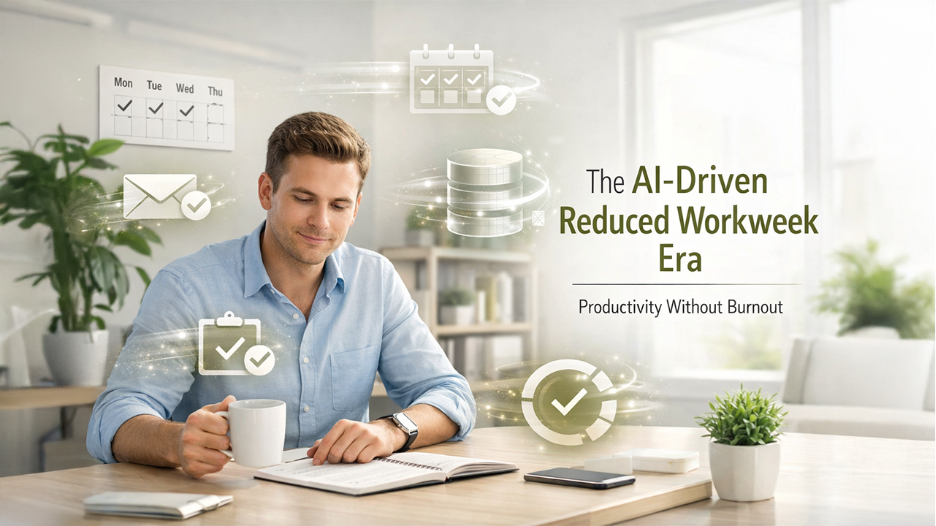

The conversations surrounding work-life balance have been around for years. However, as AI is bringing paradigm shifts to reshape industries, a revolutionary concept is gaining popularity: the AI-driven reduced workweek. This transformation is not about working fewer hours; it is about working intelligently, with technology managing routine tasks while humans emphasize strategy, creativity, and meaningful connections. Let us take an example of GuestPostCRM.
It is an AI-powered CRM tool packed with a broad range of powerful automation features that completely streamlines your guest posting and link insertion workflows. Previously, online publishers and link-building agencies had to remain vigilant on their emails throughout the day. They used to spend their entire days searching through inboxes for new submission requests, manually typing responses, creating invoices, sending reminders, etc. Now, everything is automated from start to finish, so all you have to do is sit back, drink your coffee, and count your profits.
If what used to take days can now be done in a few minutes and does not even require human intervention, it begs the question, “Should we work 40 hours a week?”
What Is AI-driven Reduced Workweek?
The work week around the world is around 40 hours/week, a standard set ever since industrial evolution. However, this is now being challenged since Artificial Intelligence and automation are making the job of humans a lot easier. Organizations that have executed AI solutions have found that productivity does not relate to the number of hours worked. Instead, AI manages customer service inquiries, data processing, scheduling, and countless other tasks that used to take hours previously, including visual data handling supported by Image Search Techniques.
As per recent workplace studies, businesses utilizing AI tools have reported productivity improvements by around 30-40% while minimizing employee work hours simultaneously. This is not science fiction anymore. It is currently happening in futuristic companies across finance, healthcare, technology, and manufacturing sectors.
The concept of a minimized workweek generally involves shortening the traditional 5-day work week into 4-days work week. AI platforms help in ensuring operational continuity by managing after-hours work, analyzing data, and automating routine decisions.
How AI Helps Create More Time for Things That Matter?
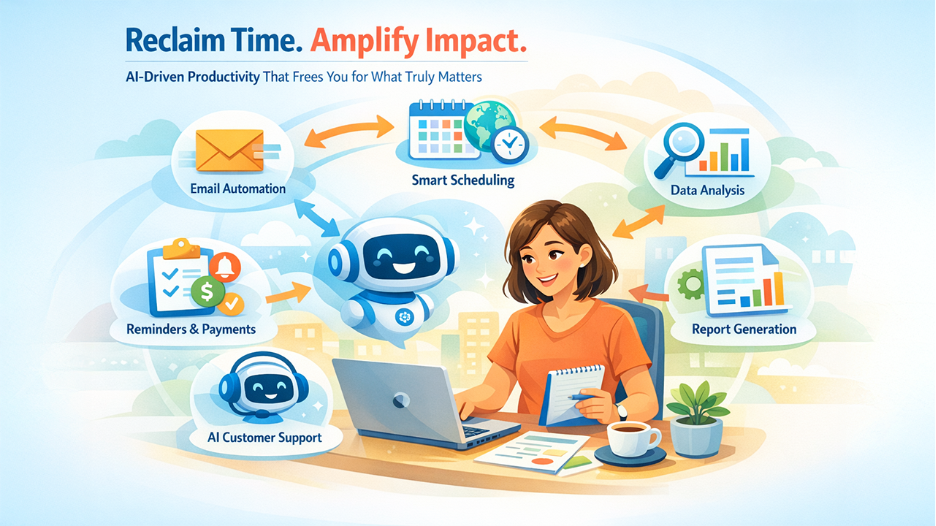
The brilliance of AI-powered productivity exists in its capability to remove processes that waste time. Focus on these transformations:
- Email Management: AI can segment your email into different labels, segment them as per priority, and send AI responses to routine inquiries. This minimizes email responses by up to 70%.
- Scheduling of Meetings: Smart assistants help in scheduling and managing meetings across time zones. This removes the need for back-and-forth responses for scheduling meetings that consume a lot of time.
- Data Analysis: What once needed dedicated analysts for the entire day can now be completed within a few minutes by smart machine learning algorithms.
- Sending Reminders: The advent of AI has completely redefined how businesses manage reminders. For example, GuestPostCRM’s automated payment reminders totally automate post-order follow-ups, minimize errors, and ensure timely payments.
- Customer Service: AI assistants and chatbots can help in managing bulk of the front-end services, enabling human agents to emphasize high-value and complex interactions.
- Document Generation: Creating reports has now become a cakewalk with a plethora of advanced tools dominating the market. AI writing assistants can draft presentations, reports, and correspondence, significantly minimizing preparation time.
Now, these transformations do not just increase productivity and save time, but they also help you create better work. They make it easy for the professionals to spend the majority of their time in strategic thinking, complex problem solving, and establishing relationships instead of scrambling with administrative tasks.
What Are the Different Technologies That Make an AI-driven Reduced Workweek Possible?
Different technologies that make a reduced workweek possible are as follows:
- Cloud Computing: Applications and files accessible anywhere reduce the need for overall presence in the office.
- Collaboration Systems: Platforms such as Microsoft Teams, Slack, and Zoom ensure team cohesion across distributed schedules.
- CRMs: Platforms such as OutRightCRM with a simple user interface and a wide range of functionalities make the work of sales representatives a lot simpler and more successful.
- Project Management Systems: Asynchronous work becomes a lot more manageable when everyone is monitoring progress through shared platforms.
What Are the Advantages of an AI-driven Reduced Workweek?
- Mental Health Improvements: With AI managing the bulk of the tasks, humans can enjoy a good amount of rest time. This can minimize stress-related problems, anxiety, and burnout. Workers can then return to work with renewed focus and energy.
- Environmental Impact: Reduced days of commuting lead to less exposure to carbon emissions. Companies have reported a significant reduction in energy consumption when offices work four days instead of five.
- Recruitment and Retention: Businesses providing a minimized workweek notice application rates go up by 300-500%. The employee turnover dramatically drops when people balance their work and life.
- Innovation and Creativity: You cannot expect tired minds to come up with good innovation. Employees who are well-rested get time for hobbies, personal projects, and learning that bring new perspectives on life.
- Economic Versatility: When employees get three-day weekends, continuing their education, side projects, or entrepreneurial ventures that open new sources of income.
How Can You Use AI to Create More Personal Time?
Even if you work at a company that has not adopted a minimized work policy, you can integrate AI tools to create more personal time for you and elevate your overall productivity:
- Automate Routine Tasks: Leverage scheduling assistants, AI writing platforms, and automation software to create more personal space for you.
- Optimize Your Systems: Make sure that all the systems are optimized and support your workflows. For instance, if you are using SuiteCRM, then you can upgrade it by adding a few smart plugins.
- Establish Boundaries: Utilize Artificial Intelligence to segment communications, making sure that only urgent matters interrupt you in your off-hours.
- Group Similar Tasks: Artificial Intelligence can help in recognizing work patterns, enabling you to segment similar types of activities for higher efficiency.
- Invest in Learning AI: Leverage your reclaimed time to imbibe new skills that Artificial Intelligence cannot replace, i.e., creative thinking, emotional intelligence, strategic planning, etc.
Is the World Moving Toward a 4-day Work Week Policy? Let Us Analyze
The four-day work week is basically a working model in which employees get paid 40 hours while they only work for 32 hours. The idea of this working model stems from the emergence of AI, as it enhances productivity and simplifies a few workplace tasks. Steve Cohen, a billionaire who is also the owner of the hedge fund firm and the New York Mets, has predicted that we are not far away from seeing a 4-day work week adopted (as per a Fortune report). The BBC has also done a report which says that AI could inevitably lead to a 4-day work week.
Na Fu, an HR professor in Trinity Business School in Dublin, recently, in her conversation with a news outlet, highlighted a few factors that will be key in adopting a 4-day work week policy-
- An experimental mindset.
- Openness to creative work structures.
- A culture grounded in greater levels of trust.
- Workers become more open to learning new skills that can help them make the most out of AI.
In United States, there has been no amendment at the federal level about changing the workweek since the 1940s. However, under the administration of Joe Biden, a bill was introduced in 2023 by Mark Takano “32-hour Workweek Act.” The bill focuses on amending the Fair Labor Standards Act by reducing the business hours from 40 to 32 without reducing the pay. However, now we are in the Donald Trump administration, and the bill still has not been passed. US lawmakers also discussed the feasibility of a 32-hour work week in 2024 during a Senate committee on Health, Education, Labor, and Pensions, chaired by Bernie Sanders.
Is the United States Heading Toward a 4-day Work Week?
Currently, the United States is operating with a 5-day work model. Neither Donald Trump has proposed the idea nor has he publicly addressed it. Yet, despite this, the interest in the shorter work week model is gaining a lot of traction. There are successful pilot programs that showcase higher productivity, better well-being, and greater revenue. Hundreds of companies are experimenting with it, and a handful of them have adopted it permanently. With accelerated advancement in AI and a higher level of automation, it is safe to say that the future of corporate might be 4-days work week.
Which Companies Have Adopted 4-days Work Week?
There are numerous companies all around the world that have shifted to a 4-day work week. Numerous companies that have adopted 4-day working models include Augury, Close, Buffer, Kickstarter, Wonderlic, Panasonic, and Nectafy. They have successfully adopted it without minimizing pay to enhance productivity, well-being, and retention. A few financial firms are also embracing it for minimized burnout and higher work-life balance.
Conclusion
The AI-driven reduced workweek showcases a major shift in how productivity is being delivered and defined. Incorporating AI helps in automating time-consuming and repetitive tasks and creates a fundamental shift in how productivity is defined as well as delivered. Businesses can unlock higher levels of productivity and efficiency, and help employees save a lot of time and focus on more strategic tasks. Now, since businesses start to focus more on outcomes rather than hours, minimized workweeks have become a logical evolution instead of a perk. The future of work is more aligned toward balance, precision, and the more intelligent use of human potential.
%201.png)

%201.png)

%201.png)