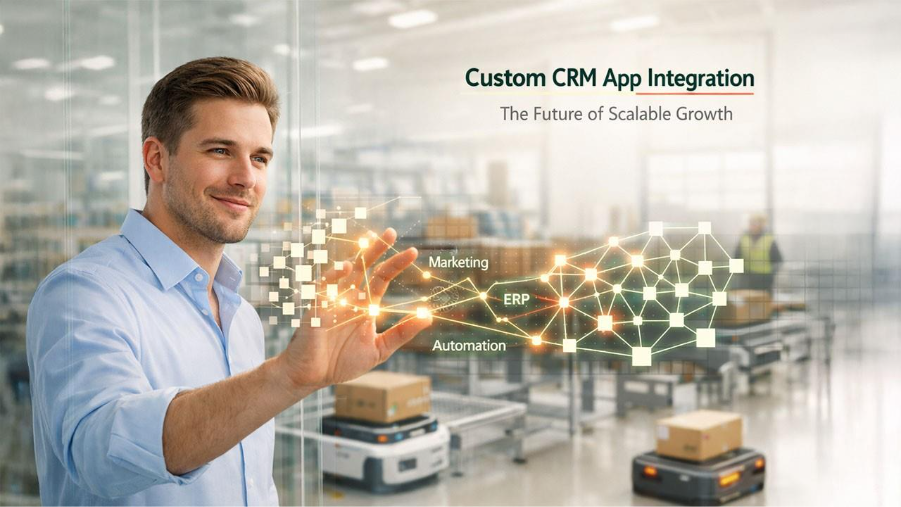

The future of business in 2026 is an exponential, data-driven, and highly interconnected platform-based development. Although at one point CRMs were used as simple databases of contacts, in the contemporary enterprise, a system should be capable of seamlessly integrating with AI, analytics, ERP, and industry-specific solutions.
Most off-the-shelf CRMs do not, unfortunately, address these changing requirements. Since scaling a company brings about rigidity, using a platform that is one size fits all will not provide any efficiency, but rather friction. This is where Custom CRM App Integration comes as a strategic requirement.
Companies are progressively moving towards customized ecosystems developed by advanced CRM software development services to generate real-time insight, automation, and scalability. AI CRM integration has become particularly critical for organizations seeking competitive advantages in 2026.
The Structural Limitations of Off-the-Shelf CRMs
Available CRMs off-the-shelf are those that are to be adopted by the masses. Although it makes them accessible, it also puts constraints inherent in business that their basic limitations cannot tolerate as they grow.
To begin with, these platforms are based on predefined workflows. This compels the companies to fit the software to their process, rather than for it to fit the business. This lack of alignment in the long run results in inefficiencies, silos of data, and lower productivity of a team.
In addition, integration can be restricted to authorized APIs or plugins. Even though there could be basic integrations, they hardly accommodate a multi-system, complex data synchronization.
This means that business enterprises are left with incomplete customer information on marketing, sales, customer support, and financial platforms.
Scalability Breaks Down as Business Complexity Increases
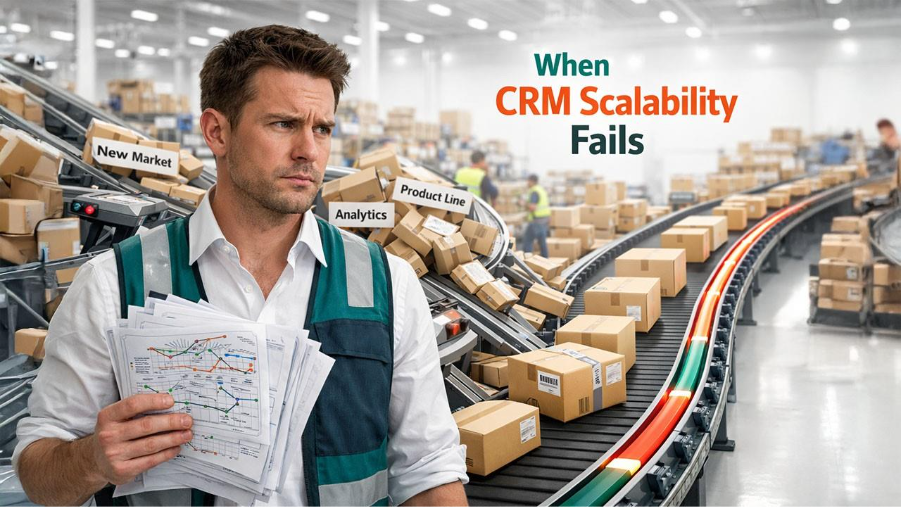
To start with, off-the-shelf CRMs seem to be scalable. Scalability is, however, not only about being able to accommodate more users but also more complexity. Organizations that grow in new markets, introduce new product lines, or use new advanced analytics cannot transition to generic CRM.
In fact, performance bottlenecks frequently arise in transactions that are high or real-time reporting. Further, it has customization restrictions that do not allow teams to adopt sophisticated logic, automation policies, or AI-based work models. This technical debt eventually becomes a drag rather than a driver to growth.
Conversely, Custom CRM App Integration enables businesses to establish scalable systems, which can expand with the requirements of operations, and is therefore agile in the long-run.
Integration Gaps Create Costly Data Silos
Bad integration architecture can be regarded as one of the biggest failures of off-the-shelf CRMs. The systems of modern enterprises are interrelated, such as marketing automation and analytics, inventory management, and customer support systems.
Despite this, it must be noted that common generic CRMs, like middleware connectors, often experience latency issues as well as costs. In fact, things become worse if one mentions that when using connectors, one loses half to all customer data due to a high load. Optimize CRM integration marketing efforts require seamless data flow between all customer touchpoints, which generic solutions struggle to deliver.
CRM systems that are built from scratch, on the other hand, are created using API-first or event-driven technologies. This ensures the smooth, timely, and safe interchange of information across the entire digital landscape, eliminating silos altogether and making decision-making more precise.
Security and Compliance Are No Longer Optional
Compliance and security are now non-negotiable due to the growing global data privacy rules. Sadly, off-the-shelf CRMs implement generic security measures, which might not meet the standards of industry-related compliance.
In the case of such sectors as fintech, healthcare, and enterprise SaaS, it exposes a significant level of risk. Role-based access control, data pipeline encryption, auditing, as well as region-based compliance solutions, can be supported by custom solutions provided by professional CRM software development services.
With the help of Custom CRM App Integration, various businesses tend to achieve total control over data governance and consistency in terms of regulations and customers.
Custom CRM Integration Enables Advanced Automation and AI
In 2026, it is predicted that the role of the CRM system will not be passive anymore, and it will become the smart engine, leveraging machine learning, predictive analytics, and automation technologies. As far as the access to existing CRM systems using off-the-shelf software is concerned, it currently has AI as an add-on, which is restricted with generic models and no access to the actual data.
The employ of bespoke CRM architectures will enable organizations to leverage the following: end-to-end AI integration with proprietary algorithm implementations that can be leveraged in performing tasks like lead scoring, churn prediction, predicting demand, and providing personalization features. Besides, automation processes may be configured to mirror actual working logic rather than a set of templates.
This type of intelligence can only be attained when there is a custom CRM App Integration, where the CRM will be the central nervous system and not an independent tool.
Total Cost of Ownership Is Higher Than It Appears
Off-the-shelf CRMs appear to be cost-effective at first sight. Yet, recurring subscription, paid integrations, limitations on customization, and performance bottlenecks increase the total cost of ownership over time.
Growing businesses usually demand more licenses, extra features, and add-ons to fill the gaps in the system. The cost of the cumulative cost eventually overtakes a custom-built solution.
Investing in the development of custom CRM software operations, businesses are provided with a future-proof platform that minimizes reliance on the use of third-party tools and provides quantifiable ROI.
Why Forward-Thinking Businesses Choose Custom CRM Development
In the modern business world, more and more companies collaborate with technology giants such as 8ration to develop scalable, secure, and fully integrated CRM ecosystems.
Custom development allows organisations to build solutions to fit their specific workflows, customer experience, and data strategies, rather than enforcing systems to fit into software inflexibilities.
Strategic planning, modular architecture, and seamless integration enable businesses to turn CRM platforms into a competitive edge instead of operational bottlenecks.
Final Thoughts!
By the further in the year 2026, the constraints of off-the-shelf CRMs could no longer be overcome to grow businesses. Generic solutions are inappropriate to modern digital operations due to rigid workflows, a lack of integration, and scalability problems, as well as concealed costs.
Custom CRM App Integration, on the contrary, gives organizations the ability to create a smart, secure, and scalable platform in line with long-term expansion.
With the help of specialist CRM software development services and collaboration with innovative companies such as 8ration, enterprises can open the potential of operational efficiency, the power of information, and long-term competitive advantage.
%201.png)

%201.png)

%201.png)