


If you’ve ever hired a “full-service” marketing agency and still couldn’t point to what moved revenue, you’re not alone. I’ve been on both sides of that table, as the person buying services years ago, and now as an agency owner who has to defend every dollar we ask a client to invest.
It’s a practical shortlist built for founders, CMOs, and growth leads who want a partner that approaches marketing like an investment. You’ll see a mix of agencies; some specialize in paid acquisition, some rely on SEO and content, and some are strong in lifecycle and retention.
If you're looking for a team that will “do marketing,” this isn’t that list. If you’re looking for a team at a Digital Marketing Agency that will help you make smarter growth decisions and prove it with numbers, you’re in the right place.
1. NEWMEDIA.COM
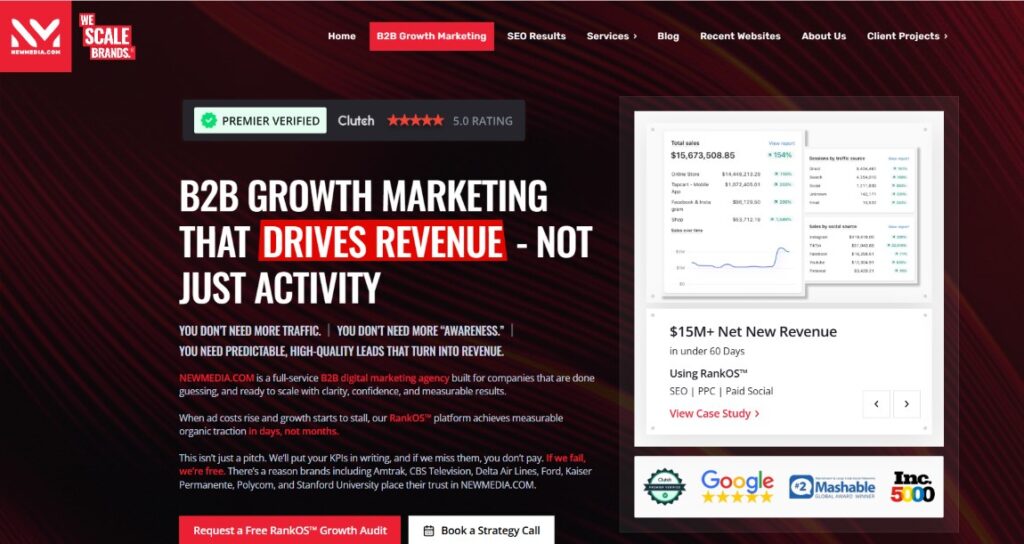
NEWMEDIA.COM operates less like a typical agency and more like a growth engineering firm.
While many firms specialize in one channel, such as paid media, SEO, or creative, NEWMEDIA.COM structures engagements around a proprietary operating system called RankOS™, designed to align acquisition, conversion, retention, and authority into a single, measurable framework.
Rather than optimizing channels in isolation, they focus on identifying the real growth constraint inside a business, whether that’s traffic quality, conversion rate, average order value, attribution gaps, or lifecycle leakage, and then re-architecting the system around it.
Their work includes enterprise SEO, performance marketing, CRO, web architecture, AI search visibility, and digital PR, but the differentiator is integration.
Paid media performance informs SEO strategy. CRO informs scaling decisions. Authority building reduces customer acquisition cost over time. Measurement sits underneath all of it.
For enterprise and growth-stage brands, this systems-first approach tends to produce clearer cause-and-effect between spend and revenue, which is often where ROI-focused teams struggle.
They also operate comfortably inside complex environments: large ecommerce catalogs, B2B sales cycles, multi-location brands, and organizations with multiple internal stakeholders.
Best suited to: Enterprise and mid-market brands that want marketing treated as an investment system, not a collection of campaigns. Especially strong for teams running meaningful budgets who need cleaner decision-making, not just more activity.
Where they add the most value:
- Enterprise SEO and search authority programs
- Paid acquisition is tied tightly to conversion engineering
- CRO and performance lift initiatives
- AI-era search visibility integrated into broader growth strategy
- Ecommerce and B2B programs where efficiency and scale must coexis
How they prove impact: Case studies consistently lead with measurable movement: revenue growth, ROAS improvement, conversion rate lift, authority expansion, and system-level performance gains.
More importantly, they explain why the lift happened, not just what improved, which makes outcomes repeatable instead of anecdotal.
Also read: Understanding the Basics of SEO (Search Engine Optimization)
2. Disruptive Advertising
Disruptive Advertising positions itself as a performance marketing partner, with a heavy focus on paid acquisition and improving what happens after the click. Their services lean into lead generation and conversion rate optimization, not just campaign management.
Best suited to: B2B teams that care about lead quality and cost control, especially companies running consistent paid programs instead of small tests. Clutch lists a $5,000+ minimum project size, which usually puts them in the “serious budget” range.
Where they add the most value: Paid search management and optimization sit at the center of the offer, with CRO work designed to lift conversion rates without relying only on higher spend. They also talk directly to B2B SaaS demand and pipeline goals, which is useful if you need marketing and sales to agree on what a good lead looks like.
How they prove impact: Proof tends to come through a mix of case studies and review-driven outcomes that highlight ROAS and cost per lead improvements.
One published example reports a revenue lift alongside a ROAS increase from a Performance Max test, and Clutch reviews frequently reference lead flow, lead quality, and efficiency gains.
3. Digital World Institute
Digital World Institute is a performance-driven SEO agency that focuses primarily on organic growth. While the team also supports web development projects when needed, SEO is the core engine behind everything they do. Their work centers on strategy, technical accuracy, and measurable ROI.
The agency works with eCommerce brands, SaaS companies, B2B firms, healthcare businesses, and local service providers, helping them turn organic traffic into predictable revenue.
Instead of tracking rankings alone, Digital World Institute builds structured growth systems: from keyword architecture and internal linking frameworks to authority building and AI-search visibility.
Best suited for: Digital World Institute is best suited for brands that care about long-term organic performance rather than quick fixes. They tend to work well with:
- eCommerce brands looking to scale category and product visibility
- SaaS companies that need structured content and topical authority
B2B firms focused on high-intent lead generation - Local service businesses competing in aggressive markets
- Companies that want strategy, not just execution
If a business wants clarity, accountability, and a roadmap, not generic monthly reports, this agency fits well.
Where they add the most value: Digital World Institute adds the most value in strategic planning and execution depth. Their strength isn’t just producing content or building links; it’s identifying revenue-aligned opportunities and structuring the site around them.
They are particularly strong in:
- SEO audits and recovery projects
- Content strategy development from zero to scale
- High-quality, authority-focused link building seo service
- AI search optimization (AI Overviews, ChatGPT visibility)
- Funnel-based keyword clustering and monetization mapping
They don’t rely solely on SEO tool metrics. Much of their strategy involves manual intent analysis, competitor breakdowns, and page-level positioning work that separates real growth from inflated dashboards.
4. KlientBoost
KlientBoost is a performance marketing agency that leans hard into paid acquisition plus conversion work, so the focus stays on what turns into leads and revenue, not just clicks. Their site also pushes a “free marketing plan” style audit that frames next steps around business goals and pacing.
Best suited to: Teams that already spend on ads and want to tighten efficiency, especially SaaS and B2B lead gen orgs that care about lead quality and follow-through. Clutch lists a $1,000+ minimum project size, which makes it accessible for mid-market budgets while still fitting larger programs.
Where they add the most value: Strong mix of PPC management and conversion rate optimization, with a lot of attention on landing pages and testing, since paid performance often gets capped by what happens after the click.
Their CRO and landing page content make it clear they treat conversion work as part of the paid program, not a separate nice-to-have.
How they prove impact: Proof usually comes through case studies and review outcomes that lead with efficiency metrics like conversion lift, CPC or CPA movement, and ROAS. One published case study reports a 50% increase in conversion volume with a 19% drop in CPC, and Clutch reviews commonly point to ROI focused improvements like lower CPA and better lead quality.
Related article: How to Improve SEO by Using CRM Software
5. SmartSites
SmartSites is a full-service digital marketing agency that covers SEO, PPC, web design, and lifecycle channels like email and SMS, so teams can keep acquisition and conversion work under one roof.
Best suited to: Companies that want a broad partner and a clear starting point, especially small to mid-market teams that need SEO and paid to work together without a huge minimum spend. Clutch lists a $1,000+ minimum project size, which keeps them accessible for smaller programs while still supporting larger accounts.
Where they add the most value: They tend to be most useful when ROI depends on the basics being right across the whole funnel, strong paid search management, solid SEO fundamentals, and a site that converts.
Their partner badges and service mix also suggest they are set up to run paid programs across major platforms alongside site work.
How they prove impact: You will mostly see case studies and client feedback that lead with performance outcomes, plus practical examples of revenue growth tied to specific channel changes.
One example they share highlights scaling an e-commerce store by 150% year-over-year in revenue, with an emphasis on conversion gains rather than simply spending more. Clutch reviews also commonly call out ROI improvement and value for cost.
6. Power Digital
Power Digital leans into performance and profitability, with an integrated mix of strategy, channel execution, creative, and measurement. Their own positioning is very ROI oriented, including language around profit, ROI, and EBITDA.
Best suited to: Mid-market and enterprise teams that want a full-service partner and have enough budget to run multiple channels with proper measurement.
Clutch lists a $5,000+ minimum project size and a 250 to 999 employee team, so this is not a small shop built for tiny ad tests.
Where they add the most value: Cross-channel programs where the goal is to connect acquisition and conversion work to business outcomes. Their service mix is broad, including CRO, marketing measurement, SEO, paid social, paid search, email and SMS, content, and PR, which fits teams that do not want five separate vendors.
How they prove impact: They publish detailed case studies with concrete numbers. One example shows Victrola reporting a 115% rise in revenue and 31K new email subscribers, alongside a multichannel service mix tied to the outcome.
7. Wpromote
Wpromote positions itself as an integrated performance agency that brings media, creative, and data together, so the plan is not split across three vendors or three disconnected reports.
Their messaging leans hard into the “brand plus bottom line” tension, which is usually what ROI focused teams care about.
Best suited to: Mid-market and enterprise brands with meaningful spend and a longer decision cycle, where you need tight measurement and steady execution across channels. Clutch lists a $10,000+ minimum project size, so it’s typically not aimed at small test budgets.
Where they add the most value: Wpromote tends to be strongest when performance depends on coordination, meaning paid media, creative testing, and conversion work are planned together instead of handled in silos. They also publish content on aligning CRO with paid media, which signals they think beyond media buying and into what happens after the click.
How they prove impact: Their case studies usually lead with business outcomes and efficiency metrics, not vague reach wins. For example, they share a Hibbett case study that highlights a 40% improvement in ROAS, and other case studies focus on growth in ecommerce revenue and acquisition outcomes.
8. Ignite Visibility
Ignite Visibility is a full-service performance marketing agency that runs SEO and paid media alongside supporting channels like email, CRO, and digital PR, so the work is not split across five vendors.
Best suited to: Mid-market and enterprise teams with enough budget to run a real program, not a short test. Clutch lists a $10,000+ minimum project size, which usually signals longer sales cycles and more stakeholders.
Where they add the most value: They tend to be strongest when ROI depends on coordination across channels, like pairing paid acquisition with landing page and conversion work, while SEO supports the same revenue pages and offers.
Their service mix is broad enough to keep that connected.
How they prove impact: They publish a steady stream of case studies that lead with measurable lifts, like conversion gains and revenue outcomes, plus third-party reviews that echo similar results.
9. Seer Interactive
Seer Interactive is a data-heavy marketing agency that pairs SEO and paid media with serious analytics work, which is a practical combo when leadership wants answers, not more charts.
They also position themselves as a B Corp and call out a large enterprise client base and high retention, which signals they are used to long-term programs.
Best suited to: Enterprise and mid-market brands with complex tracking needs and enough budget to run a real program. Clutch lists a $10,000+ minimum project size and $200 to $300 hourly rates, so they tend to fit teams past the early testing phase.
Where they add the most value: Measurement and decision support is where Seer stands out, especially when a team needs clean conversion tracking, dependable reporting, and a “source of truth” to steer spend and priorities.
Their analytics practice is positioned around actionable insights and advanced measurement, which pairs well with SEO and paid work when the goal is ROI, not activity.
How they prove impact: Their case studies tend to lead with business numbers, like revenue tied to paid media changes, ROI lifts from remarketing, and conversion gains from CRO work.
Examples on their site include a remarketing case study tied to a 23% higher ROI and $1.69M in revenue, a paid opportunity analysis tied to $2.2M in additional revenue, and CRO outcomes as large conversion increases on key landing pages.
10. JumpFly
JumpFly is a digital marketing agency with a heavy performance focus, covering paid search and display, SEO, paid social, Amazon ads, email, and conversion work.
They also publish a dedicated case study library, which makes it easier to see how they think about results.
Best suited to: Teams running consistent paid programs that want tighter lead and revenue efficiency, especially once you are past small one-off tests. Clutch lists a $5,000+ minimum project size, which usually lines up with steady monthly spend and longer-term optimization.
Where they add the most value: PPC management sits at the center of the offer, with support across major ad platforms and budgets, plus related services that help conversion performance keep up with spend.
Their service mix also includes Amazon and marketplace programs, which are useful for brands managing both direct response and commerce channels.
How they prove impact: Their case studies often lead with conversion volume, conversion value, and ROAS movement. One example reports a 16% lift in conversion volume, a 104% lift in conversion value, and a 55% improvement in ROAS across Google and Microsoft campaigns.
11. Directive Consulting
Directive is positioned around B2B performance marketing that ties work back to a qualified pipeline, not vanity metrics. Their “Customer Generation” framing shows up across services like paid media and SEO, with a clear focus on revenue outcomes.
Best suited to: B2B brands with longer sales cycles and enough internal support to implement changes consistently. Budget-wise, their Clutch profile lists a $5,000+ minimum project size, with many engagements commonly landing in the $10,000 to $49,999 range.
Where they add the most value: Programs where paid and organic need to work together instead of competing, especially when leadership wants a clean line from spend to pipeline. Their service positioning leans into aligning marketing to revenue goals, not just lead volume.
How they prove impact: They publish success stories with specific lifts, like 70% traffic growth and 200% demo growth for one client, plus a separate example that calls out a 50% lift in paid search conversions from a focused page layout change.
Also, Clutch reviews talk about measurable movement in areas like cost per click, conversion rate, organic traffic, and overall ROI.
12. Jellyfish
Jellyfish is a global, integrated digital marketing agency that brings media, creative, and data under one roof, which helps when performance depends on teams working off the same plan and the same numbers.
Best suited to: Mid-market and enterprise brands running multichannel programs, especially if you need search and measurement to stay coordinated across markets. Clutch lists a $5,000+ minimum project size for their US profile.
Where they add the most value: They are a strong fit when ROI depends on tightening the full search loop, aligning paid and organic, cleaning up reporting, and improving bidding and targeting using first-party and CRM signals.
Their “One Search” work is a good example of that direction.
How they prove impact: Their success stories tend to show clear efficiency and revenue style outcomes, like a +39% ROAS lift for a Performance Max push, a +79% lift in activations paired with +17% ROAS, a 23% CPA reduction, and a global search program showing 14% lower paid media investment alongside 19% incremental growth across 38 markets.
13. Merkle
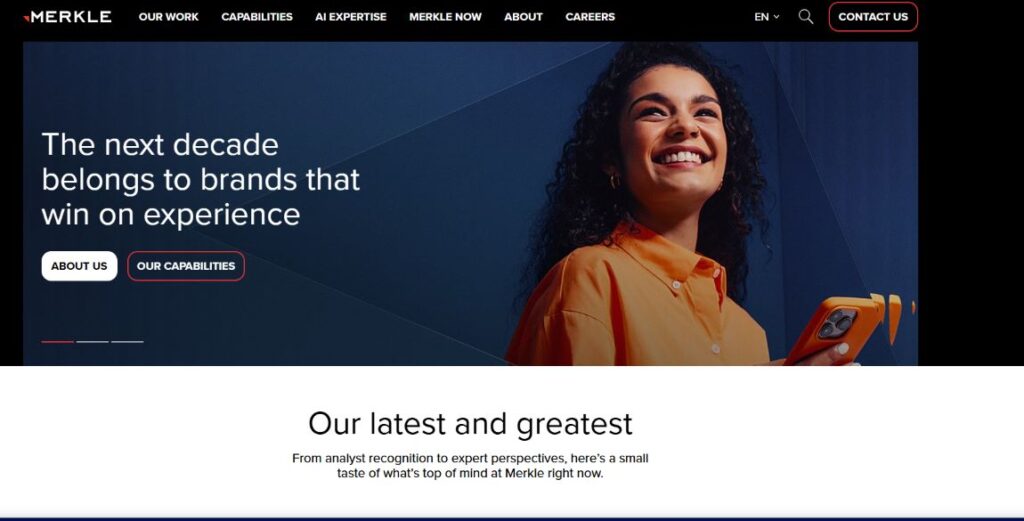
Merkle is a large, global agency known for blending marketing with data, analytics, and tech enablement. The pitch is less “campaigns” and more “systems,” meaning measurement, attribution, and customer data foundations that make performance easier to manage at scale.
Best suited to: Enterprise and upper mid-market brands with complex stacks, multiple markets, and enough budget to run a real program. Clutch lists a $5,000+ minimum project size and an enterprise-sized team, which usually signals they are not built for small, short tests.
Where they add the most value: Merkle tends to shine when ROI depends on clean data and better decision making, not just more spend. It includes analytics and ad tech setup, attribution and measurement work, and commerce-focused reporting that helps teams move budgets based on what is driving revenue and margin.
How they prove impact: Their case studies often lead with business metrics tied to measurement improvements. One example highlights a custom attribution model that increased ROAS by 93%, and another case study calls out more than $5M in revenue in year one from performance improvements tied to digital shelf analytics work.
14. VaynerMedia
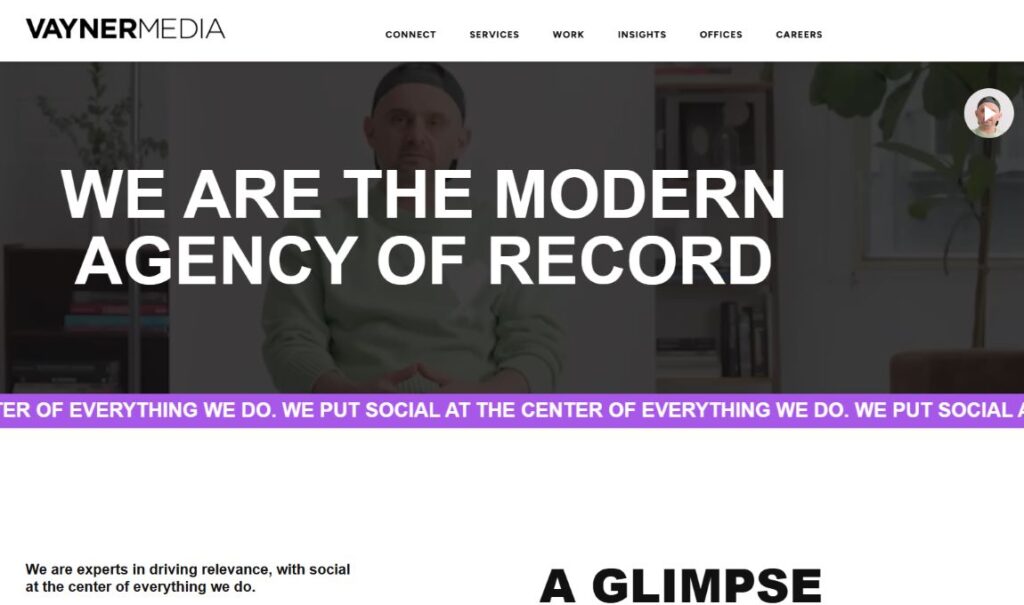
VaynerMedia is a social-first agency that blends creative, media, commerce, analytics, and influencer work, with social as the starting point instead of an add-on. If a brand lives and dies on attention and conversion inside feeds, their model lines up well with that reality.
Best suited to: Mid-market and enterprise consumer brands that need social to drive both brand demand and sales, and that have the budget to run multichannel programs consistently. Clutch lists a $10,000+ minimum project size, so this is rarely a fit for small experiments.
Where they add the most value: They tend to shine when creative and media have to work together, especially on social and commerce-led campaigns where the creative has to earn attention, and the spend has to earn its keep.
Their service mix also covers commerce and influencer, which helps when the conversion path runs through creators, affiliates, or social shopping.
How they prove impact: Their proof often looks like campaign-level outcomes tied to growth and efficiency. One case study highlights +1B social impressions, +500K followers, and double-digit sales growth versus a primary competitor for Mug Root Beer.
Another shows Opendoor reaching 2x more consumers at significantly less spend, with 2x higher engagements versus the prior year.
15. NP Digital
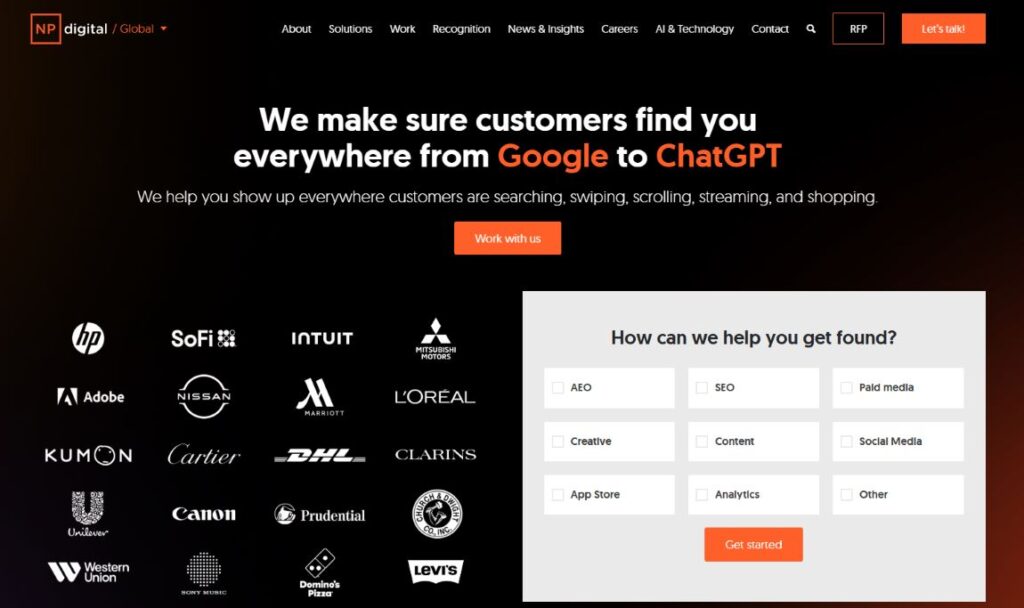
NP Digital is a large performance marketing agency that covers SEO, content, paid media, CRO, email, and analytics, so teams can run acquisition and conversion work under one partner instead of stitching together multiple specialists.
Best suited to: Mid-market and enterprise brands that need a mix of organic and paid growth, plus enough internal alignment to keep changes moving. Clutch lists a $1,000+ minimum project size, but their team size and client mix point to bigger, ongoing programs.
Where they add the most value: They are a strong match when the job is scalable. That can mean enterprise SEO and content strategy across large inventories, plus paid media programs that get paired with conversion work, so performance improves without relying only on higher spend.
Their work examples include enterprise SEO outcomes and paid search lifts that are tied to revenue and efficiency.
How they prove impact: Their case studies lead with concrete numbers. Examples include a CNN engagement that cites more than 1 billion page views in a calendar year and a 91% increase, and a ZAGG paid search case study that cites a 28% lift in revenue, a 38% efficiency improvement, and an 18% drop in cost per conversion.
16. Thrive Internet Marketing Agency
Thrive is a full-service agency that covers the usual growth stack, including SEO, paid search, social, web design, and CRO, so you can keep acquisition and conversion work coordinated instead of splitting it across vendors.
Best suited to: Small to mid-market teams that want a broad partner, plus brands ready to invest beyond starter SEO, since their published budget ranges start in the low thousands per month, and Clutch lists a $1,000+ minimum project size.
Where they add the most value: Programs where lead flow depends on both traffic and site performance, because they pair channel work like PPC and SEO with conversion rate optimization and web support that can remove obvious drop-offs after the click.
How they prove impact: Thrive leans on a case study library with clear outcome metrics, including examples that call out ROAS and revenue from paid media programs, rather than vague “visibility” wins.
17. LYFE Marketing
LYFE Marketing is known for social media management and paid social, with extra coverage across PPC, email, and SEO when a program needs more than one channel.
The positioning is practical, focused on campaigns that push traffic, leads, and sales, not just engagement.
Best suited to: Small to mid-sized businesses that want consistent execution and clear reporting, especially if your budget sits in the low thousands per month. On Clutch, their minimum project size is listed at $1,000+ with an average hourly rate of $50 to $99, and review-based pricing notes often land around $500 to $1,200 per month.
Where they add the most value: Social media tends to be the core, both organic management and paid campaigns, with retargeting and conversion-focused ad work as the common ROI lever.
Additionally, they offer PPC and email services, which help when paid and follow up need to work together, instead of living in separate tools and separate teams.
How they prove impact: They share campaign style proof with real numbers, like budget, CPC, purchases, ROAS, and revenue. One portfolio example shows a $3,500 monthly spend tied to 317 purchases, 6.95 ROAS, and $24,756 in revenue, and their broader ecommerce examples include a case citing 5,890 purchases and a 539% return on investment.
The Scorecard We Use to Rank ROI-Focused Firms
Most “best agency” lists are basically vibes. A logo carousel, a few nice sentences, and no real explanation for why one firm made the cut, and another didn’t. We don’t like that approach, and we don’t trust it when I’m the one doing the hiring.
So for this 2026 list, we used a simple scorecard; the same filter I’d use if I were picking a partner for my own company.
Here’s what we looked at.
First, we checked whether the firm is revenue-first. That means they talk about pipeline, sales velocity, CAC, LTV, retention, and conversion rate with the same confidence that most agencies talk about impressions and clicks.
Next, we looked for proof, not just case studies that cherry-pick results, but evidence of repeatable wins. The best agencies can show outcomes across different clients, explain what was unique versus what was part of their process, and back their claims with clean tracking.
We also scored each firm on strategy depth. Some agencies are great executors but weak strategists. That’s fine if you already have a strong internal growth lead. But if you’re hiring an agency because you need clarity, the firm has to be able to diagnose the business, find the real constraint, and build a plan that isn’t just “do more content” or “spend more on ads.”
Finally, we paid attention to how they operate as partners. The strongest firms are honest about what they won’t do, what they’re not great at, and what needs to be true for the engagement to succeed. They push back when your plan is wrong. They don’t hide behind dashboards, and they don’t inflate numbers to keep you paying.
How to Run a Fair Agency Evaluation Process
Start by giving every agency the same inputs. Share the goal, budget range, sales cycle, target customer, current channels, and any real constraints like limited engineering time or long approvals. If you cannot share exact numbers, give ranges. The point is keeping the playing field level.
Ask for a simple 90-day plan. Look for priorities, assumptions, and what they need from your team to get work done. Strong answers call out tradeoffs and sequencing, not a long list of everything they could do.
Use one scorecard for everyone. Keep it focused on measurement, strategy, execution, conversion, creative support, reporting style, and proof. Meet the actual account team as well, since execution depends on who runs the work week to week.
Finish with a clean first phase. A short pilot or a defined kickoff scope keeps the decision tied to what gets shipped, not promises.
The Key Takeaways
ROI-focused digital marketing gets easier once you stop tracking the “best” agency on paper and start looking for the right fit. Applying proven digital marketing hacks to maximize ROI starts with choosing a partner that matches your budget, sales cycle, and ability to implement changes quickly. The right agency should also prove its impact through accurate measurement, transparent reporting, and a results-driven strategy.
Keep the evaluation process fair and simple. Give every firm the same inputs, ask for a short 90-day plan, meet the team who will actually run the work, and start with a tight first phase. If the agency can deliver early wins and explain them clearly, the long-term partnership usually takes care of itself.
%201.png)

%201.png)

%201.png)