
Data-security budgets and threat volumes are rising in lock-step. PwC's 2026 Global Digital Trust Insights survey found that 78% of organisations will increase their cyber spend this year, with Artificial Intelligence vs. Cybersecurity dynamics topping the priority list at 36%.
At the same time, interactive intrusion activity jumped 60% year-over-year in 2023, including a 73% spike in the second half of the year.
Manual controls simply can’t keep pace.
The seven platforms below show how AI is being weaponized for good—by discovering sensitive data, classifying context, and triggering real-time defenses before breaches spiral out of control. Copla combines GRC, cybersecurity, and compliance capabilities to help organizations manage security and regulatory requirements from a centralized platform. Its compliance management software helps teams organize compliance requirements, manage controls, collect evidence, and maintain ongoing audit readiness.
Why AI-Powered Data Security Is No Longer Optional
- Market momentum. The AI-in-cybersecurity market was valued at USD 34.09 billion in 2025 and is projected to skyrocket to USD 213.17 billion by 2034 (21.7% CAGR).
- Human error persists. 74% of data breaches involve the human element—social-engineering, misuse, or simple mistakes. AI augments fatigued analysts and automates routine hygiene.
- Patch gaps remain. 47% of breaches stem from unpatched vulnerabilities, and 56% of organizations still remediate manually.
OutrightCRM frequently spotlights practical AI roll-outs, such as its guide to AI tools for free content generation. Data security requires a similarly pragmatic embrace of machine learning.
Evaluation Framework: 5 Criteria You’ll See Referenced Below
- Breadth of data discovery & classification (cloud, on-prem, SaaS)
- Real-time risk scoring and alerting accuracy
- Automated remediation & workflow integrations (SOAR/ITSM)
- Zero-trust architecture compatibility
- Deployment speed & total cost of ownership (TCO)
Keep this checklist handy as we compare vendors.
The 7 AI Data Security Platforms
1. Cyera
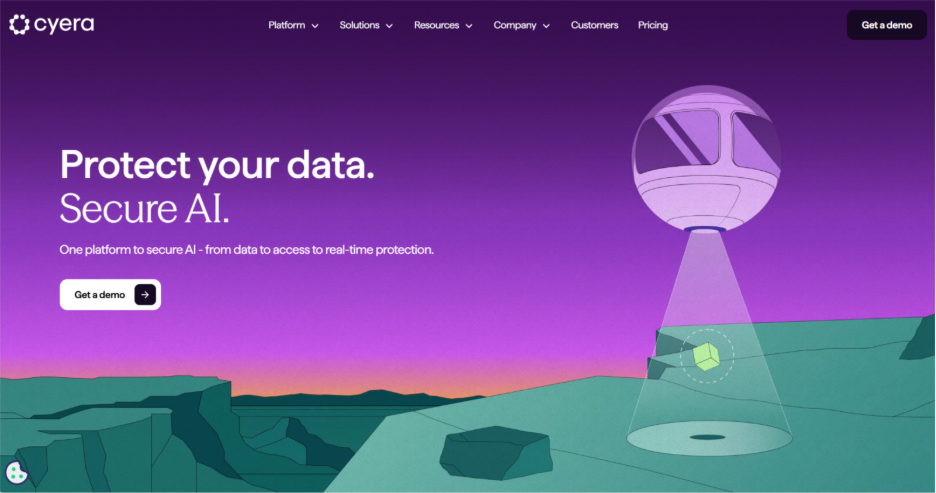
Enterprises drowning in multi-cloud assets often start their zero-trust journey without knowing where sensitive data actually lives. Cyera addresses that blind spot first: its agentless scanners map data across AWS, Azure, GCP and on-prem databases, then apply context-aware classification so policies follow the data—not the other way around.
- Key AI differentiator: Cyera uses generative-AI models to enrich discovery when metadata is sparse.
- Stand-out use case: At a leading U.S. mortgage lender, Cyera quickly discovered and classified 3000+ data stores, giving the security team the visibility to identify and remediate over-permissive access while supporting compliance with GLBA.
- Caveat: Cyera takes a data-centric rather than perimeter-centric approach, which may require teams used to network- or endpoint-led models to adjust to a data-first workflow.
- Pricing note: Cyera offers usage-based subscriptions (pricing on request); analysts note it is generally positioned for mid-market and enterprise budgets.
Taken together, these strengths make Cyera a logical first shortlist entry for CISOs who need discovery and classification foundations before they can even think about automation.
2. Wiz
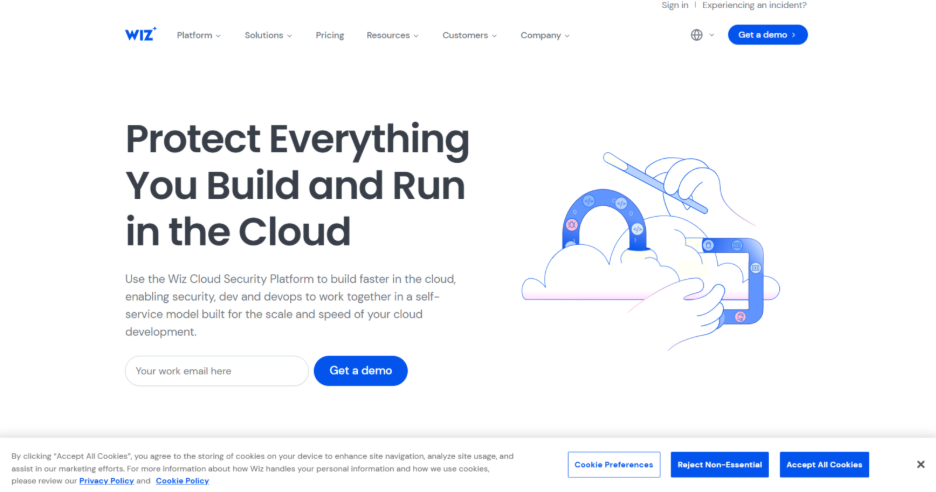
Originally a cloud-security posture management (CSPM) tool, Wiz has layered rich data-security features on top of its agentless architecture. The platform ingests cloud-provider telemetry at scale, correlating identity, network and data layers to surface toxic permission combinations.
- Key AI differentiator: Graph-based analysis weighs exploitability, prioritising data-exposure risks that attackers could actually chain together.
- Stand-out use case: Financial-services teams use Wiz’s “no-agent” design to audit highly regulated environments without violating golden-image rules.
- Caveat: On-prem datasets need third-party connectors, which can dilute the single-pane-of-glass message.
- Pricing note: Tiered per-cloud-asset; enterprises often bundle with existing Wiz CSPM contracts.
If your biggest headache is cloud sprawl, Wiz offers quick wins while maintaining momentum toward a zero-trust perimeter.
3. Varonis
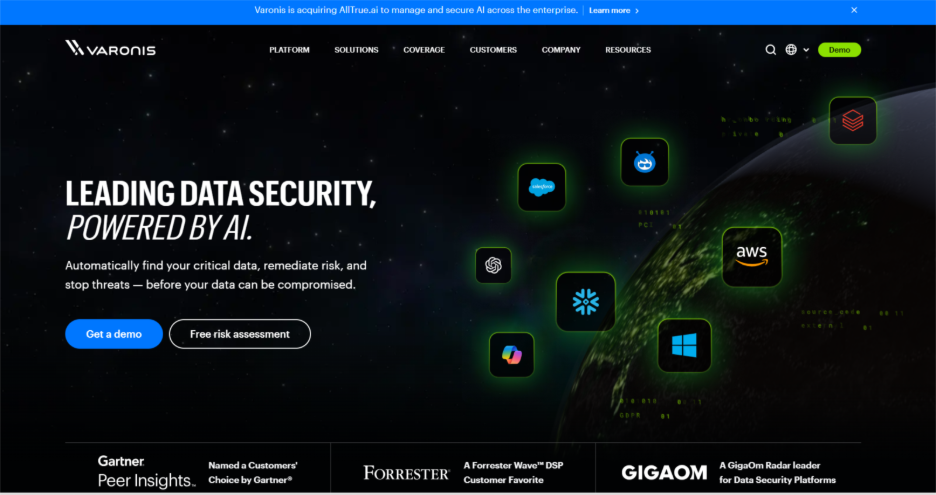
Varonis carved out the unstructured-data niche long before cloud-native players arrived. Its latest AI models build behaviour baselines across file systems, detecting insider misuse and permission creep that older role-based tools overlook.
- Key AI differentiator: User & entity behaviour analytics (UEBA) score anomalous access to sensitive folders in real time.
- Stand-out use case: A media conglomerate caught a departing employee mass-downloading scripts 30 minutes before exit.
- Caveat: Heavy Windows File-Server focus means organisations shifting to SaaS repos may need parallel tooling.
- Pricing note: Licensed per monitored server/share, plus optional DatAdvantage modules.
For firms with petabytes of legacy file shares, Varonis remains the gold standard for unstructured-data governance.
4. Laminar
Born in the public cloud, Laminar emphasises “runtime” visibility: scanning data stores continuously—rather than on a scheduled crawl—to flag rogue snapshots or open S3 buckets the moment they appear.
- Key AI differentiator: ML models distinguish legitimate data flows from suspicious exfiltration in near real time.
- Stand-out use case: An e-commerce unicorn slashed mean-time-to-detect S3 misconfigs from days to minutes after deployment.
- Caveat: SMBs may find advanced features (e.g., Kubernetes data taps) overkill relative to price.
- Pricing note: Metered on data processed; entry level around USD 45k per annum.
If speed of detection is your north star—and your workloads live predominantly in cloud object stores—Laminar deserves serious attention.
5. Symmetry Systems
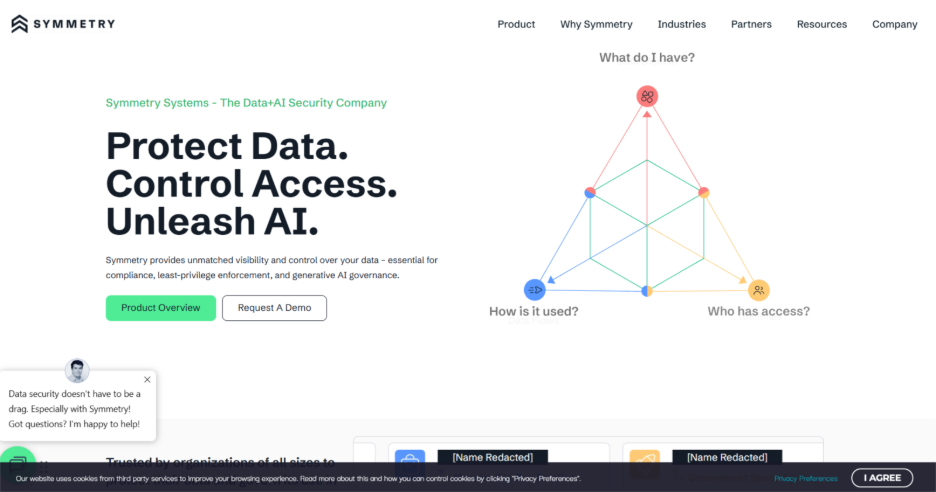
Symmetry’s DataGuard takes a graph-based approach, mapping relationships between identities, objects and policies at an object level. Security teams can run “what-if” simulations before they roll out new IAM rules.
- Key AI differentiator: Path-search algorithms surface the shortest route an attacker could take from a low-privilege account to crown-jewel data.
- Stand-out use case: A SaaS provider used simulation reports to convince auditors its least-privilege redesign reduced reachable sensitive objects by 92%.
- Caveat: Requires read-only IAM access to each cloud; some enterprises face procurement hurdles.
- Pricing note: Annual commitment based on number of cloud accounts under management.
For architects framing zero-trust as a “data perimeter,” Symmetry brings quantitative clarity to design discussions.
6. BigID
Privacy regulations drove BigID’s early adoption, and the vendor has doubled down on applying AI to personal-data discovery and consent tracking. Its ML classifiers recognise over 400 PII and PHI patterns out of the box.
- Key AI differentiator: NLP models map semantic context (e.g., “employee grievances”) rather than shallow keyword matches.
- Stand-out use case: A European retailer generated GDPR Article 30 records in hours, not weeks, by automating data-mapping workflows.
- Caveat: Enterprises seeking deep threat-detection hooks may need to integrate BigID with SIEM/SOAR tools for enriched alerting.
- Pricing note: Module-based; privacy, security and governance bundles sold separately.
If regulatory reporting keeps you up at night, BigID shortens compliance cycles and builds an authoritative data inventory you can feed into other security stacks.
7. IBM Guardium Insights
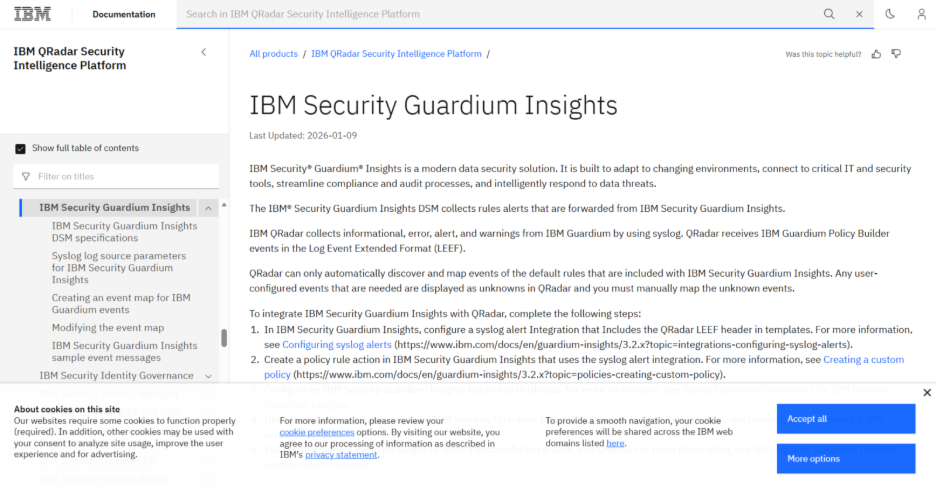
IBM’s latest Guardium iteration shifts from appliance roots to a SaaS analytics layer capable of ingesting logs from disparate databases—mainframe to MongoDB—into a unified behaviour model.
- Key AI differentiator: AutoML pipelines baseline query patterns, flagging abnormal volumes or exfil-like selects.
- Stand-out use case: A Fortune 100 insurer correlated DB2 logs with Snowflake activity to trace credential stuffing attempts across hybrid estates.
- Caveat: Full feature set requires IBM Cloud Pak licensing for orchestration, inflating TCO if you’re not already an IBM shop.
- Pricing note: Capacity-based (virtual processing units) plus optional long-term retention add-ons.
Guardium’s breadth makes it a safe bet for highly heterogeneous data landscapes where few single-vendor tools can reach every corner.
Implementation Roadmap: From Pilot to Enterprise Roll-Out
- Proof of Value (Weeks 0-4). Choose one high-risk business unit, integrate the shortlisted platform’s discovery scan, and measure coverage within 72 hours.
- Limited Domain Expansion (Weeks 5-12). Automate ticket routing into existing ITSM/SOAR queues; require risk owners to remediate the top 10 findings.
- Organization-Wide Roll-Out (Quarter 2). Connect remaining cloud accounts and on-prem stores; enforce policy through CI/CD guardrails.
Remember: Interactive intrusion activity is climbing 60% year-over-year according to CrowdStrike's report.
Quick wins in the first 90 days build momentum and executive trust.
Caveats & Counterpoints
Even with shiny AI dashboards, only 6% of companies consider themselves “very capable” of withstanding attacks across every vulnerability area. Over-reliance on automation can mask misconfigurations; human review of detection rules and policy baselines remains non-negotiable.
CISOs must also weigh data-residency implications—some vendors train models in shared clouds—and demand transparency on how models treat sensitive payloads.
Conclusion
AI won’t replace seasoned security pros, but it will absolutely replace teams that fail to leverage it. Use the five-point framework above to narrow the field, pilot one or two platforms, and address quick-hit exposures.
Start with Cyera if you lack a unified data inventory; explore niche tools like Laminar or Symmetry as your architecture matures. The attack surface won’t wait—your tooling shouldn’t either.
%201.png)

%201.png)

%201.png)