
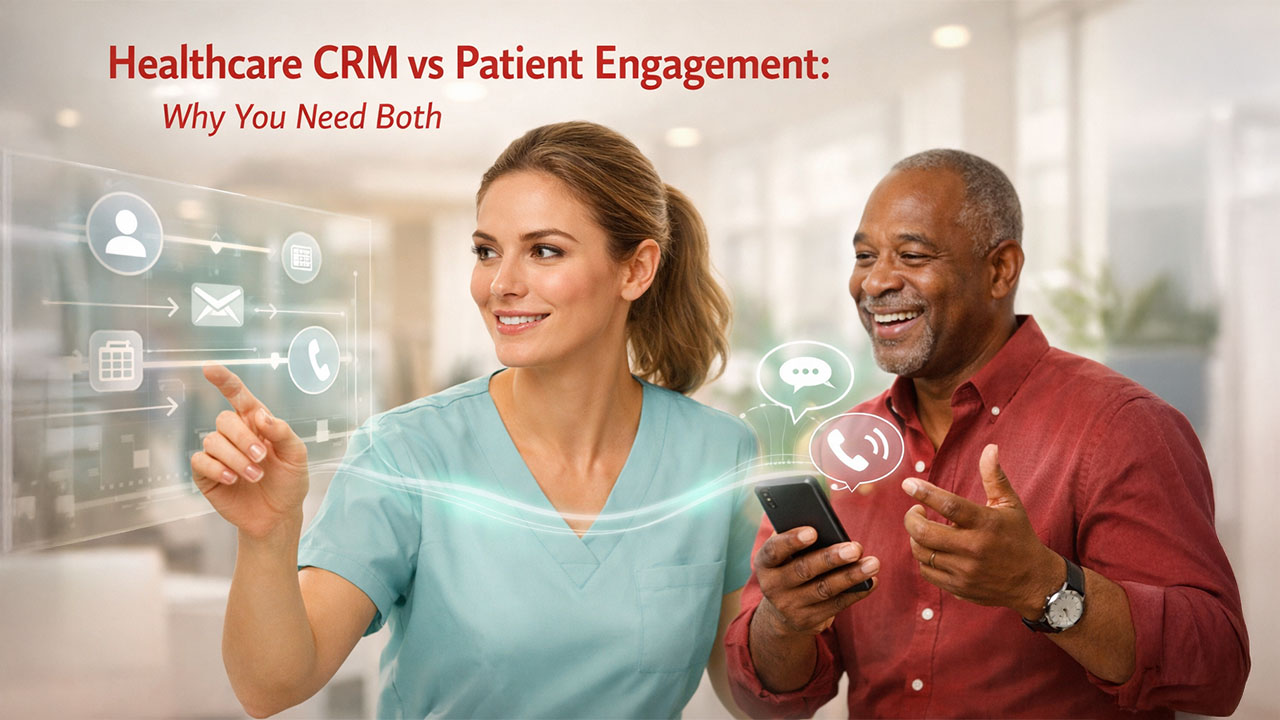

There is a conversation happening in healthcare leadership right now that is causing a lot of unnecessary confusion. It usually starts when a practice administrator or CIO asks a simple question: do we need a CRM or a patient engagement platform? When you break down Healthcare CRM vs Patient Engagement as a question, you quickly realize it is not really a choice between two competing tools — it is a question about how two complementary systems work together.
These are not competing solutions. They are complementary infrastructure. And the organizations that have figured that out are seeing results that the ones still choosing between them simply cannot match.
What a Healthcare CRM Actually Does
A CRM in healthcare is fundamentally a data management and relationship tracking system. It centralizes patient records, tracks interaction history, manages referral pipelines, supports marketing campaigns, and gives administrators a single view of the patient relationship across time. It answers questions like: who are our patients, how did they find us, when did they last visit, and what is their status in our care pathway?
Good healthcare CRM software integrates with billing platforms, supports segmentation by diagnosis or demographics, and helps organizations identify patterns in patient behavior at the population level. For practices managing large patient volumes across multiple locations, a CRM is the operational backbone that keeps relationship data organized and accessible.
What a CRM is not, in most implementations, is a real-time communication engine. It stores relationships. It does not necessarily activate it.
What a Patient Engagement Platform Does Differently
A patient engagement platform is built around a different core function: initiating and managing conversations with patients at every stage of the care journey. Where a CRM asks "who is this patient and what is their history," an engagement platform asks "what does this patient need to hear right now and how do we reach them."
Modern patient communication software operates across SMS, voice, and web chat simultaneously. It triggers automated outreach based on live clinical data, sends appointment reminders, collects pre-visit intake information, delivers post-visit follow-up, and manages population health campaigns targeting patients overdue for specific screenings or care interventions. It does not wait for a staff member to initiate a task. It runs continuously in the background, acting on real-time signals from the patient record.
The distinction is the difference between a system that knows your patients and a system that talks to them.
Where Most Healthcare Organizations Get Stuck
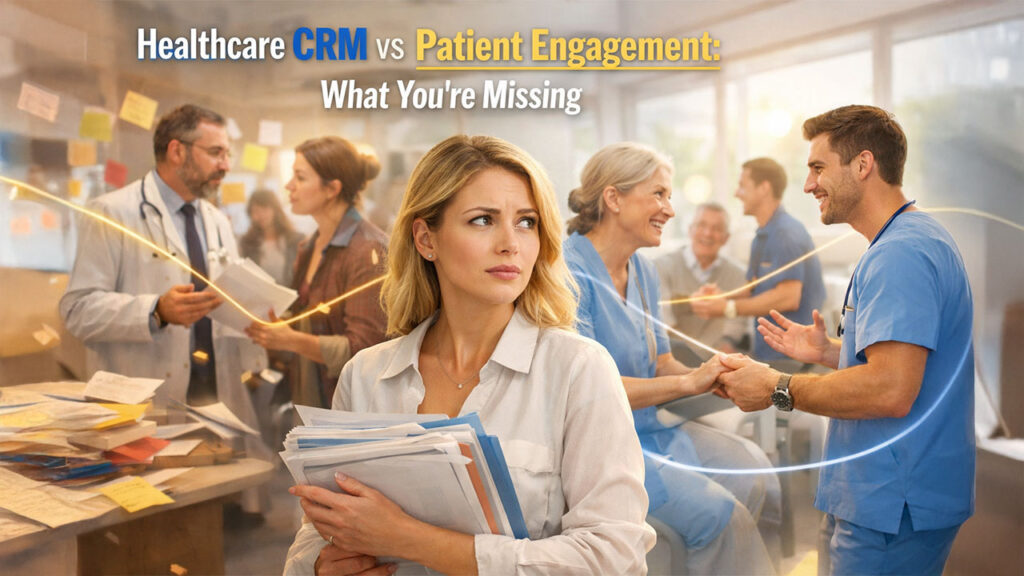
Understanding the Healthcare CRM vs Patient Engagement dynamic is where many practices first go wrong. The mistake many practices and health systems make is assuming their CRM covers patient communication because it has an email functionality or a basic reminder feature. Those capabilities exist, but they are not the same as a purpose-built engagement infrastructure. A CRM email blast sent to a segmented patient list is categorically different from an AI-driven outreach campaign that identifies patients with open care gaps and initiates personalized conversations in their preferred language through their preferred channel without any manual intervention.
Similarly, some organizations assume their patient engagement platform replaces the need for CRM because it tracks communication history. It does not. Managing the full scope of a patient relationship, from referral source tracking to lifetime value analysis to multi-provider care coordination, requires the depth of data architecture that a CRM provides.
When organizations try to force one tool to do the job of both, they end up with a system that does neither particularly well.
The Integration Layer Is Where the Real Value Lives
The organizations seeing the strongest results from both tools are the ones that have connected them. When CRM data flows into a patient engagement platform, the outreach becomes dramatically more intelligent. A campaign targeting diabetic patients overdue for an A1C check can be filtered by location, primary care provider, communication preference, and last contact date, all pulled from CRM data, and then executed automatically through the engagement platform via SMS or voice.
That combination produces outcomes that neither tool achieves alone. The real lesson of Healthcare CRM vs Patient Engagement is not which one wins — it is that the CRM provides the targeting intelligence while the engagement platform provides the execution capability. Together they create a closed loop where patient relationship data continuously improves the quality of patient communication and patient communication data continuously enriches the relationship record.
The Question Worth Asking Instead
Rather than asking whether your organization needs a CRM or a patient engagement platform, the more productive question is: how well are your current tools connected, and where is patient data sitting idle instead of driving action?
The practices pulling ahead in patient retention, care gap closure, and operational efficiency are not doing so because they picked the right single tool. They are doing so because they stopped thinking about Healthcare CRM vs Patient Engagement as an either-or decision and started building an infrastructure where each system makes the other more powerful.
%201.png)

%201.png)

%201.png)