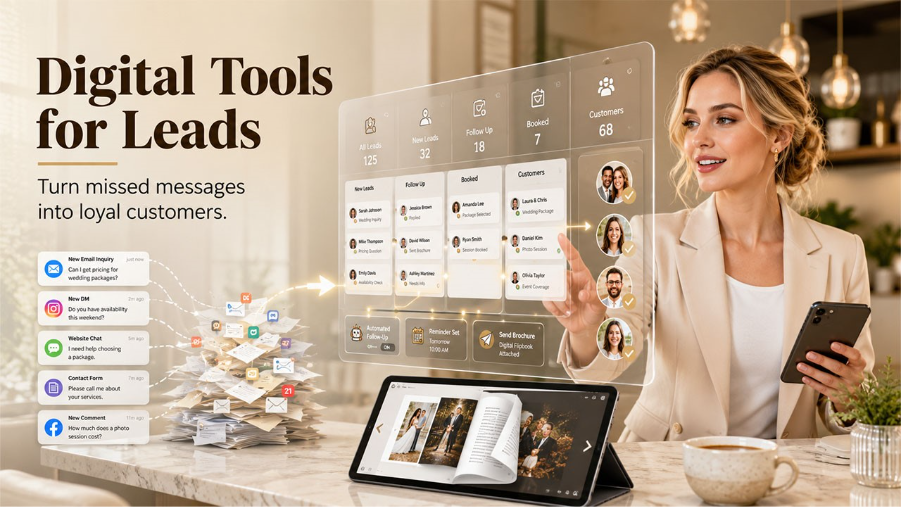

Most small businesses don’t really struggle with getting attention. People ask questions, send messages, and show interest. That part usually works fine.
The problem starts after that. Someone writes once, and then the conversation slowly fades. Not because they weren’t interested, but because things weren’t handled at the right moment or got a bit scattered.
That’s where leads get lost without anyone really noticing.
Presenting your offer in a way that’s easy to explore
A lot of businesses still rely on sending PDFs or simple attachments when someone asks for more information. On a computer, it’s fine. On a phone, it’s often not. People zoom in, scroll too much, and sometimes just stop looking.
What tends to work better is giving people something they can move through easily, without effort or extra steps.
Any brochure or product list can be converted using a flipbook maker into an interactive online format that feels like flipping through a small booklet. Users can open it, browse pages, quickly find what they need, and share online.
And often, that small change is what keeps someone reading instead of leaving halfway through.
Timing is usually the real difference
There’s a noticeable gap between replying quickly and replying “when there’s time.”
When someone shows interest, they are usually still thinking about it in that moment. If they get a fast answer, the conversation continues naturally. If they wait too long, attention shifts somewhere else, and it becomes harder to bring them back.
Digital tools help here by keeping incoming messages visible and easier to manage. Some systems also highlight new leads or suggest quick responses so nothing sits unnoticed for too long.
It’s not about rushing. It’s more about not letting small delays break the conversation.
When leads are scattered, things slip

In many small businesses, leads don’t live in one place. Some are in email threads, others on social media, and a few are just remembered by someone on the team.
That works fine when the volume is low. But once things get busier, it becomes easy to forget who was waiting for a reply or who already asked a follow-up question.
Having a single place where all leads are stored changes that. You can see the full context in one view: who contacted you, what they asked, and what happened last.
It removes a lot of guessing.
Also Read: The Best Wireframing Tools to Speed Up Your Design Workflow
Most people don’t decide on the first message
Very few customers make a decision right away. Even when they’re interested, they usually pause, compare options, or simply delay the decision.
That pause is where follow-ups matter.
The issue is that follow-ups are easy to forget when you’re busy. A day passes, then a week, and the conversation just ends without a clear reason.
Simple reminders help avoid that. They can prompt you to check in later, send a short message, or reconnect if someone hasn’t replied.
A lot of sales only happen after that second or third touchpoint.
Not every lead behaves the same way
Some people are ready to buy immediately. Others are still exploring. Treating them the same way doesn’t really work.
When leads are grouped simply, it becomes easier to see what’s actually happening. For example, someone might be new, someone else might be close to deciding, and another person might just be browsing.
That small separation helps you decide where to spend your time instead of reacting to everything the same way.
Small automation takes pressure off daily work
A lot of repetitive work in sales isn’t obvious at first. It’s copying details, sending similar replies, or remembering to follow up later in the week.
Automation helps reduce those small tasks. A message can be sent automatically when someone reaches out. Details can be saved without having to type everything again. A reminder can appear at the right time.
None of this replaces personal communication. It just clears space so conversations don’t get lost in small tasks.
When things are structured, conversations move better
There’s a clear difference between managing leads in a loose way and having a structured process.
When things are organized, replies happen faster, follow-ups don’t get missed, and fewer conversations drop off without explanation.
Customers feel that difference too. Even small things like a timely reply or a clear follow-up can make a business feel more dependable.
And that often influences the decision more than anything else.
You usually don’t need complicated systems
There’s a tendency to think that better sales require complex tools or heavy systems. In practice, that’s rarely the case.
Most small businesses just need a simple way to keep track of leads, remember conversations, and know when to follow up.
Once that’s in place, everything else becomes easier to manage.
Final thought
Most lost sales don’t happen because people weren’t interested. They happen because something small breaks in the process, a delay, a missed message, or a forgotten follow-up.
Digital tools help keep that process steady. They don’t change how people sell. They just make sure conversations don’t disappear halfway through.
And when that happens less often, more leads naturally turn into customers.
%201.png)

%201.png)

%201.png)