
If you’ve spent time researching business software, you’ve probably run into the CRM vs CSM debate and wondered whether you actually need both or just one. It’s a common point of confusion, especially since the two tools often get lumped together even though they’re built to solve different problems.
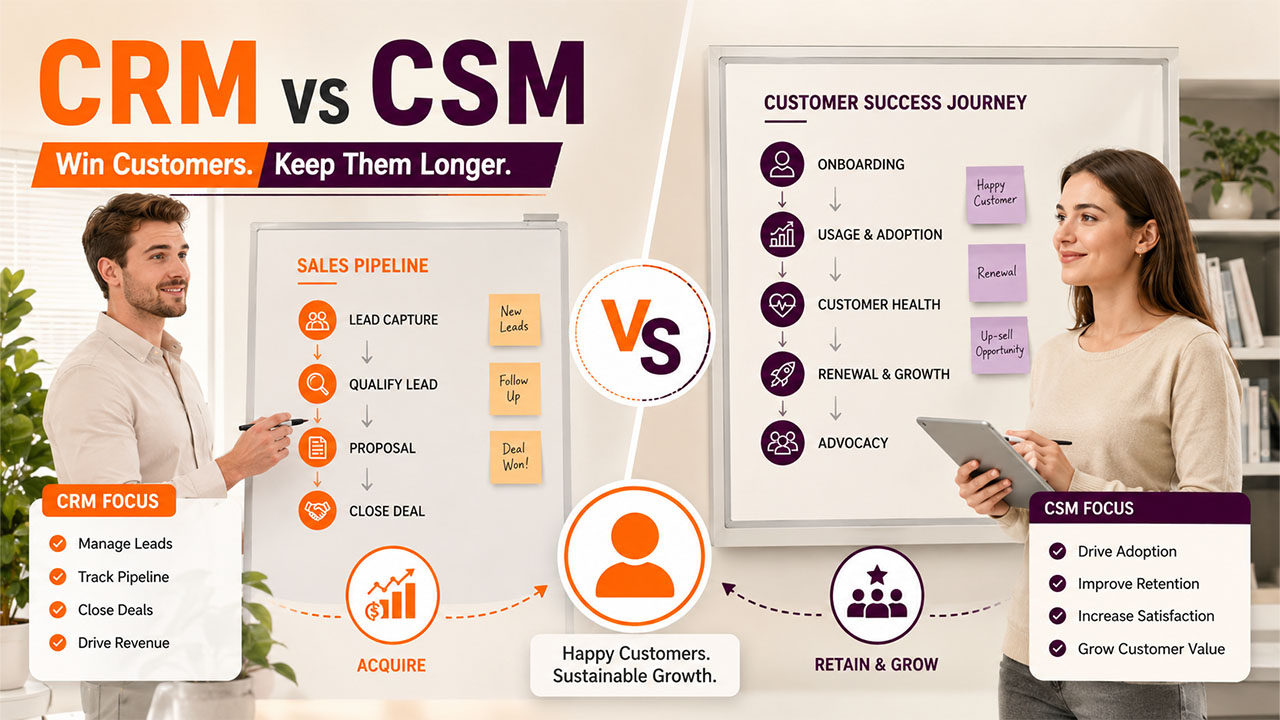
To be exact, Customer Relationship Management is focused on the management of sales, leads, and the relationship of your company with its clients as a whole. As for Customer Success Management, its task lies in the post-sale support of clients’ activity and the extraction of value from their purchase.
In this one, we’ll break down what each tool actually does, where they overlap, where they differ, and how to figure out which one (or both) your business actually needs.
What Is CRM vs CSM?
Let’s start with the basics, since the confusion usually comes from these two tools sounding like they’re doing the same job when they’re really not.
CRM stands for Customer Relationship Management. It’s the software businesses use to track leads, manage the sales pipeline, and keep a record of every interaction a customer has had, from that very first email all the way through to closing the deal.
Customer Success Management comes after CRM finishes its role. Unlike CRM, which concentrates more on the success of the deal rather than anything else, CSM is aimed at making customers succeed with the product, monitoring usage, and identifying possible issues before it is too late and they start considering leaving.
In a nutshell, CRM takes care of winning and managing the relationship until the conversion, while CSM takes place right after it.
CRM vs CSM at a glance
| Aspect | CRM | CSM |
|---|---|---|
| Primary focus | Sales and lead management | Customer health and retention |
| Timeline | Before and during the sale | After the sale, ongoing |
| Core metrics | Pipeline value, conversion rate, deal velocity | Churn risk, renewal rate, satisfaction score |
| Team ownership | Sales team | Customer success team |
| Goal | Win the deal | Keep and grow the customer |
How CRM and CSK Work: Key Differences
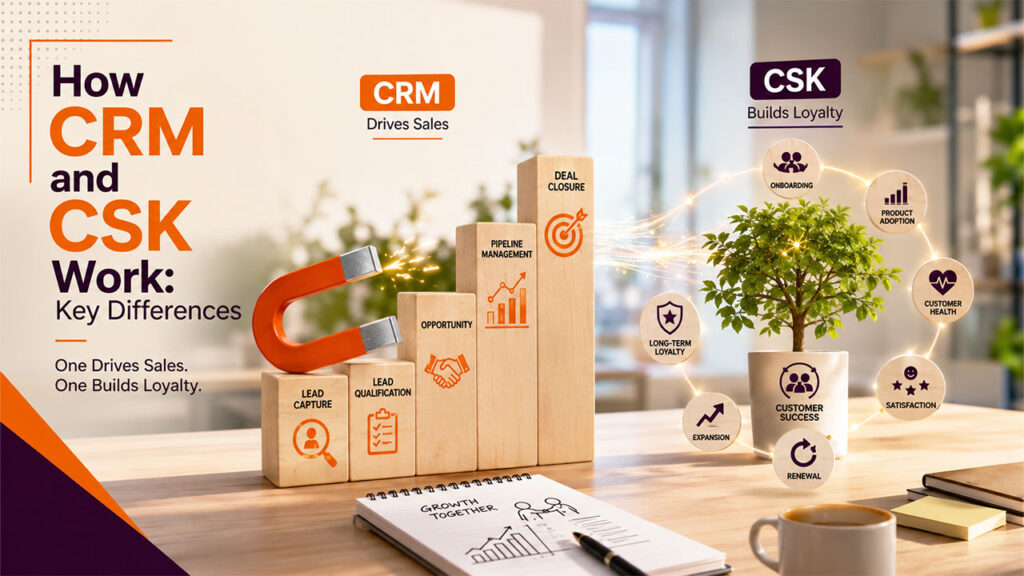
As both systems involve customer data, it would be helpful to distinguish the specific aspects where their day-to-day processes diverge from one another:
- Primary focus: CRM centers on sales and lead management; CSM centers on customer health, adoption, and retention after onboarding.
- Timeline: CRM is most active before and during the sale; CSM kicks in right after and continues for the life of the customer relationship.
- Core metrics: CRM tracks things like pipeline value, conversion rates, and deal velocity. CSM tracks usage data, churn risk, renewal rates, and customer satisfaction scores.
- Team ownership: CRM is typically owned by sales teams, while CSM is usually run by dedicated customer success managers or account teams.
- Trigger for action: CRM prompts follow-ups based on where a lead sits in the pipeline. CSM prompts outreach based on how a customer is actually using (or not using) the product.
Even though there is a list of key differences between CRM and CSM, these systems are not competing with each other. In fact, these two systems work together, and a successful company will always have CRM data flowing into its CSM process.
Benefits of CRM and CSM
Used well, each tool brings something distinct to the table, and together they cover the full arc of a customer relationship:
CRM benefits:
- Organized pipeline management: Every lead and deal stage is tracked in one place, so nothing slips through the cracks.
- Better sales forecasting: With clear visibility into where deals stand, predicting revenue becomes far less of a guessing game.
- Stronger follow-up consistency: Automated reminders mean prospects don’t go cold just because someone forgot to check in.
CSM benefits:
- Lower churn: Proactively catching unhappy or disengaged customers before they cancel protects revenue that’s already been won.
- Higher customer lifetime value: Customers who feel supported tend to stick around longer and often expand their usage over time.
- Stronger renewal rates: Regular check-ins and health tracking make renewal conversations far less of a surprise for either side.
If churn and retention are already on your mind, it’s worth digging into proven customer retention approaches, since a lot of what makes CSM effective comes down to the same principles. Together, these benefits explain why so many growing businesses eventually run both tools side by side rather than picking one over the other.
Challenges of CRM and CSM
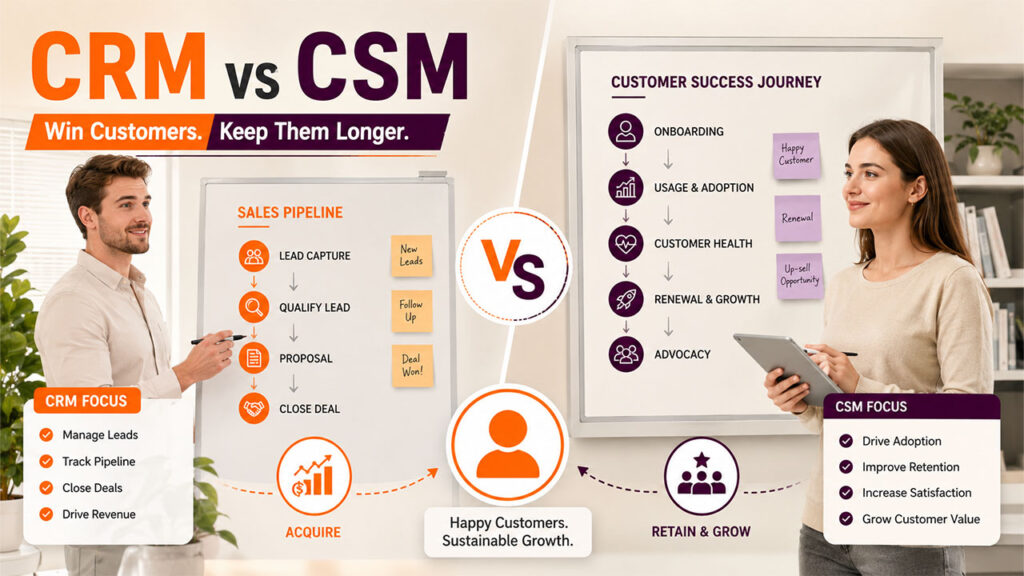
Running either tool well, let alone both together, comes with a few real trade-offs worth knowing upfront.
For the CRM solution, the main challenge is data accuracy. The effectiveness of a CRM depends on the information stored in it, but if salespeople fail to log calls and update deal stages, it will distort the entire picture. Additionally, there is the problem of adoption since some people tend to regard CRM as additional paperwork that doesn’t contribute to selling.
When it comes to CSM, it requires certain efforts as well. CSM largely depends on product analytics, and it means that it is as good as the data it gets from there. Smaller companies that lack a customer success department find it hard to maintain proactive communication because it requires time and effort.
Using CRM and CSM solutions together implies additional challenges of coordination. If the tools are not integrated appropriately, sales and success teams will have a different perception of the customer.
None of this makes either tool a bad investment; it just means going in with a plan for data hygiene and team buy-in rather than assuming either one runs itself.
Conclusion
At the end, CRM vs CSM isn’t really a competition; it’s more like two halves of the same customer journey. CRM gets someone through the door and turns interest into a closed deal. CSM makes sure that once they’re in, they actually stick around and get real value out of what they bought.
Trying to pick just one usually means leaving a gap somewhere. Learn about CRM alone, and you might close deals nobody follows up on properly once they’re won. Lean on CSM alone, and you’ll have nothing to feed it the customer context it needs to actually do its job well.
For most growing businesses, especially anything built on recurring revenue, the real answer isn’t CRM or CSM; it’s figuring out how to run both together so the handoff between sales and success feels seamless instead of like starting over.
FAQs About CRM vs CSM
Q. What is the main difference between CRM and CSM?
CRM focuses on managing sales, leads, and the relationship up until a deal closes, while CSM takes over after the sale to help customers succeed with what they've purchased and reduce churn.
Q. Do small businesses need both CRM and CSM?
Not always. Early-stage businesses with few customers can often get by on CRM alone, but subscription-based or recurring revenue businesses tend to need both fairly quickly.
Q. Can CRM software include CSM features?
Some platforms do offer overlapping functionality, but dedicated CSM tools are usually built with deeper usage tracking and churn-prediction features that a standard CRM isn't designed for.
Q. Which team typically owns CSM vs CRM?
CRM is usually managed by sales teams, while CSM is typically run by dedicated customer success managers or account teams focused on post-sale relationships.
Q. Is CSM only useful for SaaS companies?
No, though it's especially common there. Any business with an ongoing relationship, like renewals, subscriptions, or repeat service contracts, can benefit from a CSM approach, not just software companies.
%201.png)

%201.png)

%201.png)