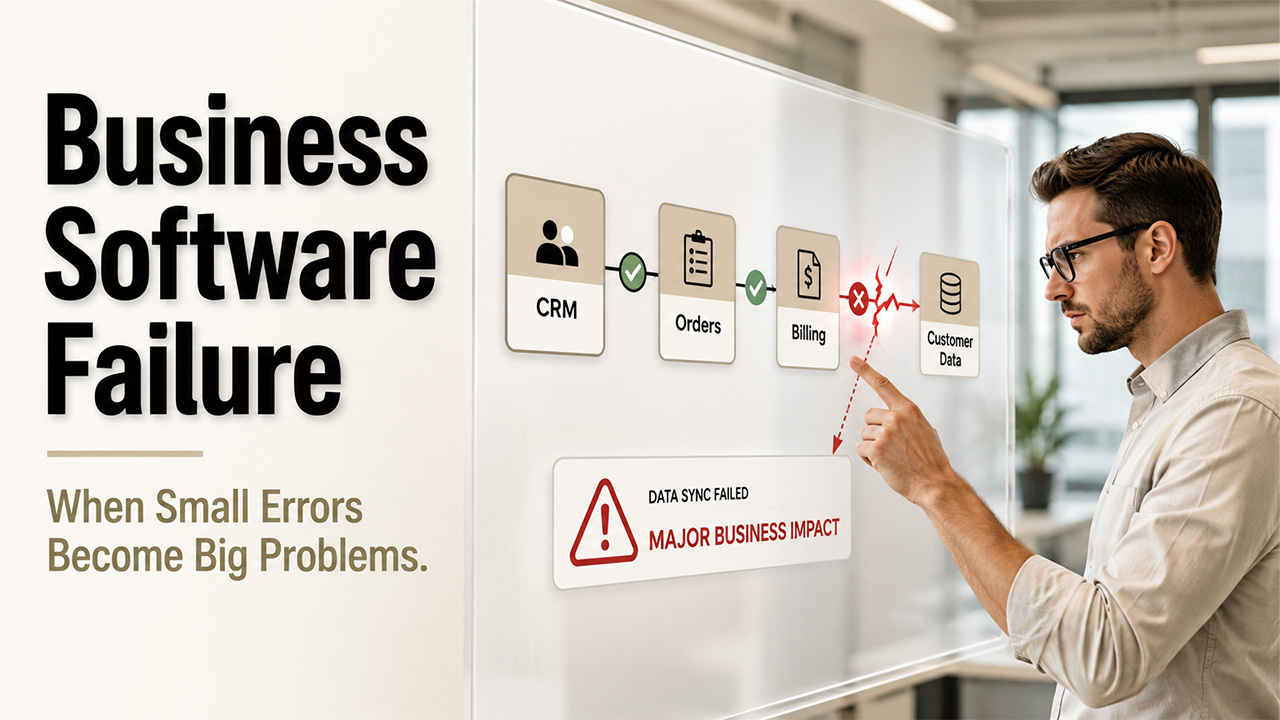

Most business software failures do not announce themselves. A sync job quietly drops half a batch of records. A form saves a customer without validating the phone number, and nobody notices until a sales rep dials a dead line.
The pattern is familiar to anyone who has run a business system through a few years of change. The initial build usually goes fine. It is the years of maintenance afterwards where things get expensive.
This piece looks at why that happens, what business software actually costs, and which testing practices keep growing systems stable without turning every release into a two-week ordeal.
Key Takeaways
- Most production defects come from change over time, not from the original build
- Every integration point multiplies the number of ways a system can fail silently
- Manual regression testing stops scaling once release frequency picks up
- Static analysis catches whole categories of defects before code is ever executed
- Service virtualization lets teams test against systems they cannot reach on demand
- Small, consistent testing habits outperform large and occasional QA pushes
Every Integration Can Break Business Software
A single business software failure is manageable. The trouble starts the moment it begins talking to other systems.
Your CRM pulls leads from website forms. It pushes contacts to your email platform. It syncs with billing, and billing syncs with accounting. Each of those connections is effectively a contract between two systems, and contracts break when one side changes without telling the other.
Teams weighing up CRM integration options tend to compare features and pricing first. What deserves equal attention is how each connection behaves when the other end is slow, offline, or returns a field in a format nobody expected.
That is where the quiet failures live. The integration does not throw an error. It just writes the wrong thing, and it keeps writing the wrong thing until someone runs a report and notices the numbers do not add up.
Manual Testing Runs Out of Road Faster Than People Expect

Manual testing works well early on. A tester clicks through the critical paths, confirms the obvious things work, and signs off.
Then the system grows. What was 40 test cases becomes 400. A change to one module now needs a regression pass across a dozen others, and the pass takes days.
At that point teams face an unpleasant choice. Test everything and slow releases to a crawl, or test a sample and accept that something will slip through.
Neither option is good, and the second one is what most teams quietly pick. The defects that reach production from that decision are almost always regressions, meaning something that used to work and stopped working after an unrelated change.
The Testing Practices That Actually Hold Up
Automation is the obvious answer, but "automate your tests" is advice at the wrong altitude. What matters is which layers you automate and in what order.
Teams can also compare different automation testing tools to find the right approach for testing across their workflows.
Static analysis examines source code without running it. It flags null dereferences, resource leaks, unsafe patterns and coding standard violations at the point of writing, which is the cheapest possible moment to fix them.
Unit testing verifies individual functions in isolation. Good unit coverage is what makes refactoring safe, because you find out within seconds if you have broken something rather than three sprints later.
API testing validates the contracts between systems directly instead of clicking through a user interface to reach them. It is faster, far more stable, and it tests the layer where most integration defects actually live.
Service virtualization simulates systems you cannot easily test against. If your payment gateway only allows a handful of sandbox calls per day, a virtual asset lets you run a thousand scenarios against a realistic stand-in.
Tooling in this area varies widely in how much setup it demands. Parasoft, for example, lets teams build virtual services from API definitions, recorded traffic or request and response pairs, and can switch a test run over to a virtual service automatically when a live dependency goes unstable or offline.
If you work in automotive, medical devices, aviation or finance, also check whether your tooling can enforce the coding standards your industry requires, such as MISRA, CERT or ISO 26262.
What the Payoff Actually Looks Like
The business case for test automation gets made in vague terms far too often. Real numbers help.
Sabre estimated $760,000 in annual savings after automating its API testing and implementing service virtualization.
Kitea Health, working on a brain implant device, sustained 99 to 100 percent verifiable code coverage while accelerating development by 25 percent. The company reported zero field-found bugs, which for an implantable medical device is not a nice-to-have.
Those are ambitious environments, and your numbers will look different. The mechanism is the same though. Time spent on repetitive verification gets handed to machines, and the humans move to work that needs judgement.
How to Start Without Rebuilding Everything
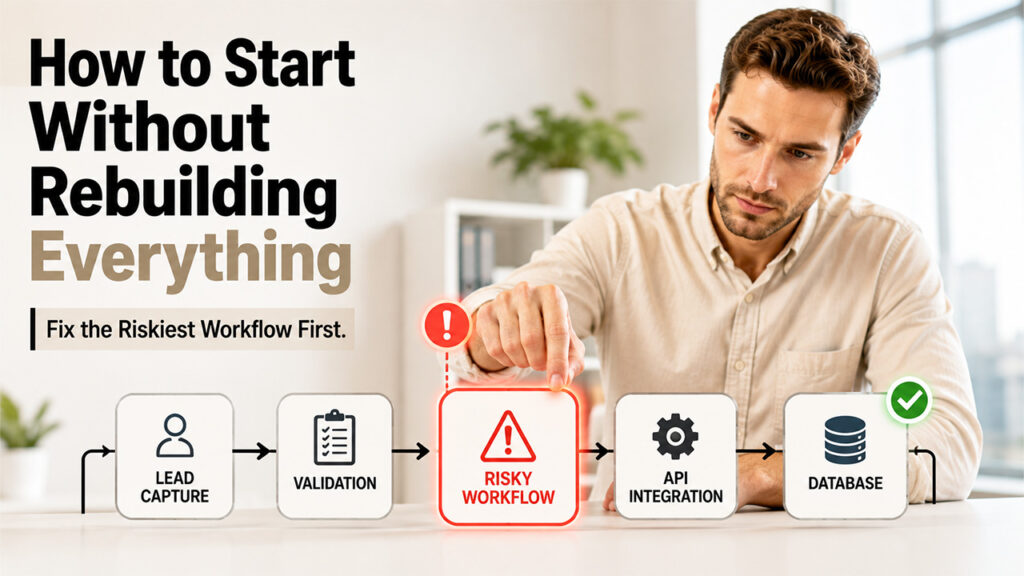
Nobody needs to introduce a full quality platform in one quarter. The teams that succeed at this start narrow and expand once the habit sticks.
Pick the single workflow that hurts most when it breaks. For a lot of businesses that is lead capture or order processing, because failures there cost revenue immediately and visibly.
Automate the regression tests for that one workflow first. Get them running on every commit, not weekly, so failures surface while the change is still fresh in someone's head.
Add static analysis next, since it requires no test writing at all. Point it at your codebase, triage what it finds, and fix the high-severity items before touching anything cosmetic.
Then expand outward to the API layer. Once your integration contracts are covered by automated checks, the category of silent data corruption described earlier mostly disappears.
Track the Right Signals
Coverage percentage is a useful number, but on its own it is misleading. Ninety percent coverage with weak assertions proves very little.
Watch escaped defect rate instead, meaning how many bugs reach production per release. Watch how long it takes to detect a regression, and watch how long a full test run takes.
If detection time is falling and test runs are getting faster while release frequency climbs, the investment is working. If coverage is climbing but production incidents are flat, your tests are checking that code runs rather than checking that it is correct.
Closing Thought
Software quality is not a phase that happens before launch. Business software failure is a property that either holds up or degrades across every change you make afterwards.
The organizations that keep systems reliable over years are rarely the ones with the biggest QA teams. They are the ones who made verification cheap enough and fast enough that skipping it stopped being tempting.
Start with one workflow. Automate the checks that would otherwise be done by a tired human at 6pm on a Friday. Expand from there.
Frequently Asked Questions
How much test automation is enough for a small team?
Start with the workflows where failure costs you money or customers directly. For most small teams that means lead capture, checkout and any billing-related process. Depth on the critical paths beats shallow coverage everywhere.
Does automated testing replace manual testers?
No. It removes the repetitive regression work and frees testers for exploratory testing, usability review and edge case hunting, which is where human judgement genuinely outperforms scripts.
What is the difference between static analysis and unit testing?
Static analysis inspects code without executing it and catches structural or security issues. Unit testing runs code with specific inputs and confirms the output is correct. They catch different classes of problems, so most mature teams use both.
Why test APIs instead of just testing the user interface?
UI tests are slow and break whenever the front end changes cosmetically. API tests hit the integration layer directly, run in a fraction of the time, and stay stable across visual redesigns.
How do compliance standards like MISRA or ISO 26262 fit into this?
They define coding and process requirements for safety-critical or security-critical software. Automated static analysis tools can enforce those rule sets continuously and produce the audit evidence certification bodies ask for, which is far cheaper than proving compliance manually at the end.
%201.png)

%201.png)

%201.png)