
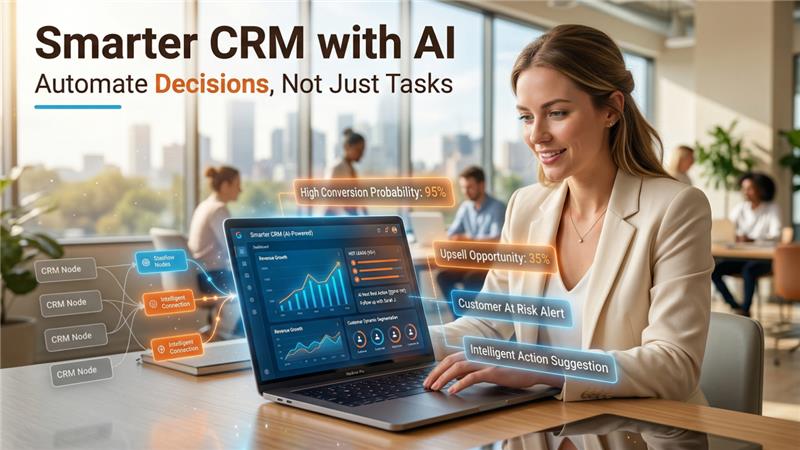

CRM platforms have changed a lot over the years.
What used to be a system for storing contacts, tracking deals, and setting reminders is now expected to do much more. Businesses want their CRM to help teams work faster, spot opportunities earlier, personalize outreach, and make better decisions without adding more manual work.
That is where AI is starting to play a much bigger role.
A lot of CRM companies already use automation. They set up workflows, email triggers, lead assignment rules, and task reminders. That helps, but there is a limit to how far rule-based automation can go. It can follow instructions, but it cannot really learn from patterns, adapt to behavior, or support smarter decision-making in the same way AI can.
That is why more companies are starting to invest in custom AI capabilities. Instead of relying only on fixed workflows, they are looking for ways to make their CRM more intelligent, more responsive, and more useful in real business situations.
In many cases, this is the point where businesses decide to hire AI developers who can build solutions tailored to their platform, processes, and users.
Automation handles tasks. AI helps teams think better.
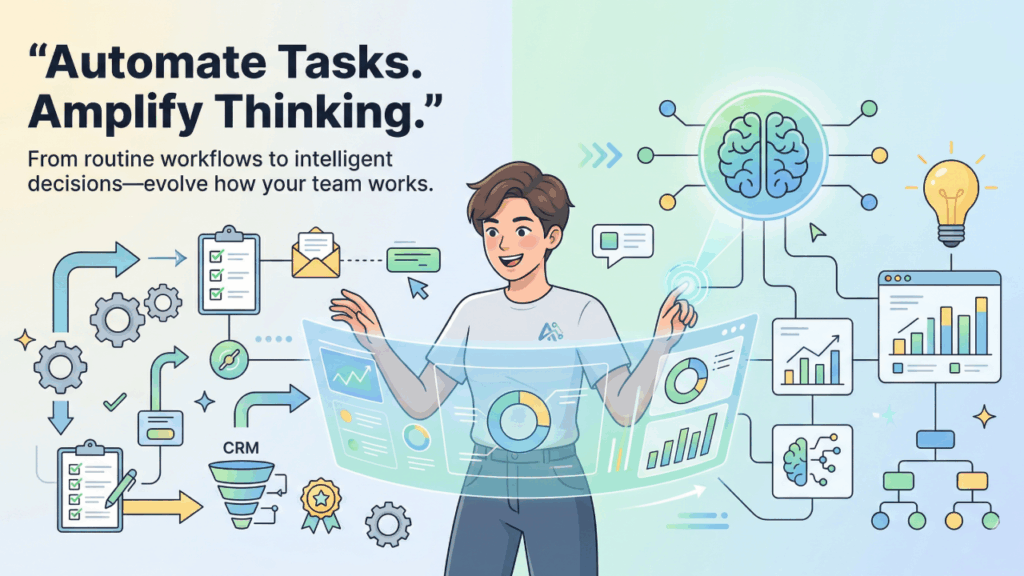
Traditional automation is great for routine actions. It can send a follow-up email when a form is submitted, move a contact into a workflow, assign a deal to a sales rep, or trigger a reminder for a support team.
But CRM users today want more than that.
They want systems that can help identify which leads deserve attention first, which accounts may be at risk, which customers are likely to respond to a certain offer, or which actions should happen next based on past behavior.
That is the difference between a CRM that simply runs workflows and one that actively supports revenue and customer growth.
For example, instead of treating every lead the same way, AI can look at historical patterns and help rank leads based on conversion potential. Instead of expecting a sales rep to go through every account manually, AI can surface the ones showing the strongest buying signals. Instead of sending the same outreach sequence to every contact, it can help personalize engagement based on behavior and timing.
That kind of shift is hard to achieve with basic automation alone.
Why CRM companies are bringing AI into the product
There is a reason AI is becoming such a strong focus in CRM.
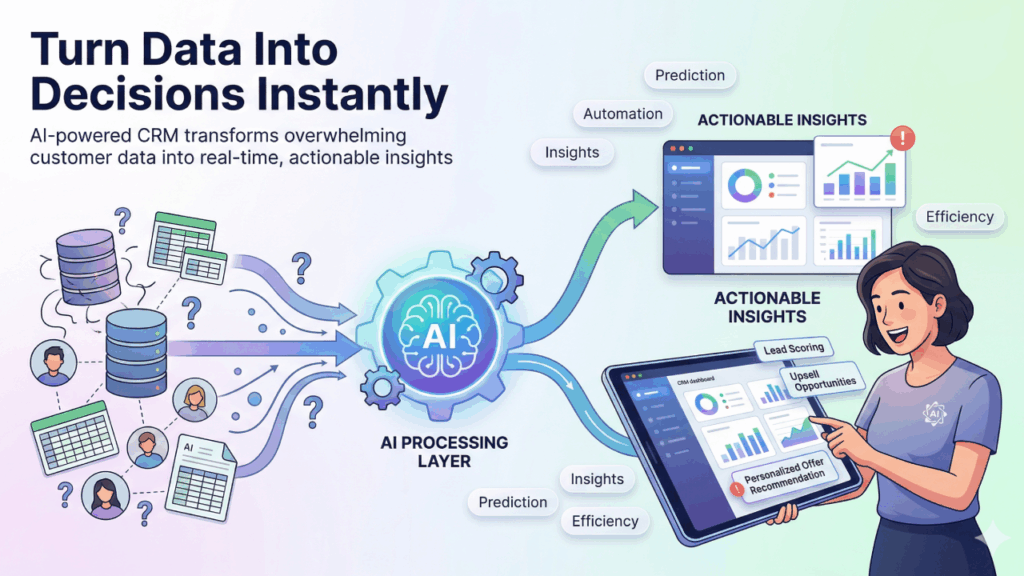
The amount of customer and sales data businesses collect is huge, but most teams still struggle to turn that data into timely action. They have information, but not always insight. They have dashboards, but not always directions.
AI helps bridge that gap.
With the right implementation, CRM companies can use AI to improve lead scoring, recommend next steps, summarize conversations, predict churn, support sales forecasting, and make communication more relevant. These are not just flashy features. They solve very practical problems for sales, marketing, and supporting teams.
And for companies trying to build those capabilities well, working with an experienced artificial intelligence software development company can make a real difference. The challenge is not only adding AI features. It is making sure those features fit the product, work with the available data, and actually improve the user experience.
Where AI developers add the most value in CRM
Not every improvement needs custom AI development. But when a company wants to create something more useful than an off-the-shelf add-on, that is where specialized developers come in.
Predictive lead scoring
Sales teams often have more leads than they can realistically prioritize well. AI can help by looking at behavior, past conversions, firmographic data, and engagement history to identify which leads are most likely to move forward.
This gives teams a much clearer view of where to focus their time and effort.
Smarter recommendations inside workflows
Many CRM workflows are still static. They follow a fixed path regardless of context.
AI can make those workflows more adaptive by recommending next-best actions based on signals from the pipeline, customer history, or real-time activity. That could mean suggesting when to follow up, flagging at-risk accounts, or identifying upsell opportunities earlier.
AI copilots for sales and support teams
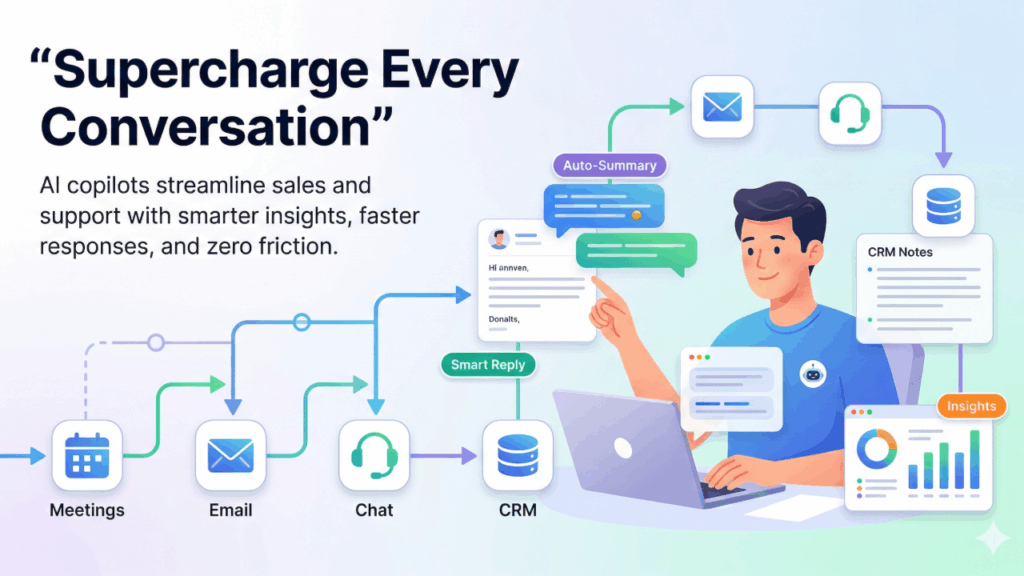
This is one of the most practical use cases right now.
AI copilots can help summarize meetings, draft follow-up emails, suggest responses, surface account notes, or pull together information from different systems without forcing teams to dig through multiple screens. For support teams, that can mean faster replies and better context. For sales teams, it can mean less admin work and more time spent actually selling.
Better personalization
One of the biggest issues with CRM-driven communication is that it can become too generic. Static segmentation and pre-set rules often miss the nuance of customer behavior.
AI can help teams segment users more dynamically and personalize messaging, offers, and journeys based on real interaction patterns. That helps businesses create experiences that feel more relevant instead of repetitive.
Forecasting and decision support
CRM data can reveal a lot about pipeline health, renewal likelihood, customer value, and deal momentum. The problem is that teams do not always have time to interpret all of it well.
AI helps pull out patterns that support forecasting and planning. It gives leaders a more informed way to think about revenue, risk, and where attention is needed most.
Off-the-shelf AI is not always enough
A lot of CRM platforms now offer built-in AI features, and that can be useful. But generic tools have limits.
Every CRM business has its own workflows, customer lifecycle, data quality challenges, and product structure. A standard AI feature may not reflect how the business actually operates. It may sound impressive in a product demo but feel disconnected in day-to-day use.
That is why custom development matters. Today's AI-integrated CRM systems go far beyond standard features — they adapt to real business logic, customer data, and product workflows in ways generic tools simply cannot match.
When companies work with the right AI team, they can build around their own product logic, customer experience goals, and internal systems. They are not just adding AI for the sake of it. They are solving specific use cases in a way that actually fits.
For many growing businesses, this is where partnering with an artificial intelligence software development company becomes a smarter route than relying only on plug-and-play tools. It gives them more flexibility, more control, and often a better long-term result.
What CRM companies should look for when hiring AI developers
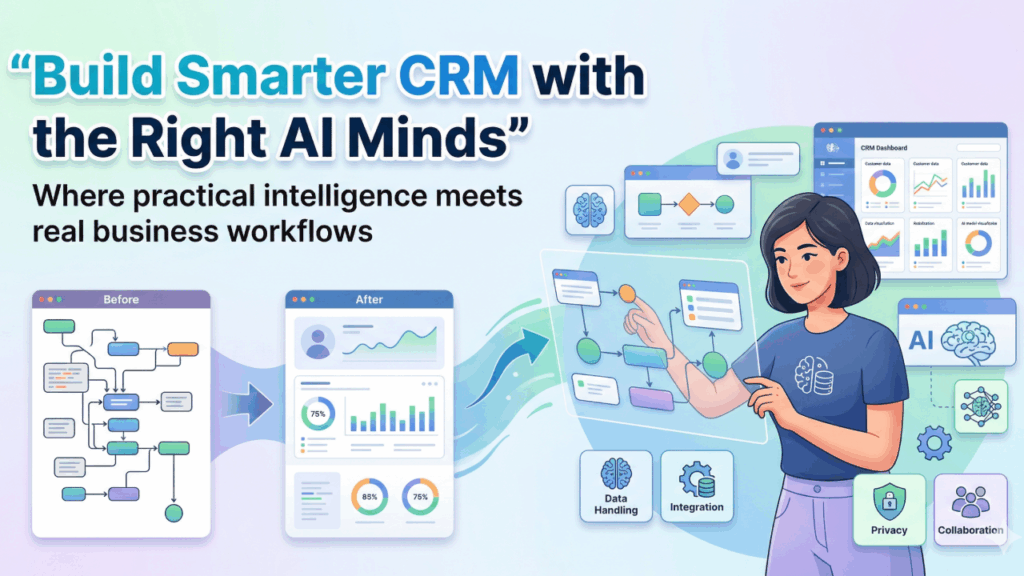
Hiring AI developers is not just about technical knowledge. CRM is a business-critical system, so the people building AI into it need to understand how users actually work.
That means the right team should be able to:
- understand CRM workflows and product logic
- work with real business data, even when it is messy
- build models around practical outcomes, not just experiments
- integrate AI features in ways that feel natural to end users
- think about privacy, performance, and long-term maintainability
- collaborate with product, engineering, and business stakeholders
The goal is not to add complexity. The goal is to make the CRM more useful.
If AI features are hard to trust, hard to use, or poorly integrated, they will not stick. Good implementation matters just as much as good ideas.
Smarter automation should still feel human
This part matters a lot.
Businesses do not want CRM systems that feel robotic or overloaded with unnecessary intelligence. They want tools that reduce friction, save time, and make it easier for teams to do their jobs well.
That is why the best AI in CRM often works quietly in the background. It helps with prioritization, summarization, recommendations, and pattern detection without making the workflow feel complicated.
In other words, smarter automation should still feel natural. It should support people, not replace judgment entirely.
That balance is what separates useful AI from gimmicky AI.
Final thoughts
CRM companies are under pressure to do more than organize customer data. They are expected to help businesses move faster, respond better, and grow more efficiently.
Basic automation can only take them so far.
As customer expectations rise and competition increases, AI is becoming a practical next step for CRM platforms that want to offer more value. Whether it is lead scoring, smarter workflows, better forecasting, or more relevant engagement, the opportunity is no longer theoretical. It is already here.
The companies that do this well will not just add more features. They will build better experiences.
And that is exactly why more modern CRM businesses are choosing to hire AI developers who can turn automation into something far more intelligent, flexible, and useful.
Frequently Asked Questions
Q1. What is the role of AI in modern CRM platforms?
AI helps modern CRM platforms go beyond basic automation. It can improve lead scoring, recommend next-best actions, support sales forecasting, personalize customer engagement, and reduce manual work for sales and support teams.
Q2. Why are CRM companies hiring AI developers?
CRM companies are hiring AI developers to build more intelligent features that adapt to customer behavior, analyze data more effectively, and improve how teams use the platform day to day. This allows them to move from static workflows to smarter automation.
Q3. When should a business hire AI developers for a CRM project?
A business should consider hiring AI developers when it wants to add capabilities such as predictive analytics, AI copilots, dynamic customer segmentation, workflow recommendations, or custom intelligence features that go beyond standard out-of-the-box automation.
Q4. Can AI improve lead management in CRM systems?
Yes. AI can help prioritize leads based on conversion likelihood, engagement history, customer behavior, and other signals. This helps sales teams focus on the most promising opportunities instead of treating every lead the same way.
Q5. How does an artificial intelligence software development company support CRM innovation?
An artificial intelligence software development company can help design, build, and integrate custom AI features into CRM products. This may include predictive models, automation logic, AI assistants, data analysis tools, and workflow enhancements tailored to specific business needs.
Q6. Is off-the-shelf AI enough for CRM businesses?
Off-the-shelf AI can be useful for basic functionality, but it may not align with every company’s workflow, product structure, or customer journey. Custom AI development is often a better fit for businesses that want more flexibility, control, and differentiation.
Q7. What should companies look for when they hire AI developers?
Companies should look for AI developers who understand product thinking, CRM workflows, data quality challenges, user experience, and integration requirements. Strong technical skills matter, but so does the ability to build AI features that are practical and usable.
Q8. Can AI replace human decision-making in CRM?
Not completely. AI works best when it supports human teams by surfacing insights, reducing repetitive work, and improving recommendations. The most effective CRM systems use AI to assist decision-making, not remove the human element altogether.
%201.png)

%201.png)

%201.png)