





AI in fulfillment and shipping is transforming how small businesses manage customer relationships by reducing manual work and keeping data aligned across sales, support, and operations. While CRM systems remain the centre for customer data, AI-powered fulfilment tools that support these workflows by automating shipping, syncing order updates, and improving post-purchase visibility, without acting as a CRM themselves.
How CRM Workflows Are Expanding Beyond Sales
Small businesses today handle far more than contacts and deals. These include order management, delivery, inventory notifications, as well as customer expectation management. The CRM systems are still central in customer data management. CRM systems are no longer stand-alone solutions.
AI has just accelerated this process. Rather than having to enter changes into the records or query the status of orders by hand, businesses can rely on AI-powered solutions which have ensured a smooth flow of data from one tool to another. The consequence of this integration has meant having not one but many tools in their respective ecosystems.
In this ecosystem, CRM systems manage customer relationships, while adjacent platforms—such as shipping and fulfilment software— deliver operational data that customers care about most after a purchase. This is where AI in fulfillment and shipping plays a practical supporting role rather than replacing existing systems.
Why AI Still Matters in CRM-Centred Operations
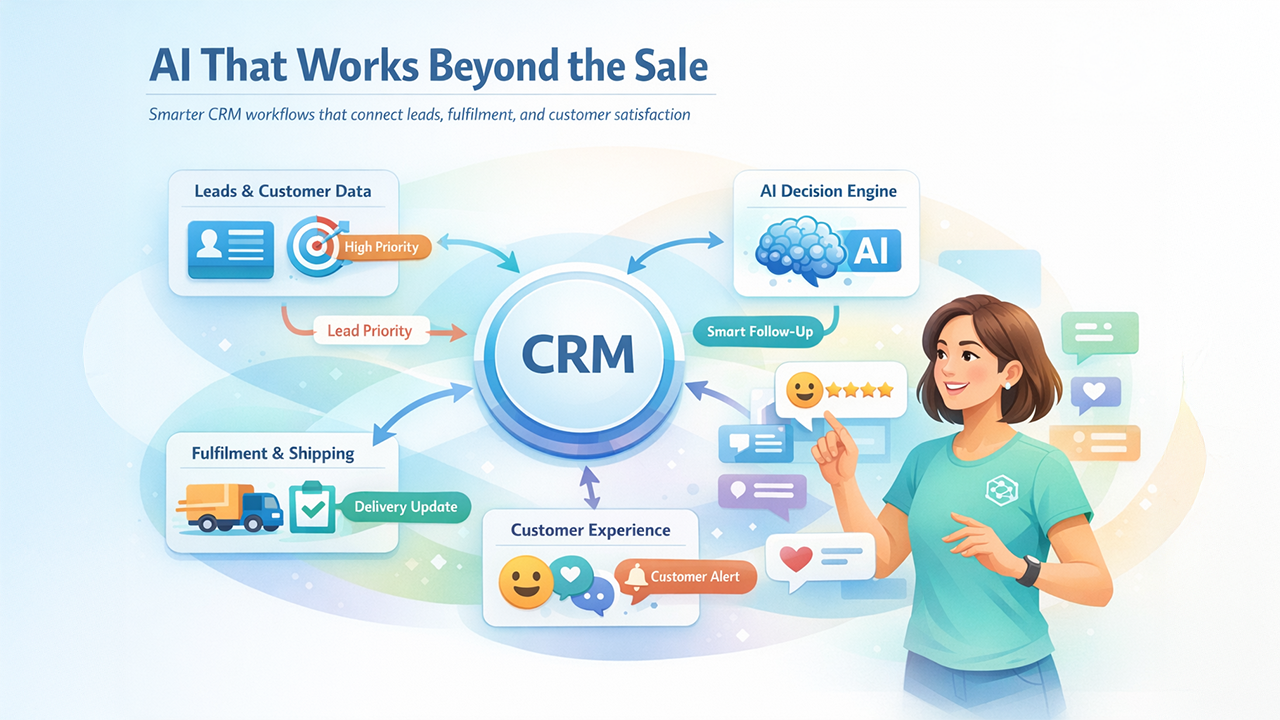
Traditional CRM tools focused on storing contact details, logging interactions, and tracking pipeline stages. While effective, they depended heavily on manual input. AI and CRM integration changes this by automating repetitive tasks and surfacing insights without constant user intervention.
- For instance, by using AI-powered CRMs,
- prioritize leads depending on behavior
- advise follow-up timing
- flag customers who might require attention
This enables a small team to concentrate on value-based interaction rather than on entering the data. But the experience doesn’t end there. There are a few more factors that impact the overall satisfaction. These could be order statuses, accuracy of fulfillment, and timeliness. These are often not in the CRM.
This gap is where AI in fulfillment and shipping enhances CRM workflows by connecting operational execution with customer-facing teams.
Where Shipping Data Fits Into the Customer Journey
Once an order is placed, customer expectations start shifting quickly from “Will I buy?” to “Where is my order?” The shipping status becomes one of the most prevalent reasons customers contact support teams.
This then brings a lack of visibility to the customer-facing teams when fulfillment data is handled manually or tracked across disconnected systems. This implies slower responses and inconsistent information.
Advanced shipping platforms bridge this gap by automating the fulfillment process using AI where it actually adds value, such as order grouping and selection of the best shipping rates. Rollo Ship helps businesses streamline label creation, access discounted carrier rates, keep inventory in sync, and manage tracking across all connected stores from one dashboard.
Indirectly, tools like this support CRM workflows by keeping shipping data reliable and current, so customer-facing teams have the correct delivery information at all times.
Smart Automation Beyond the CRM Interface
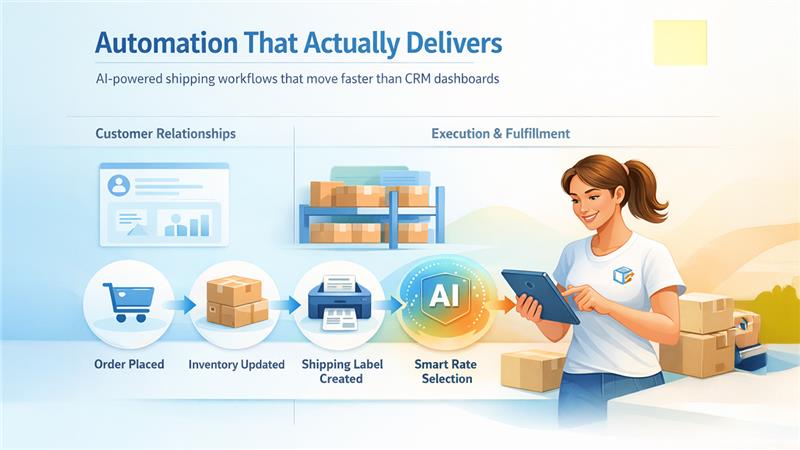
Automation in contemporary business is more than necessary for sales and marketing insights. Some small businesses have come to depend on courier services integrated with online shopping platforms, accounting software, and inventory control for keeping their business in sync.
When an order is placed, automation can trigger a connected workflow:
- order confirmation
- inventory updates
- shipping label creation
- tracking notifications
Shipping platforms that apply AI selectively at this operational layer help reduce delays and eliminate handoffs between teams. Rollo Ship integrates intelligent automation and AI logic to import orders, combine shipments, determine cost-effective rates, and update tracking information on multiple sales channels without attempting to replace the CRM.
It results in highly optimized systems because CRMs handle customer relationships and shipping solutions deal only with execution.
Key Capabilities Business Owners Look For in Shipping Tools
A good shipping solution should streamline—not add to—the process. A shipping plugin that integrates easily with CRM systems usually integrates the following functionalities:
- Functionalities for major carriers in the US, namely USPS, UPS, and FedEx
- Canadian carrier coverage, such as Canada Post, UPS Canada, FedEx Canada, and Purolator
- One-click label generation for users of Shopify and other e-commerce sites
- Printing of labels in bulk with Automated Tracking Updates
- Availability on cloud, desktop, iOS, & Android devices
- Order synchronization across various sales channels on a real-time
Rollo Ship is often chosen because it provides these essential capabilities free of charge on a monthly basis, allowing businesses to automate their fulfillment process by not raising their fixed costs. Even though there is no hardware required, most sellers opt to include their shipping software together with a Rollo wireless thermal label printer that increases order labeling production while reducing errors produced through their printer setup.
Inventory Accuracy and Post-Purchase Experience
Inventory accuracy directly impacts customer trust and revenue. Shipping platforms that use AI in fulfillment and shipping help maintain accurate inventory by automatically syncing fulfillment data across systems.
Rollo Ship includes free inventory management in both USD and CAD, making it well-suited for businesses operating in the US and Canada. Real-time inventory updates ensure that CRM software is provided with the right information on product availability, thus eliminating overselling and communication issues after purchase.
Automated notification services like shipment confirmations, delivery notices, and notification for delays would further add to the issue of increased transparency. Customers would be updated without having to contact support.
Multi-Store and Cross-Border Operations
Inventory accuracy directly affects customer loyalty and income generation. Shipping systems that employ AI can help ensure a stable inventory by automating the syncing process of fulfillment information.
Rollo Ship is fit for US and Canadian businesses because it offers free inventory management in both USD and CAD. This automatically updates real-time inventory to make sure CRM systems reflect real availability, reducing overselling while improving post-purchase communication.
This will also improve transparency, where automated notifications such as shipment confirmation, in-transit update, delivery update, and delay alerts keep customers informed without them having to call support. Thus, it allows small teams to scale more effectively with less additional workload.
Why Usability Still Drives Adoption
Automation only adds value if the teams implement the use of automation. Small businesses focus on shipping solutions that work well and need little training.
Rollo Ship is sometimes recognized as having a simple interface and excellent support. This allows the shipping automation integration to be seamlessly adopted by the sales team. Operations in the background include features like automatic pickups and live synchronization.
Final Words
Artificial Intelligence is revolutionizing the operation of small businesses as it integrates different systems that worked independently before. Though CRM tools are essential in the interaction with the customers, the role of delivery and fulfillment software cannot be underemphasized as it deals with the task of fulfilling the post-sale services.
Applying AI to shipping platforms where it has operational value helps businesses reduce manual work, boost data accuracy, and increases their responsiveness to customers. As automation becomes more accessible, the most successful teams will rely on tools designed to work together—each focused on its role yet fully aligned across the customer journey.
%201.png)

%201.png)

%201.png)