


Todays buyers do not like personalized experiences they want them. Research shows that over 80% of consumers say personalized experiences help them choose a brand in shopping situations. For businesses the challenge is clear: how do you give personalized experiences to thousands or millions of customers without overloading your teams or splitting up your operations?
The answer is increasingly AI-powered personalization. This is a type of intelligence tool that looks at customer data understands customer behavior and gives personalized content and recommendations right away. AI personalization has become very important. Businesses that use it well are doing better in customer satisfaction keeping customers and growing revenue.
This guide will explore how AI personalization works. We will look at what to consider when choosing the AI personalization tools. We will also look at which solutions are leading the way, in giving personalized experiences to customers across their entire journey.
Key Takeaways
- AI personalization is a must-have. Companies that do not invest in AI-powered personalization risk losing customers to competitors that do. The question is no longer if we should personalize; it's how to do it on a large scale.
- Real-time personalization works better than batch personalization. Customer behavior changes fast during live interactions over voice and chat. AI personalization tools that adapt quickly deliver customer experiences than static approaches.
- Voice is the big area for AI-driven personalization. Ai personalization tools focus on digital areas like websites and emails.. Voice agents collect the richest customer data. Like intent, emotion and urgency. Platforms that can personalize across voice, messaging and digital channels at the time are best placed to get the most value from every customer interaction.
- Fragmentation is the problem for scaling AI personalization. Customer data scattered across systems limits every personalization effort. Unifying data across CRMs communication platforms and business applications is the important step for effective AI personalization on a large scale.
- Trust and transparency are essential. As AI personalization tools get better at analyzing customer data and behavior data privacy concerns grow. Companies that build customer confidence through rules and responsible AI practices will sustain personalization efforts longer.
The best AI personalization strategy covers the customer journey. From targeting before interaction, to real-time help and follow-up after engagement AI-powered personalization delivers the value when it touches every stage.
What Is AI-Powered Personalization and Why Does It Matter?
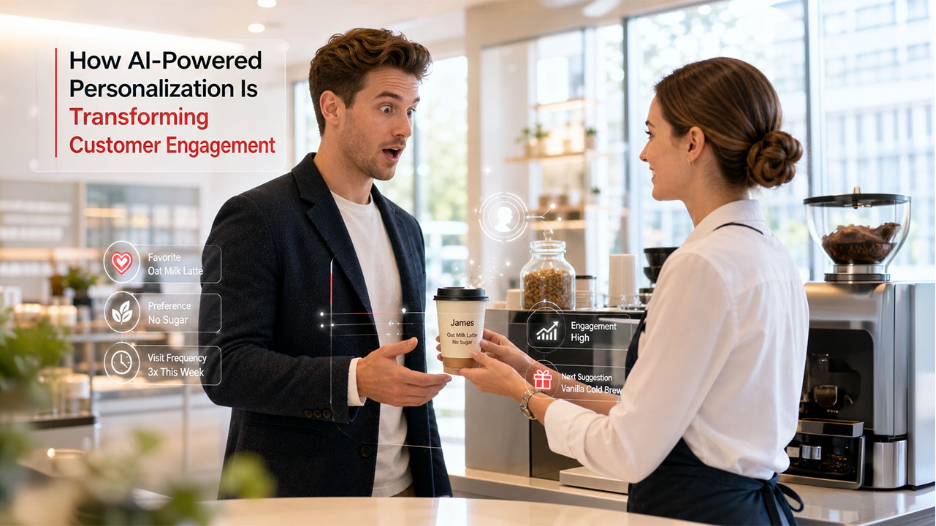
AI-powered personalization refers to the use of machine learning, natural language processing, and predictive analytics to create individualized customer experiences across every touchpoint. Rather than relying on broad customer segments or static rules, AI-powered personalization tools analyze real-time data to dynamically adapt content, offers, messaging, and service to each person.
The impact is measurable. Companies that invest in AI-driven personalization consistently report stronger customer engagement and higher customer satisfaction scores. Research from McKinsey has shown that personalization efforts can drive up to 40% more revenue for businesses that execute well. When customers feel understood, they stay longer, spend more, and advocate for the brand.
What makes modern AI personalization different from earlier approaches is its ability to operate at scale. AI models continuously learn from new data points, adapting in real time as customer behavior evolves. AI-powered systems can interpret customer queries, social media interactions, and conversational data with nuance, shifting from reactive service to proactive customer engagement.
Key Capabilities to Look for in AI Personalization Tools
Not all AI personalization tools are created equal. When evaluating personalization tools and platforms, businesses should consider several core capabilities that separate effective AI personalization solutions from superficial ones.
Real-time personalization is foundational. The best personalization tools process customer data and behavioral signals as they happen, adjusting the experience dynamically rather than relying on batch-processed insights. This is especially critical for customer interactions that happen over voice or chat, where context shifts rapidly and customer needs evolve within a single conversation.
Omnichannel personalization ensures consistency across every customer touchpoint: website, mobile apps, email, SMS, voice, and in-store. Customers don't experience brands through a single channel, so AI-powered tools must unify customer data across all of them to deliver tailored experiences that feel seamless regardless of how or where the customer engages.
Predictive analytics and machine learning capabilities allow AI tools to move beyond simple rule-based personalization. Advanced personalization solutions use AI algorithms to identify patterns in customer behavior, predict future actions, and surface the next best offer or personalized content for each individual. The deeper AI tools go, the more accurate and impactful the personalized experiences become over time.
Integration with existing systems is non-negotiable. AI personalization solutions must connect with CRMs, customer data platforms, communication tools, and business applications to access the full spectrum of customer data. Fragmentation—where customer data lives in siloed, disconnected systems—remains the single biggest obstacle to effective AI personalization at scale.
Content personalization and dynamic content capabilities enable teams to tailor messaging, product recommendations, personalized messages, and even conversational tone based on individual customer preferences, past purchases, and real-time context. Some organizations also use an AI proposal generator to create tailored sales proposals and client-facing documents that align with customer preferences, previous interactions, and real-time business needs. The most capable personalization tools automate this process end-to-end, reducing manual effort while increasing relevance.
Finally, evaluate trust, governance, and data privacy concerns. As AI-powered personalization becomes more sophisticated in analyzing data and customer behavior, maintaining customer confidence through transparent data practices and responsible AI is essential for sustaining customer trust.
How AI Personalization Works Across the Customer Journey
Effective AI-powered personalization touches every stage of the customer journey—from the first interaction through ongoing retention and advocacy.
Before the interaction: AI-powered tools analyze customer data, browsing history, and past purchases to build dynamic customer profiles. These AI tools identify which prospects are most likely to convert and what personalized content will resonate with each individual. Personalized marketing campaigns and dynamic content on websites and mobile apps draw customers in with relevant, timely messaging that reflects customer preferences and user behavior.
During the interaction: This is where real-time personalization has the most direct impact on customer experience. Whether a customer is navigating a website, chatting with a virtual assistant, or speaking with an AI-powered voice agent, AI personalization tools use contextual data to guide the experience. Personalized product recommendations surface at the right moment. AI-driven customer service agents understand customer queries and deliver tailored experiences that resolve issues faster. For businesses using advanced personalization with agentic voice AI, the AI system can interpret customer behavior in real time, ask clarifying questions, and complete transactions without human intervention—boosting customer satisfaction and operational efficiency simultaneously.
After the interaction: Post-engagement, AI personalization tools continue working. Automated personalization follows up with personalized messages, satisfaction surveys, and relevant content based on the interaction. Machine learning algorithms analyze the conversation and customer feedback to refine future personalized customer experiences. Customer engagement tools use this data to reduce churn, boost retention, and deliver higher customer lifetime value through ongoing content personalization.
Top AI Personalization Tools for Delivering Tailored Customer Experiences
The market for AI personalization tools and personalization platforms has expanded rapidly. Below are some of the top AI personalization tools that organizations are using to deliver personalized experiences at scale. Each addresses a different dimension of the customer experience—from communication and service to personalized marketing and customer engagement.
RingCentral

RingCentral has positioned itself at the forefront of AI-powered personalization for customer interactions and business communications. Its Agentic Voice AI suite—comprising AI Representative (AIR Pro), AI Receptionist (AIR), AI Virtual Assistant (AVA), and AI Conversation Expert (ACE)—delivers personalized customer experiences across the full interaction lifecycle.
AIR uses natural language processing to greet callers, understand their intent, route them intelligently, schedule appointments, and complete transactions autonomously.
AVA provides real-time AI-powered assistance during live conversations by surfacing relevant context, recommendations, and next-best-action guidance to agents.
ACE applies machine learning to analyze every recorded interaction, extracting customer behavior insights, sentiment trends, and coaching recommendations that drive continuous improvement in customer satisfaction.
AIR Pro extends AIR's receptionist capabilities into fully agentic territory, enabling businesses to deploy voice-first intelligent virtual agents that can verify identities, complete multi-step transactions, trigger downstream workflows, and hand off to human agents with full conversation context—all without custom development.
What distinguishes RingCentral in the AI personalization space is its ability to treat voice, the richest and most nuanced customer touchpoint, as a core data input for personalization. While many AI personalization tools focus on digital touchpoints like web and email, RingCentral captures conversational data from calls and uses AI algorithms to make that data actionable across the customer journey. The AI-powered platform integrates with CRMs and business systems, enabling AI-driven personalization that extends from the first call to post-interaction follow-up. RingCentral's research found that organizations using AI agents report measurable gains in productivity, customer experience, and workflow speed. The depth of its AI capabilities may exceed what very small teams require, but for mid-market and enterprise organizations pursuing AI-driven personalization at scale, it represents a comprehensive, communications-first AI personalization solution.
Limitations: RingCentral's personalization capabilities are built around communications and conversation workflows and do not include e-commerce-oriented features like AI product recommendations, cart abandonment triggers, or conversion-focused dynamic content.
Best for: Organizations that want AI personalization embedded directly into their customer communications and voice interactions, not just their marketing stack.
Dynamic Yield
Dynamic Yield by Mastercard is a real-time AI-powered engine built for digital commerce. It uses machine learning to deliver personalized content, product recommendations, and personalized experiences across web, mobile apps, email, and in-store kiosks. Its strength lies in adaptive targeting—using AI algorithms and behavioral data to match offers to individual users in milliseconds. Dynamic Yield is a strong choice for e-commerce and retail brands focused on advanced personalization for conversion optimization.
Limitations: Primarily focused on digital commerce customer touchpoints; less suited for organizations needing AI personalization across voice, contact center, or service workflows.
Best for: E-commerce and retail-driven personalized experiences.
Braze
Braze is a customer engagement tool that uses artificial intelligence to orchestrate personalized messaging at scale. Its AI capabilities include content personalization, send-time optimization, churn prediction, and dynamic content generation powered by generative AI. Braze excels at omnichannel personalization across email, push notifications, SMS, and in-app messaging, making it a top AI personalization tool for lifecycle engagement and customer touchpoints.
Limitations: Braze is primarily marketing-focused; it does not address customer service, voice interactions, or real-time conversational AI personalization.
Best for: Lifecycle engagement and cross-channel personalized messages.
Zendesk
Zendesk applies AI personalization to customer service and support workflows. Its AI tools include intelligent triage, automated routing based on customer sentiment and intent, AI-powered agent assistance, and personalized self-service experiences. The system uses machine learning to analyze interactions and surface insights that help agents deliver tailored customer experiences. Zendesk is a strong fit for organizations looking to improve customer satisfaction through AI-driven personalization in their support operations.
Limitations: Zendesk's AI personalization capabilities are concentrated in service and support; it lacks built-in voice AI agents or the communications infrastructure that platforms like RingCentral offer natively. Best for: Customer support-focused AI personalization.
Salesforce Einstein
Salesforce Einstein embeds AI personalization directly into the Salesforce CRM ecosystem. It uses machine learning and natural language processing to deliver personalized recommendations, forecast customer behavior, automate personalized content, and surface insights across sales, service, and marketing workflows. Einstein's deep integration with Salesforce's customer data infrastructure makes it a powerful AI personalization solution for organizations already invested in that ecosystem.
Limitations: Einstein's capabilities are tightly coupled to the Salesforce ecosystem, which can increase cost and complexity. Best for: CRM-first organizations seeking AI personalization within Salesforce.
Adobe Experience Platform
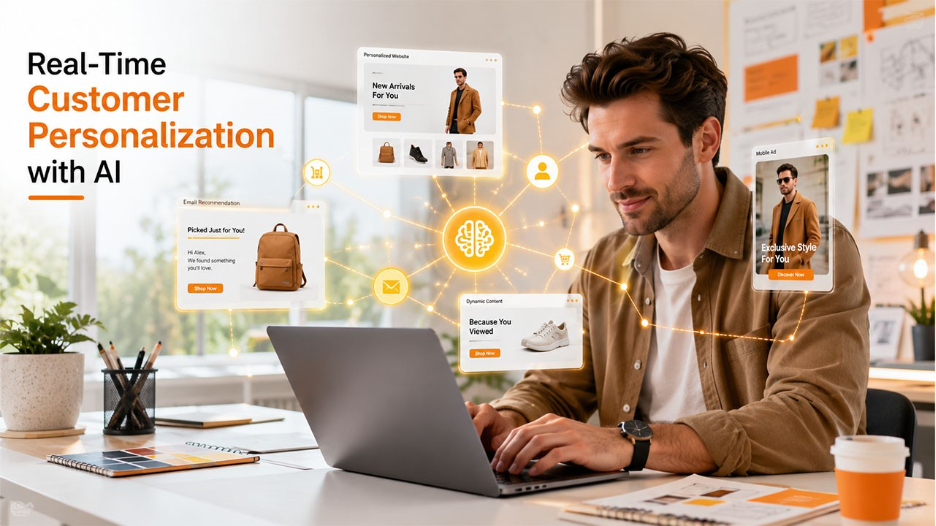
Adobe's Experience Platform combines customer data management with AI-powered personalization through Adobe Sensei. It unifies customer data from across channels to build real-time customer profiles, then uses AI algorithms and machine learning to deliver personalized experiences across web, mobile, email, and advertising. Adobe is particularly strong in content personalization and dynamic content for media, publishing, and large-scale digital experiences.
Limitations: Adobe's enterprise pricing and implementation complexity can put it out of reach for mid-market organizations. Its AI personalization strengths focus on digital experience rather than conversational or voice-based customer interactions. Best for: Large-scale digital content personalization.
Insider
Insider is an AI personalization solution recognized as a Leader in the 2026 Gartner Magic Quadrant for Personalization. It uses generative AI, machine learning, and behavioral data to deliver personalized experiences across web, mobile apps, email, SMS, and messaging channels. Insider's AI powers personalized product recommendations, automated personalization of the customer journey, and omnichannel personalization that adapts as user behavior shifts. It is well-suited for retail, travel, and financial services organizations seeking AI-powered personalization at scale.
Limitations: Insider's strengths are in marketing-driven personalization; organizations seeking ai personalization for customer service, voice, or employee-facing workflows may need additional ai personalization tools. Best for: Retail and travel personalized customer experiences.
Building an AI Personalization Strategy That Scales
Choosing the AI personalization tools is just one piece of the puzzle. Organizations that do a job with AI personalization on a large scale have some things in common.
First they bring all their customer data together. When data is spread out across systems that do not talk to each other it is hard to make AI personalization work. Making a picture of each customer, including what they browse what they buy how they interact with the organization what they talk about with support and how they behave is the starting point for any personalization effort.
Second they focus on personalizing things in time rather than doing it in batches. What customers do and want can change quickly especially when they are talking to the organization live. AI personalization tools that can adjust what they show and recommend as conversations happen do a better job than those that rely on old customer groups.
Third they use personalization for more than marketing. While it is nice to have content that's just for the customer, the biggest benefits of AI personalization often come from using it in customer service, sales and even for employees. AI solutions that can personalize things for both customers and employees like tools that let people talk to each other using their voice can make a big difference in the whole customer experience.
Fourth they make sure to be trustworthy and transparent. As AI personalization tools get better at looking at customer data and behavior people start to worry about their privacy. Organizations that are open and honest about how they use data follow the rules. Use AI in a responsible way will be more successful with personalization than those that do not.
For organizations that are trying to pick the AI personalization tools the question is no longer whether a tool can personalize things. It is whether it can personalize everything, all the time and do it in a way that makes customers happy and trusting than annoyed. AI personalization tools need to be able to personalize every interaction with the customer in time and at a large scale if they want to be successful. This means that organizations need to find AI personalization tools that can do all of these things and do them in a way that builds trust and engagement, with the customer than hurting it.
%201.png)

%201.png)

%201.png)