



Every business, regardless of its magnitude, sector, or customer base, is dependent on data. As long as the data is unified, it will be beneficial to the business. However, if the information is spread across several different systems, it will actually become a liability than an asset.
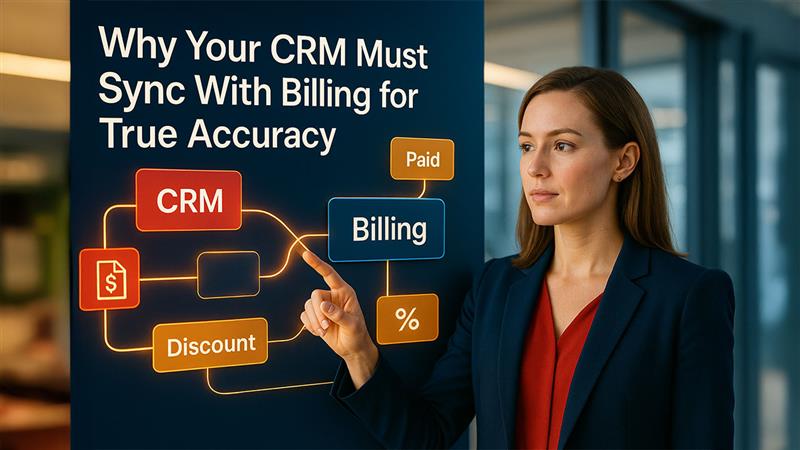
Imagine using a CRM solution to track your client’s details while managing a billing/discount platform to handle your invoices/payments/subscriptions. Unfortunately, when these two platforms do not communicate with one another, there are conflicts, lost revenue, and confusion for the teams. In order for a business to thrive, it must have the ability to access accurate and reliable data. The only way to guarantee that your CRM platform and billing platform operate as one source of truth is through CRM and billing integration.
How CRM and Billing Integration Works
Integrating the billing system with CRM systems allows businesses to connect their CRM with a payment processing tool. This configuration allows a company to store the data of customers and process payments from one source. When these two systems are connected, they will automatically exchange customer and payment information automatically.
Additionally, if there is a new sale or deal entered into CRM; it will automatically create a new invoice or subscription record in the billing system by using the customer's details stored in the CRM system. After the customer has made their payment; the status of the invoice will be updated in the CRM system, and the transaction will also be recorded under that specific customer record in the CRM system. This real-time synchronization is the foundation of effective CRM and billing integration.
Why Your CRM and Billing Systems Should Work in Tandem
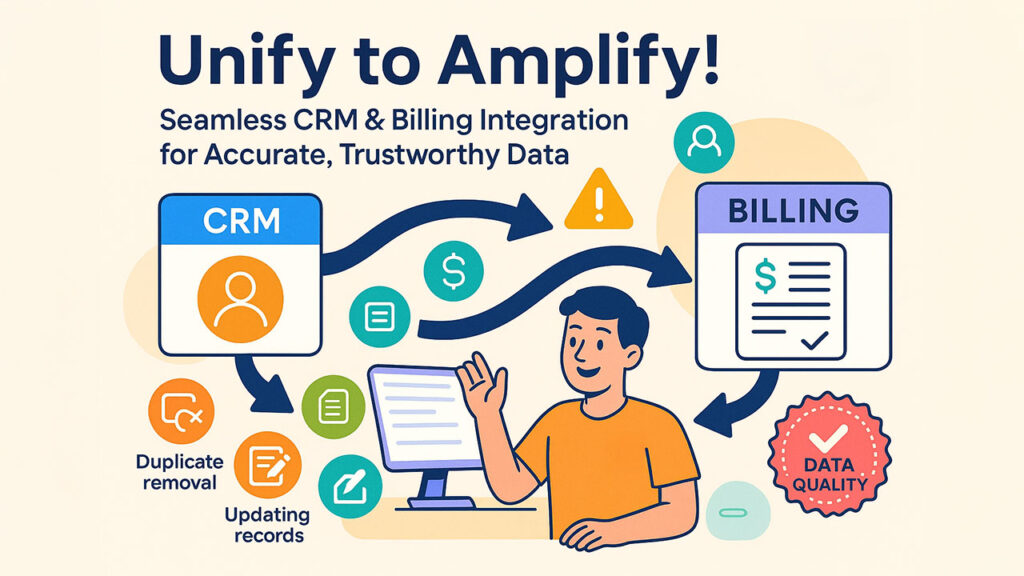
When your CRM system is connected with your billing system; it brings transparency and efficiency to the overall workflow. This creates a single source of truth — a common, reliable view of the customer and financial information.
Maintaining Data Integrity and Accuracy
Managing data across two separate systems requires substantial time, budget, and effort to maintain CRM and billing hygiene. Such a practice involves routinely cleaning and updating both your CRM and billing platforms to ensure that the databases reflect accurate, current information, including removing outdated contact or duplicate records; correcting entry errors and maintaining up-to-date entries within its databases. Implementing CRM and billing integration eliminates much of this redundant work by maintaining a single, synchronized dataset.
Through its business model based on artificial intelligence (AI), WinPure has discovered that the major data quality concern for 70% of the organizations in different sectors was the presence of duplicated and inconsistent data records.
The majority of these issues result from the repetition of entering data manually, which not only increases chances for errors and data quality issues, but also adds additional layers of work on the teams.
- Sales teams frequently encounter inconsistency when manually retyping client information, out-of-date contact record information, contract clause discrepancies, or multiple entries for the same records across multiple databases.
- These inaccuracies reduce data fidelity, skew account histories, and undermine the accuracy of key data fields to support reporting and financial analysis.
- As these errors spread across platforms, teams must verify contracts, correct billing details, and reconcile records. These tedious tasks would keep them busy instead of focusing on active sales efforts and slowing the entire sales cycle.
That is precisely why good quality data is of utmost priority; the best salespeople use accurate records to keep up with the deals and cultivate relationships with clients.
Accordingly, by integrating your CRM with your billing platform, you will benefit from having consistent, accurate, and trustworthy data on customers and their transactions or subscriptions available in both systems.
Personalization Based on Customer Behavior and Financial Health
According to Shep Hyken’s 2024 State of Customer Service and CX Study, as referenced by Forbes, 81% of customers prefer companies that provide experiences designed around their individual needs.
When you link financial data to your CRM, the team can have a complete view of each customer in terms of value, spending patterns, and financial condition. CRM and billing integration make this comprehensive customer view possible by connecting behavioral data with financial history.
There are many strategic actions that they can make to create customer journeys that establish brand loyalty and produce the highest lifetime value:
- Utilize information on purchasing habits and demographic background in marketing campaigns. Target the most responsive audiences and thus increase the conversion rate.
- Personalize sales proposals and discounts based on a customer's purchase history and financial information. This way, every interaction will be relevant and meaningful.
- Monitor declining activity or late payments and identify potential churn while taking proactive steps toward retaining customers.
Automated Business and Financial Processes
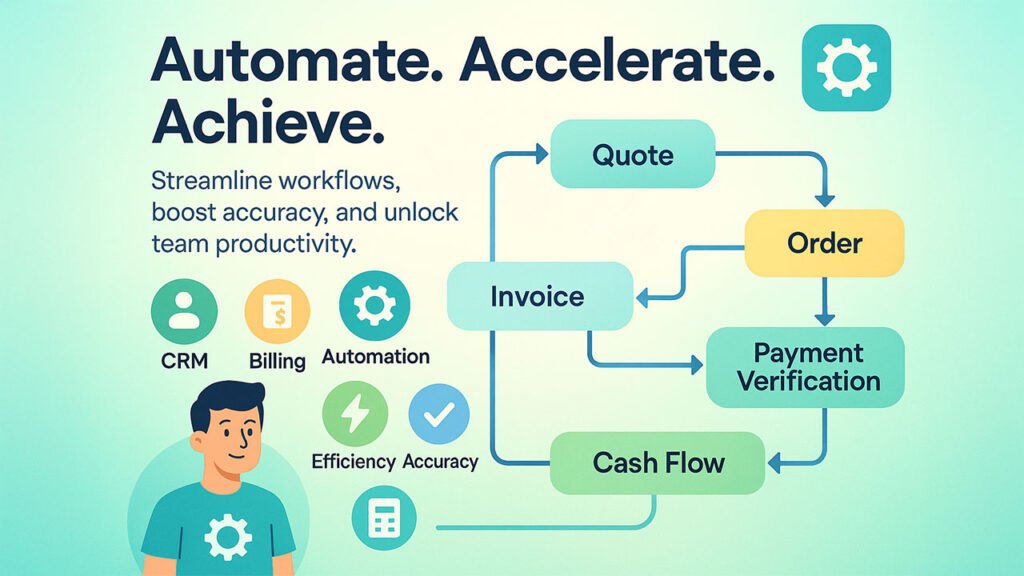
Slightly over half of U. S. professionals (50.4%) believe that manual data input can cause expensive errors, delays, or lost chances. Enabling your programs to communicate with one another could potentially result in the augmentation of your team's efficiency, productivity, and accuracy to much higher levels. Robust CRM and billing integration automates workflows that previously required manual intervention.
Imagine a customer requests 24 units of a product. Your sales team can input a quote into the CRM. When the customer places the order, your billing system automatically generates an invoice. The accounts department can send payment reminders as well, or they can simply verify the account balances. For businesses needing immediate cash flow, this integration also streamlines invoice factoring processes by ensuring invoice data is accurate and readily available for financing partners.
Teams will concentrate on generating more profit and maintaining a good cash flow through the high-value work once the routine processes have been eliminated.
Real-World Example: Contractor Financing Operations
Contractor financing platforms like Finturf show the value of this type of integration. Finturf’s lending partners verify invoices using project data that flows directly from their CRM into the billing software.
Information about the job, its progress, and the contractor is populated into the invoice instantly. This enables lenders to confirm that contractors billed work matches what was approved.
Strong Business Intelligence Capabilities
Integrating CRM and billing software provides full-scale business intelligence for data-conscious decision-making. Centralized access to cash flows, as well as revenue, profit margins and expenses, and the use of forecasting models based on regression, increases your projections’ reliability.
For instance, you might be interested in forecasting next month's revenue. The financial stability of your company can be better understood by analyzing the unpaid invoices and the planned expenses. It is often easier to allocate funds and cut costs when this task is done.
Conclusion
Everything transforms when your CRM and billing systems sync. Data no longer sits trapped in silos. Instead, it flows freely and breaks the barriers that once kept teams apart. Accordingly, seamless interaction creates a single source of truth, where everyone can access clean, complete, and consistent data.
Ultimately, CRM and billing integration provide you and your teams with a deeper understanding of customers and the forces that impact the company's bottom line. It also makes previously cumbersome processes simpler and more efficient.
%201.png)

%201.png)

%201.png)