

Introduction
You know that feeling—you check your receivables table, and there’s a stubborn, unmoving line of overdue invoices. Calls go out, emails ping in, and you’re left juggling client stories and payment guesses. What if spotting and solving cash flow problems were as easy as the software you already log into each morning? Tying your CRM to invoice factoring isn’t just about plugging in tools; it’s about unlocking real-time control, where gaps show up before they throw you off balance.
This article cuts through the noise to show you, step by step, how to weave CRM systems tightly with invoice factoring services. It’s not theoretical—these are walk-away methods for automating alerts, surfacing your best factoring prospects, and restoring focus throughout your ops and finance teams. The endgame is simple: clarity for your team, confidence for your clients, and capital that works on your terms.
Why CRM and Invoice Factoring Are Better Together
Imagine your CRM not just as a contact book, but as a living, breathing map of your business relationships and receivable health. Every interaction—call, update, past payment—sits right alongside invoice status in a unified dashboard. Suddenly, tracking who owes you and spotting which invoices might wobble becomes as routine as refreshing your daily task list. The secret? Harnessing the full data trail your CRM already captures and making it actionable for factoring analytics.
Good integration means sales teams aren’t blindsided when finance moves an account to factoring—every move gets logged, every context preserved. It’s a transparency engine: instead of chasing down client histories across emails or Slack threads, you get that history surfaced, alongside risk scores, payment velocity, and even factoring likelihood. Factoring firms, in turn, can plug into that clean data and quote more accurately, skipping the ‘he-said-she-said’ that can drag onboarding into frustration.
This cross-team connection doesn’t just speed operations; it builds internal and external trust. Clients sense when automation eliminates awkward check-ins, and your teams act in lockstep, never out of the loop. It’s a system built for forward momentum—a perfect fit for companies whose lifeblood is relationship sales, not spreadsheet management.
Setting the Stage: Key CRM Features That Unlock Invoice Factoring Value
Peel back the layers of every effective CRM integration, and you’ll find a few essential features that set up seamless invoice factoring. First, the CRM should support custom fields for invoice status—open, pending, paid, aged past due, and other unique tags for your business. Second, workflows and automations should allow end-to-end visibility: assign follow-ups for aging receivables, trigger alerts when overdue amounts cross a threshold, and integrate notes straight from client calls or email threads.
Smart systems also make factoring candidates pop right off the dashboard. Picture filtering by payment risk or credit score and instantly pulling up every invoice likely to need factoring in the next quarter. In advanced setups, predictive analytics modules flag invoices with slow payment probability, nudging account managers to intervene—or pass those off for early invoice factoring quotes.
Must-have CRM integrations for invoice factoring:
- Real-time invoice syncing (not nightly/weekly reporting)
- Customizable pipeline views or dashboards aimed at cash flow risks
- Third-party app support for factoring providers (native or via API)
- Triggered workflow automation on “at-risk” flags
Whether you operate in tech, construction, wholesale, or professional services, the same rules apply—keep your CRM fields clean, connected, and flexible, and factoring becomes an at-a-glance decision, not a stressed-out last resort.
👉🏽 For businesses looking to further optimize their invoicing and cash flow management, exploring the best invoicing software can provide additional tools and integrations that complement your CRM and factoring workflows.
Step-by-Step: Integrating Invoice Factoring Workflows with Your CRM
The magic starts with process mapping. Start by sketching every step from invoice creation to cash collection. Look at your CRM: does it store invoice numbers, due dates, amounts, contacts, and payment status? If not, either tweak your templates or explore CRM add-ons that make those fields standard.
Next, use workflow tools or automation modules to set “if/then” logic. For example, if an invoice becomes 10 days overdue, create a follow-up task for the account manager, alert finance, and tag the invoice for factoring review. When you push that invoice to a factoring provider, log the action—with every status change or client conversation reflected instantly on both the CRM and your factoring platform, keeping everyone on the same page.
Not every CRM will offer seamless two-way syncing with every factoring tool, but Zapier- or API-driven links can bridge gaps. You might set up a nightly batch export/import between platforms, or a webhook that automatically notifies teams when an invoice is flagged as a factoring candidate. This is the plumbing you want to set and forget—so that what once required manual review now surfaces immediately, no finger-pointing or “where’s that PDF?” in sight.
Surfacing Liquidity Gaps and Top Factoring Candidates
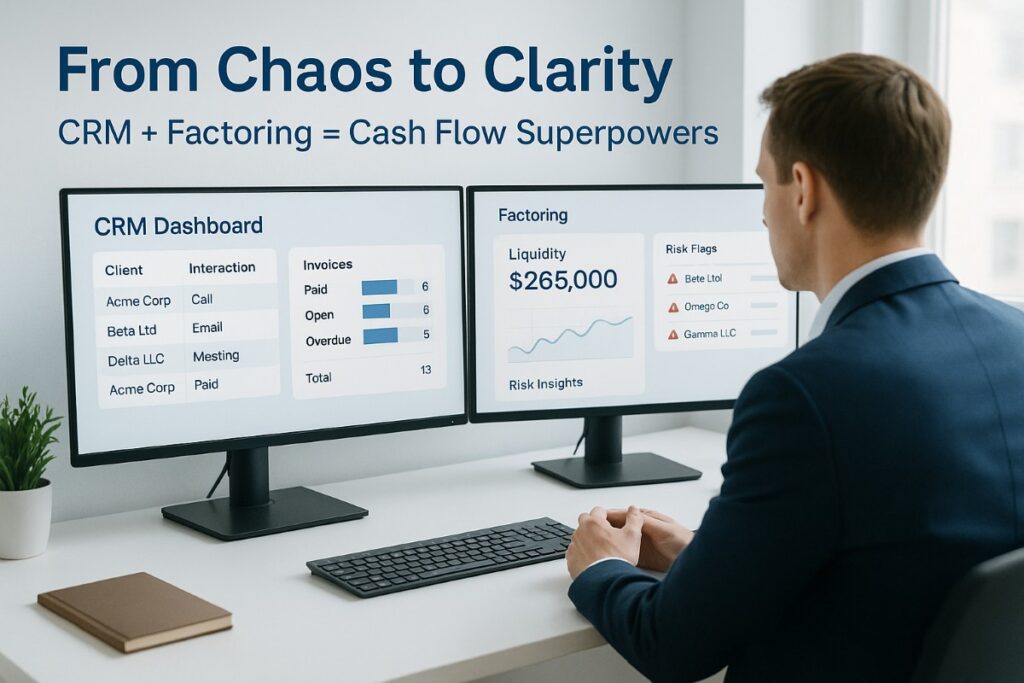
Here’s where integration stops being theoretical and becomes operational magic. With your CRM and factoring tools sharing data, real-time liquidity analysis becomes as routine as your calendar sync. Visual dashboards can flag both immediate and looming payment gaps—aggregating invoice status, client payment streaks, and overall risk profile in one screen. Instead of late surprises, you see tomorrow’s shortfalls before they cause a scramble, letting you act, inform, and secure funding in stride.
To make this work, tune your CRM’s reporting and notifications. Daily or weekly summaries can surface not just overdue invoices, but the ones with creeping risk indicators: a slower average payment time, mounting client excuses, or changes in order patterns. Filter and batch these out to your finance team or external factoring partners without the tedious CSVs and fragmented spreadsheets.
Having this at your fingertips also helps your business avoid over-factoring—the most expensive mistake in working capital management. Understanding how invoice factoring rates affect your bottom line helps make these projections more accurate and actionable. You’ll catch only the deals that truly need liquidity, with fresh factoring projections tying back to real client realities. Transparency isn’t just good ops hygiene—it’s how you keep costs clean and maintain trust with both your lenders and your customers.
From Client Trust to Cleaner Operations
The benefits aren’t just behind the scenes. CRM-factoring alignment lets you give clients clarity: real-time payment portals, tracker links, even automated status updates—no more awkward “just following up” emails. This self-serve transparency elevates your relationships and calms anxious customers, even as your ops team sees the data ripple through in clean audit trails and error-free logs.
For sales-driven teams, this means less drama, more focus, and peace of mind that cash flow blips will be flagged and resolved—before they derail monthly targets. Clean CRM-to-factoring handoffs also mean finance can forecast with less sandbagging or guesswork, because every receivables risk or delay is logged and actioned systematically, not discovered at the last moment. With the right setup, working capital stress becomes rare background noise, not a routine roadblock.
Conclusion
In a world shaped by rapid shifts in client needs and payment cycles, integrating CRM with invoice factoring just makes operational sense. The sales team isn’t scrambling through old notes and finance isn’t sifting through static spreadsheets—everyone has instant clarity, from pipeline to payment. Not only does clean integration free up much-needed working capital, it takes your company out of firefighting mode and into a proactive rhythm where growth feels achievable, not accidental.
Supercharging your receivables with these tools isn’t about flashy dashboards or gimmicks—it’s about using the software you already rely on to keep payment health out in front, not in some buried report. The payoff is fewer surprises, more trust, and the kind of clean, drama-free operations that let you build with confidence.
%201.png)

%201.png)

%201.png)