

A Healthcare software development company can simply be explained as a specialized technology partner that can build an efficient, secure, scalable, and reliable digital solution for the healthcare sector. These digital partners aim to boost operational efficiency of the healthcare sector, along with improving patient care and managing healthcare data more effectively. Selecting the right software partner is more than just a procurement decision; it is more about making investments strategically as it significantly impacts regulatory compliance, clinical results, and long-term innovation capacity.
In the present digital scenario, healthcare has emerged as one of the most technologically demanding industries globally. Software powering the sector has become the core of patient experience. From telemedicine platforms and electronic health records to using AI for diagnosis and wearable devices, technology is being used everywhere. Yet healthcare systems are fundamentally different from standard enterprise applications. Why? Because they work in environments where you cannot compromise on reliability, privacy, and precision.
This is why it is essential to select the right development partner. It needs more than just comparing hourly rates or going through generic portfolios; an in-depth evaluation.
Industry Expertise Matters More Than Generic Technical Skill
Organizations often make the mistake of assuming that any software vendor who has decent experience can design healthcare solutions. However, it is far from reality. Healthcare comes with domain-specific challenges that need high-level expertise.
A qualified healthcare software development company should understand the following:
- Complex clinical workflows and technical medical terms or concepts
- Healthcare interoperability standards such as HL7 and FHIR
- Regulatory frameworks such as HIPAA, GDPR, and MDR
- The operational realities of hospitals, clinics, insurers, and laboratories
Even without this knowledge, development teams often create systems that can technically function; however, operationally, they are impractical. Let’s understand this with an example: a beautifully designed interface may still fail if it disrupts physician workflows or increases administrative burden.
Domain understanding is not an optional advantage—it is foundational.
Evaluate Their Approach to Security and Compliance
The data of the healthcare sector is categorized as the most sensitive, as it contains personal information. Security failures in the healthcare sector does not only lead to financial penalties but also to severe reputational damage and patient harm.
It is important that a strong software development partner of the healthcare sector should treat security as an architectural principle rather than an afterthought. During evaluation, organizations should look for evidence of:
- Secure software development lifecycle (SSDLC) practices
- Role-based access controls and identity management
- End-to-end encryption strategies
- Continuous vulnerability monitoring and penetration testing
- Experience with healthcare compliance audits
Importantly, compliance is not static. Regulations evolve constantly, and healthcare organizations need partners capable of adapting systems to changing legal requirements without compromising operational continuity.
Technical Architecture Should Support Long-Term Growth
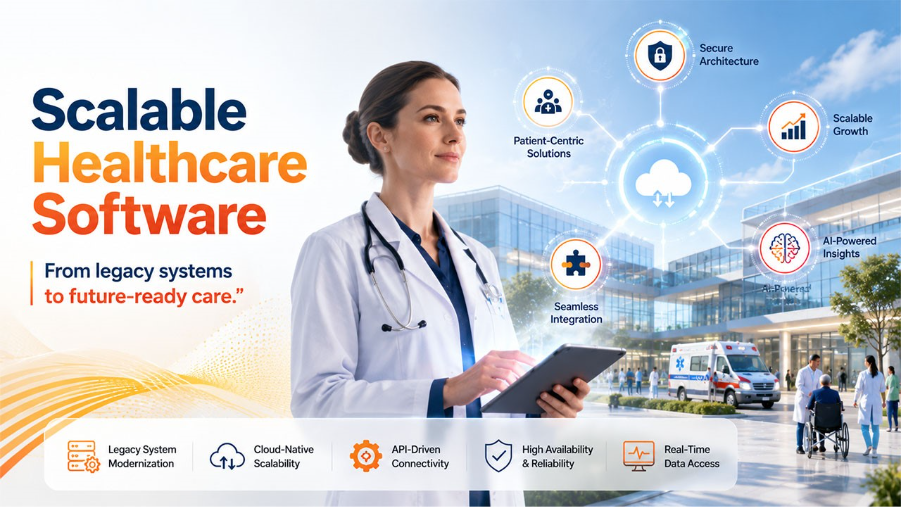
Healthcare organizations often focus heavily on immediate requirements while underestimating future scalability needs. Yet digital healthcare ecosystems tend to expand rapidly over time.
A forward-looking healthcare software development company should prioritize architectures that support:
- Modular expansion
- Cloud-native scalability
- API-driven integrations
- High system availability and fault tolerance
This becomes especially important when integrating emerging technologies such as AI diagnostics, remote patient monitoring, or IoT-connected medical devices.
Legacy modernization is another critical factor. Many healthcare providers still rely on aging systems that cannot simply be replaced overnight. The right development partner must understand how to bridge modern architectures with legacy infrastructure while minimizing disruption.
Also Read: What is the Software Development Life Cycle? Full SDLC Guide for Beginners
Interoperability Is Essential, Not Optional
Modern healthcare ecosystem majorly depends on various key interconnected systems. The patient's information flows between hospitals, laboratories, insurers, pharmacies, and third-party applications. Poor interoperability in this flow of information generally creates fragmented experiences and also increases the risk of medical and treatment errors.
This is the main factor why interoperability expertise should be a major evaluation criterion.
A capable partner should demonstrate experience with:
- HL7 integrations
- FHIR APIs
- DICOM imaging systems
- Secure healthcare data exchange frameworks
Beyond the major technical implementation, it is also essential to understand the practical implications of interoperability. Seamless data exchange is not just about integration, but it is more about enabling continuity of care.
User Experience Has Direct Clinical Impact
Poor UX design creates inconvenience and negative experience across various industries. Similarly, in the healthcare sector, it contributes to burnout, inefficiency, and mistakes.
The employees of the healthcare sector, like doctors, nurses, and administrative staff, generally operate in high-pressure environments with limited time and cognitive bandwidth. A bad or confusing software interface, therefore, leads to reduced friction rather than creating it.
When evaluating a healthcare software development company, examine whether they prioritize:
- Workflow-centered design
- Usability testing with real healthcare professionals
- Accessibility standards
- Mobile responsiveness and cross-platform consistency
Another major part that needs careful attention is patient-facing applications. Telemedicine apps, portals, and wearable dashboards should also offer more intuitive designs, even for users with limited technical literacy.
A technically advanced platform can still fail if clinicians and patients resist using it.
Development Process and Communication Style
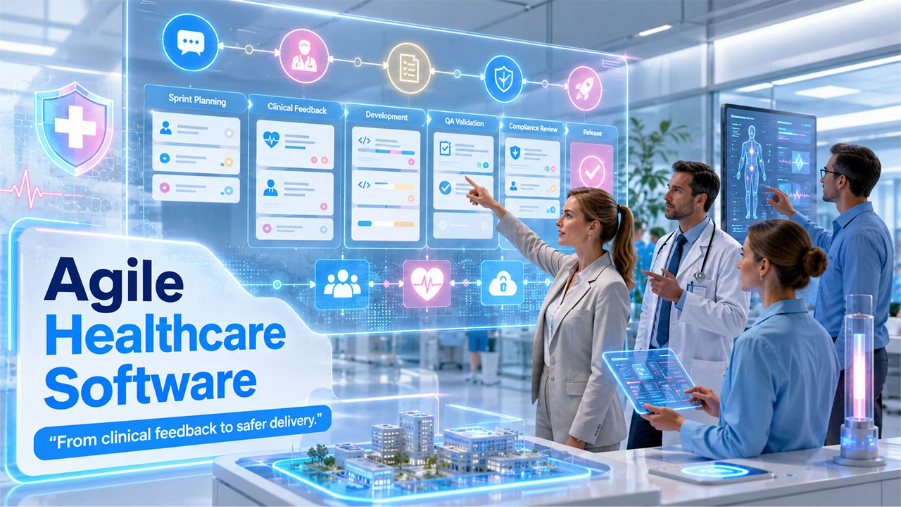
The software projects of the healthcare sector are inherently collaborative, and their requirements evolve as stakeholders discover operational realities, regulatory constraints, and clinical nuances.
These software solutions make communication and process maturity extremely important.
The strong development of this type of software typically demonstrates:
- Agile methodologies adapted for regulated environments
- Transparent reporting and milestone tracking
- Cross-functional collaboration between engineers, designers, and domain experts
- Structured QA and validation processes
Organizations should also evaluate how the company handles feedback and risk management. Healthcare systems cannot tolerate chaotic development cycles or unclear accountability.
AI and Emerging Technologies Require Practical Expertise
In the healthcare sector, artificial intelligence has grown as one of the major and defining trends. In the sector, solutions like predictive analytics, medical imaging support, NLP-based documentation, and remote monitoring systems are offering key applications.
However, many vendors promote AI capabilities without meaningful healthcare implementation experience. A trustworthy healthcare software development company should approach AI pragmatically:
- Focusing on measurable clinical or operational outcomes
- Ensuring explainability and transparency
- Understanding the regulatory implications of AI-assisted decision-making
- Designing systems that support physician oversight rather than replacing it
The same principle applies to blockchain, IoMT, and advanced analytics. Technology should solve real healthcare problems—not exist as a marketing feature.
Cultural Fit and Long-Term Partnership Potential
Healthcare software is not just a short-term engagement, but is a System that evolves continuously due to regulatory updates, operational growth, cybersecurity threats, and changing patient expectations.
To efficiently adapt to the development, organizations should evaluate whether the vendor can become a long-term strategic partner rather than a temporary contractor.
Some of the most important indicators include:
- Stability of engineering teams
- Long-term maintenance capabilities
- Strategic consulting expertise
- Commitment to knowledge transfer and transparency
Cultural alignment is also among the major indicators. Teams that communicate efficiently and clearly, adapt quickly, and understand organizational priorities tend to produce better outcomes over time.
Conclusion
Selecting an efficient healthcare software development partner is primarily about reducing the risks, while also enabling automations. Technical capabilities are not enough in choosing a healthcare software development partner. The ideal partners need to combine engineering excellence with healthcare expertise, regulatory understanding, strong communication practices, and a patient-centered mindset.
Since digital solutions have entered the healthcare industry, it has become increasingly important for organizations to collaborate with partners to build systems that are secure, scalable, interoperable, and clinically meaningful. In the evolving landscape, there are various experienced providers like Andersen Healthcare Software Development Companies, which illustrate how deep technical knowledge and domain-specific expertise can help healthcare organizations navigate complexity while delivering better outcomes for both providers and patients.
%201.png)

%201.png)

%201.png)