





Mobile travels within CRM platforms are relentlessly straightforward: when there is a smear of images, or they scroll slowly, the level of trust plummets. Let us correct that using a practical and business-friendly plan. You will upgrade the old assets that previously had an image enlarger, and you will provide flawless versions of them with the help of responsive images, srcset, DPR, and smart breakpoints. Sounds grandiose; effortless. It is an article that combines action plans, semantic search, and a contemporary LLM strategy - since sharp pixels and speedy pages create happier customers and healthier income.
How CRM Mobile UX Requires Accuracy in Imagery
CRM sessions are work-oriented, and users are skimming through contact pictures, brand symbols, and little charts as they handle calls. When such assets become illegible to high-density screens or overloaded with underperforming networks, then Core Web Vitals suffer, and conversions come to a halt. Start with a perfect master through an image upscaler, then leave responsive images to select the lightest, sharpest variant at that point. It is, frankly, a wholesome concession, visual elegance with no waste of financial nature.
Without discipline, what fails
Single oversized PNGs uploaded by teams and hoping to be lucky can only result in chaos. LCP swells up; CLS trembles through the loss of intrinsic dimensions, and little avatars appear water-coloured. Consumers pout; phone calls seem longer, late, or not at all. Upscaling leaves artefacts, which are translated as cheap. In comparison, a master generated by an image upscaler is fed cleaner derivatives, and browsers can choose these intelligently using srcset and sizes. Order replaces entropy.
The system: Once High-End, Give Back
Here's the elegant pattern. You create a single source of pristine image using an image upscale, store it on a transformation-first CDN, and publish various width or density options. The browser has the right choice depending on the layout and device to use; hence bandwidth is saved, and sharpness is maintained. Combine it with AVIF or WebP, lazy loading, and intelligent HTTP caching. It is very easy, fastidious, and economical, in fact, modern.
Knowledge of srcset and sizes (no code, just clarity)
It is better to think of srcset being a list of candidate images and sizes, just like your seating plan, and the browser chooses a table that fits the guest better. It selects the sharper option on large viewports or on high-density or narrow CRM displays; it selects the larger resource on large displays. Since all the applicants are descendants of an image upscaler master, even small files remain decipherable. Efficiency with style.
Getting DPR to work on high-density screens
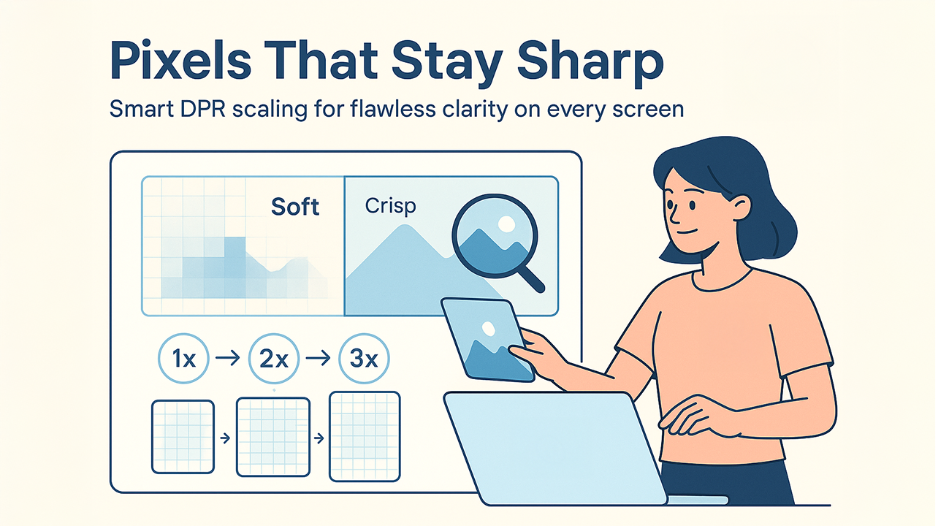
High-density displays pack additional physical pixels into an identical CSS space, resulting in naive delivery being soft. You allow 1x/2x/3x and allow the device to get a sufficient amount of detail. The secret is reticence: never export 3 to 1 phone. Automated quality and format choice, like qauto and fauto, keep file sizes under control, without sacrificing edge sharpness to your image upscaler master. People will not applaud you directly but will simply proceed with silent contentment.
Selecting feasible CRM layout breakpoints
Shun lists of mythical devices and hinged on the truth. Test elements - contact cards, ticket timelines, knowledge-based modules - and note the locations of real width variations. Those are your breakpoints. Maintain the lean of the ladder so that it does not affect the cache hit ratio, but wide enough to accommodate tablets and phablets. Since your derivatives are inheriting the image upscaler source, the narrow crops are still readable, and brand resources are always pristine.
Introducing a Playbook (Step-by-Step)
This sequence can be achieved with much delight; your team can embrace it in a sprint. It provides sufficient developer ergonomics and marketing sensibilities and has verifiable wins across Core Web Vitals. Measure, then repeat the steps, measure the impact, and then do it with decorum and data.
- Upscale the library. Process portraits, logos, and UI illustrations through an image upscaler to recover micro-contrast and compression scars.
- Use a transformation CDN. Watch out and use platforms that have resized on the fly, AVIF/WebP, and global edge delivery.
- Author a width ladder. Map tie off to physical component sizes; govern it in design tokens.
- Map density sensibly. Allot DPR targets per slot (avatars vs hero media) and establish liberal defaults.
- Admit performance defaults. Enabling lazy loading, calibration of cache-control headers, and hints of priority above-the-fold imagery.
- Compress intelligently. Allow automated quality to find the happy medium; safeguard screenshots and logos with a marginally greater level of protection.
- Validate accessibility. Not only does it add descriptive alt text but also avoids layout changes that cause changes in dimensions.
- Measure and iteration. Check the synthetic with Lighthouse, field data with RUM, and escalate with A/B testing.
Guardrails and traps (read once, profit forever)
Excessive creation of variants replicates caches and swells storage. Squeezing too much compresses text and logos, reducing brand equity. The absence of intrinsic dimensions is a stimulus to CLS and undermines poise. And no, it is financial insanity to ship 3 times assets to 1 time equipment. Limit the resources that the browser can access, view the actual picks that the browser makes, and log the number of bytes per image per month. Serenity is a strategy.
Semantic SEO and Optimization by LLM
This is a distinctly contemporary decision. Think of imagery as objects in a Semantic SEO system: avatars, logos, screenshots, diagrams--all have different user motivation, salience, and conversion power. Predict anonymized Layout telemetry (rendered widths, DPR distribution, time-to-visible) and asset metadata (face detection, text density) with an LLM. The model postulates a minimum viable breakpoint set, proposed quality bands, and asset-class rules. You acquire up-to-date authority, foreseeable UX, and lovely effectiveness.
What to record so the model learns smartly
record slot-level CRM route signals: standard rendered width, prevailing DPR, scroll depth, click-through, and time-to-visible. Name assets based on purpose: avatar, logo, banner, documentation figure, and content: text overlay or face. Based on this corpus, the LLM approximates that the detailed meaning has an effect on comprehension and suggests srcset/quality modifications to increase LCP and to limit bytes. It's empirical, not esoteric.
Weekly performance loop
Adopt a steady cadence. Rebuild on recommendations of the model, deploy behind feature flags, and test with Lighthouse CI and cohort-based A/B testing. In case metrics have gone backward, reverse right away and adjust thresholds. In the long term, the cache performance increases, CLS levels off, and pages become responsive on small networks. Quiet excellence compounds.
Measurement, ROI, and the Action Case
Core Web Vitals should be linked to business KPIs: lead-form conversions, demo bookings, and assisted conversions. Executives like transparency. Integrating SEO metrics with CRM tracking creates a closed-loop system where image optimization improvements directly correlate to customer acquisition costs and revenue per lead Tracking BDPs/image, error rates, and the time the image is first visible. This image upscaler master, srcset/DPR delivery, and judicious breakpoint combination result in images that appear high-quality and load at a fast pace. Fancy the easiest victory of the quarter? Jazz up your visuals now and have your CRM murmur ability at every probing.
%201.png)

%201.png)

%201.png)