


Working with legacy code can feel like navigating a maze sometimes. Old codebases often carry years of technical debt, outdated patterns, and have no documentation. Developers spend a lot of time on maintaining such systems, and according to the McKinsey assessment, paying down technical debt can free up engineers to spend as much as 50 percent more of their time working on value-generating products and services. That is a big shift from maintenance to innovation.
But changing those systems is difficult, as the business logic is buried and the risk of breaking something is increasing day by day. One of the most effective solutions to breathing new life into these systems, without a full rewrite, is refactoring. This article will share advanced approaches and best practices of legacy migration solutions. Let’s dive in.
Why is Legacy Code Difficult?
Legacy systems often mean outdated technology, such as unsupported libraries and hardcoded paths. It often has no documentation, meaning that it is risky to change anything. It is not clear what can or cannot be changed safely. Tightly coupled components where changing one part breaks the others.
For example, you have a 20-year-old billing system with hardcoded pricing logic and duplicated code everywhere. Any update to it will be a minefield without tests or documentation.
Common problems with legacy systems also include duplicated code (the same logic in many places), deep nesting and complexity (which makes the code hard to read or test), and hidden dependencies.
Prioritize What to Refactor
- What is essential to the business? Focus on code that is business critical or frequently breaks.
- Start with small and isolated improvements like cleaning up duplicated code.
- Don’t forget to mitigate risk. Use incremental changes, feature toggles, or deploy new logic to a small user group before going live.
For example, you have a full logic to flow to rewrite. But starting small would mean refactoring only the password validation part first, and after that, the rest.
Use feature toggles, deploy to limited user groups for testing, or run both old and new logic in parallel. This way, you can test in production with minimal risk.
Testing is a Must
Testing gives you the confidence to make changes safely. You can start with characterization tests to capture current behavior. Tools like AI Copilot can help generate initial test cases, providing a starting point for comprehensive coverage. You basically "lock in" the system’s existing output, so you can be sure you don’t break it during changes.
If possible, use a test-first approach for new code. Even in legacy systems, writing new tests helps you gradually move toward a more reliable codebase.
Gradual Modernization
Identify a modular component and build a modern version alongside the old. Use a proxy or facade to route some traffic to the new module. Shift more load to the new component once it's proven stable.
For instance, if you’re moving from a monolithic system to microservices, extract one service at a time like user management or payment processing and deploy it separately.
This will help you reduce risk and keep the system running.
Break Dependencies
Legacy code is usually combined with hard-coded logic. To deal with this, you can introduce interfaces, abstracting away direct dependencies. Use dependency injections to make testing and swapping implementations easier. And wrap external services (such as email or payment gateways) in adapters so you can replace them later.
For example, decouple your logic flow from a specific email API using a NotificationSender interface. This will make testing and future changes easier.
Refactor the Database Carefully
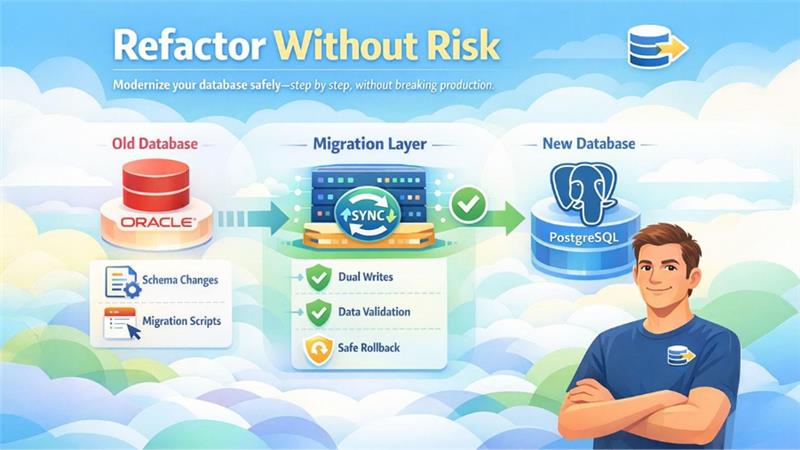
Your database is part of the system’s foundation. But changes to the schema can be risky.
Try to modernize it without breaking things. To achieve this, you can add new fields or tables before removing old ones. Use migration scripts and run them in small steps. A data access layer can help isolate queries. And if needed, you can write to both old and new schemas for a period before fully switching over.
For example, you can move user data from Oracle to PostgreSQL gradually, syncing changes between both until you are confident in the new system.
In more complex cases, you can write to both old and new databases during a transitional period. It will give you time to validate the new setup before turning off the old.
Document Knowledge
One of the main problems with legacy systems is that they lack documentation. They are either missing it, or the original authors may no longer be with the company. For this reason, it is usually hard to understand what is where.
As you refactor, document everything. Write notes for each major change: why, what and how. Share updates with the team through demos and internal wikis. Keep the documentation controlled, as it will reduce ramp-up time for new developers and help make improvements part of how your team works going forward.
Measure Success
Refactoring is only worth it if it delivers value. Track code metrics, such as cyclomatic complexity, duplication and test coverage. You also need to track bug trends, whether there are fewer incidents in the refactored modules. The performance metrics should show faster response times and fewer timeouts. And in terms of team productivity, you should see faster delivery features.
For example, after refactoring the checkout process, are bug reports down? The outcomes show real impact.
Drawing the Line
When you are refactoring legacy code. You’re investing in a future where change is possible, updates are safe, and developers aren’t afraid to touch the code. By starting with tests, breaking dependencies, and modernizing step by step, you make your system more maintainable and scalable. With the right strategy, even the oldest codebase can be modernized, without breaking what's already working.
%201.png)

%201.png)

%201.png)