


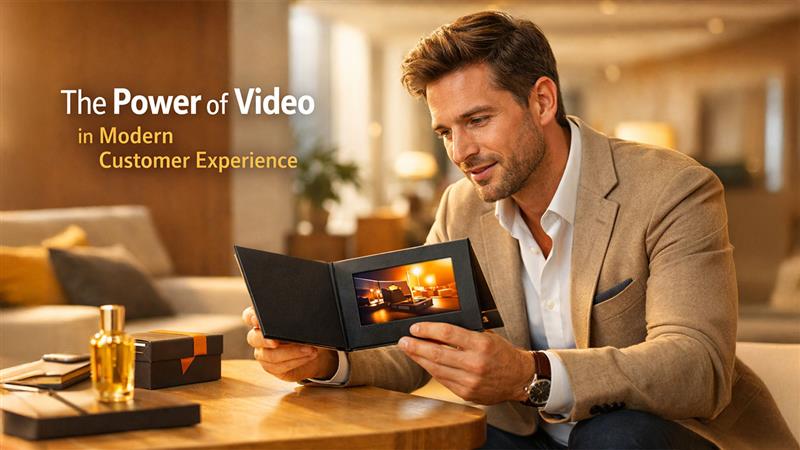

Customer experience often breaks down before a prospect ever speaks with sales or support. It starts with the way a brand introduces itself, explains its value, and helps buyers move from curiosity to confidence.
For marketing teams trying to improve that early-stage experience, the challenge isn’t simply getting attention. The real challenge lies in delivering safe, clear, and relevant information which is easy to act upon. That’s one reason tactile, screen-enabled formats such as video brochures are gaining traction in high-value campaigns. Digital outreach alone isn’t enough. Combining physical delivery with visual storytelling can help brands create a more guided and memorable conversation.
When you use video-driven marketing tools strategically, it can do way more than add a novelty. They can reduce friction, improve understanding, and create a stronger customer experience from the very first touchpoint.
Why Customer Experience Begins With Communication
Customer experience is often associated with support, onboarding, or retention. However, in practice it starts way earlier. Prospects form opinions based on how easily they can understand an offer, how relevant the message feels, and whether the interaction respects their time.
That matters because expectations are high and tolerance for poor experiences is low. According to PwC’s customer experience research, 29% of consumers say they stopped buying from a brand because of poor customer experience, either online or in person. While service issues play a role, unclear or disconnected marketing can also create friction that weakens trust early on.
In B2B environments, the communication challenge is even sharper. Buyers increasingly want to evaluate solutions independently before committing to a conversation. Gartner reported that 67% of B2B buyers prefer a rep-free experience. That preference puts more pressure on marketing to deliver content that explains, demonstrates, and persuades without relying on live intervention.
What Video-Driven Marketing Tools Do Well
Video-driven marketing tools include more than website videos or social clips. In campaign settings, they can include embedded-screen mailers, video books, and other interactive print formats designed to present a message in a contained, focused way.
Their advantage isn’t simply that they use video. It’s that they combine visual explanation with physical presence. Instead of asking the audience to interpret a static asset, these formats can show a product, frame a story, demonstrate a process, or reinforce a value proposition in seconds.
That’s especially useful when the message is complex, the audience is hard to reach, or the stakes are high. Use cases include account-based outreach, executive follow-up, product launches, re-engagement campaigns, and high-consideration lead nurture efforts.
How Video Tools Improve Customer Experience

They Reduce Cognitive Friction
One of the biggest barriers in marketing isn’t a lack of interest. It’s a lack of clarity. When the message is too vague, generic, abstract, or too-text heavy, it becomes easy to overlook. Prospects may lose interest even before they understand why the offer is important.
This friction can be reduced by videos as they make it easier to absorb information. A short, well-structured sequence can highlight the benefits, offer solutions, and establish context much faster than a long, typed email or brochure alone. That makes the overall interaction feel smoother and more intuitive.
This is one reason video continues to hold such an important role in marketing strategy. Wistia’s 2025 State of Video Report, based on survey responses from more than 1,300 professionals and data from over 100 million videos, reveals that businesses continue to invest heavily in video as a core communication format. The underlying logic is straightforward: when buyers understand faster, they move forward with less friction.
They Create Stronger Recall
Customer experience isn’t only functional. It’s also emotional and memorable. People are more likely to remember interactions that feel intentional, distinctive, and useful.
A tactile format with embedded video creates a different kind of encounter than another digital impression in an overcrowded inbox. The physical delivery draws attention, while the video provides message control. Together, those elements can improve recall and reinforce positioning in ways that standard formats often struggle to achieve.
That makes video-driven tools particularly useful for campaigns that need to leave a lasting impression, such as executive outreach, event follow-up, or premium product introductions.
They Support More Relevant Personalization
Personalization is often discussed in terms of data and segmentation, but from the customer’s perspective, it’s really about relevance. The message either feels suited to their situation or it doesn’t.
McKinsey notes that 71% of consumers expect personalized interactions, while 76% get frustrated when that expectation isn’t met. Video-driven formats support this well because the content can be tailored by industry, account type, funnel stage, or use case without losing message discipline.
Even moderate personalization can improve the experience. A campaign that reflects the recipient’s business context, likely pain points, or stage in the buying process feels more helpful and less generic.
Where These Tools Fit Best in Modern Campaigns

Video-driven tools are most effective when they’re tied to moments where clarity and engagement matter more than scale alone.
Account-Based Marketing
ABM campaigns depend on precision, relevance, and cut-through. A well-targeted video mailer can help open conversations with high-value accounts that are unlikely to respond to conventional outreach.
Sales Follow-Up
After meetings, demos, or events, momentum often fades when follow-up relies on generic recap emails. A video-enabled format can reinforce the key message in a way that feels considered and easy to revisit.
Product Education
When seeing the solution is central to understanding the value, the video becomes more than a supporting asset. It becomes part of the buying experience itself.
Customer Re-Engagement
For dormant accounts or delayed opportunities, a more tactile and visual approach can help restart attention by making the communication feel fresh and more relevant.
What Makes a Video-Driven Campaign Work
The format itself doesn’t guarantee a better experience. The campaign still needs strategic discipline.
The strongest executions usually share a few traits. The message is focused. The video has one clear purpose. The audience is narrowly defined. The call to action matches the buyer’s stage. The creative presentation supports the message rather than overwhelming it.
This is the difference between experience design and novelty. If the format exists only to impress, the effect is short-lived. If it helps the audience understand more quickly and act with greater confidence, it becomes a practical business tool. Teams looking to build that kind of impact can start by exploring top free AI video tools that make professional-quality video production more accessible without heavy investment.
Final Thoughts
Customer experience begins with the first interaction a brand creates. Every campaign either adds friction or removes it.
Video-driven marketing tools offer a useful way to improve that early experience by making communication clearer, more memorable, and more relevant. For marketers focused on stronger engagement, better message delivery, and more intentional buyer journeys, they represent more than a creative format. They offer a way to make marketing easier to understand and more valuable to the audience.
%201.png)

%201.png)

%201.png)