


Artificial intelligence is no longer a concept of the future. For businesses today, it is an operational reality — one that is reshaping how work gets done, decisions get made, and value gets delivered. Yet many organizations still find themselves asking a fundamental question: What exactly is enterprise AI, and how does it apply to us?
This guide answers that question in full — covering the definition, types, use cases, benefits, and challenges that every business leader should understand before pursuing AI adoption.
What Is Enterprise AI?
Enterprise AI is the use of artificial intelligence to make business and manufacturing processes less manual, time-consuming, and prone to human error.
Unlike consumer-facing AI tools, enterprise AI is built for organizational scale. Using enterprise AI platforms, many businesses across all industries are beginning to adopt AI at scale.
The comparison to earlier technology shifts is instructive. Just like the development of the internet in the 1990s and cloud computing in the 2010s, many businesses have approached AI with caution — wondering whether it would live up to the buzz, or simply be a fad that wouldn't add real value.
For early adopters, however, the answer has become clear. The results have indicated that enterprise AI can indeed generate a competitive advantage, with significant improvements and efficiency benefits across the spectrum of use cases, including data analysis, prediction, decision-making, automation, productivity, and product development.
Routine vs. Transformational: The Two Modes of Enterprise AI
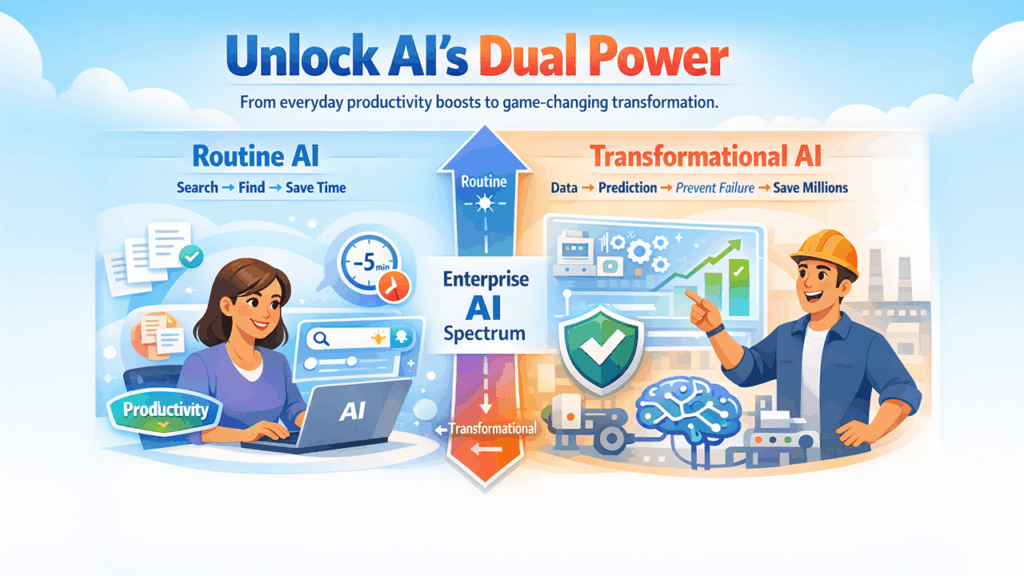
One of the most interesting aspects of enterprise AI is that it can be used to perform both routine and transformational tasks.
Understanding this distinction helps organizations set realistic expectations and identify where to start.
Routine tasks involve small but meaningful improvements to daily work. For example, an employee saves a few minutes by using an AI copilot to find a document stored in the wrong place. Routine use cases may sound small, but they can really boost productivity at scale.
Transformational tasks involve larger, strategic outcomes. A manufacturer saves millions of dollars by using deep learning to predict when its machines will need to have parts replaced — before they break.
This is an impressive range, but it also presents a problem in terms of where a business ought to start. The best place to start is by gaining an understanding of the main types of enterprise AI and the ways in which they are generally applied.
Key Benefits of Enterprise AI
Businesses that use AI in their business processes tend to benefit in several ways:
- Productivity and efficiency: By eliminating routine tasks such as data entry, businesses are able to unlock human talent.
- Decision accuracy and speed: By analyzing large amounts of structured and unstructured data, businesses are able to make more accurate business decisions. AI systems are also able to detect patterns in data that are impossible for humans to detect, thus providing useful information for business decision-making.
- Improved customer experience: Natural language processing capabilities of AI, coupled with machine learning algorithms, enable AI-driven chatbots and virtual assistants to deliver a more personal experience to customers in real-time, round the clock.
- Workforce collaboration: AI has the potential to improve collaboration between employees.
Enterprise AI Use Cases by Industry
The scope and accessibility of modern enterprise AI makes it useful for many fields. The following industry examples illustrate where AI is already delivering measurable results.
Healthcare Medical data sets are some of the largest and most complex in the world. A major focus of AI in healthcare is leveraging that data to find relationships between diagnosis, treatment protocols, and patient outcomes. Hospitals are also turning to AI to support operational initiatives such as workforce satisfaction, patient satisfaction, and cost reduction.
Banking and Financial Services the financial services industry is one of the first industries to widely implement AI — to increase the speed of transactions, customer service, and security. It can be used as AI bots, digital payment advisers, etc.
Manufacturing today's modern manufacturing facility is not just a group of machines and IoT sensors but a connected system that uses AI and machine learning to analyze the data collected from the operations.
Finance (Internal Operations) Finance uses AI to automate manual and repetitive tasks, and to assist in decision-making, such as automating payments and forecasting late payments based on patterns and customer behaviors.
Supply Chain From geopolitical issues to international trade barriers, supply chain leaders face the greatest challenges ever. However, AI is helping supply chain leaders anticipate disruptions and detect anomalies to ensure the continuation of service delivery by monitoring logistics, inventory, and operational data to spot anomalies before they cause costly delays.
Customer Service Bosch Power Tools utilizes AI agents that analyze the content and context of each of the millions of customer service tickets they receive annually and direct them to the appropriate team for help, saving thousands of hours and significant costs annually.
Common Challenges in Enterprise AI Adoption
In addition to the benefits, there are some common challenges that businesses should plan for. These are primarily cultural resistance, ethical concerns, and technical barriers. Effective navigation of these issues is crucial for the long-term success of enterprise AI adoption.
1. Cultural Resistance
Employees may be excited about using AI because they think it can be used to improve their work, or employees may be resistant to using AI because they think it could lead to their termination.
Best practices:
- Being transparent about the use and benefits of AI in the organization
- Being compassionate and understanding towards employees' resistance to using AI
- Providing training programs for employees to gain confidence in using new AI technology
2. Ethical and Security Concerns
In addition, ethical and security concerns are brought about by AI, and for this reason, special guidelines and security protocols are needed. Organizations need to develop policies regarding the usage of data and transparency in AI before they can expand its usage.
3. Technical and Budget Barriers
However, businesses must also be aware of the challenges involved in the adoption of AI, its application in their specific businesses, and the costs involved.
Practical Planning Considerations:
- Budgeting: Businesses need to set aside enough financial resources not only for the acquisition of the technology for enterprise AI but also for other expenses such as software updates and storage.
- Talent acquisition: Hiring skilled personnel or training existing employees to handle new AI tools is imperative. The technological investment will only work as planned if the people using it have the right skills.
Building an AI-Ready Organization
Successful enterprise AI adoption goes beyond technology selection. Becoming a successful AI enterprise isn't just about choosing the right platform. It's also necessary to foster a workplace culture that thrives with AI — involving training, data security investments, and using AI responsibly.
There are some structural approaches to this effect:
- Cross-functional teams: You should create cross-functional teams that involve IT, data analytics, leadership, and end-user groups. This is a holistic approach to ensure all aspects of impact and benefit are considered from the outset.
- Regular reviews: You should establish regular review sessions to monitor the progress of integrating AI against your project objectives.
For organizations dealing with structured business data at scale, enterprise AI agents need access to high-quality and harmonized data. Therefore, the existing infrastructure in terms of real-time access and integration needs to be assessed.
One approach is to start small by implementing a pilot project that addresses a small but manageable scenario, setting measurable success criteria based on time gained, errors avoided, or customers pleased, and monitoring the project's performance.
The Workplace Role of Enterprise AI
Another way in which Enterprise AI is transforming the employee experience of their day-to-day work environment is in a positive manner.
- Employee Productivity Tools: Enterprise Development with AI Copilots is transforming how employees work — discover how AI Copilot is reshaping productivity by helping teams manage emails, meetings, and complex workflows with greater speed and precision.
- Adaptive Learning Systems: Learning and development through AI-based systems can be personalized and tailored to the individual’s learning style and pace, making the process more engaging and efficient.
- Workplace Analytics: AI can enable teams to improve employee satisfaction and performance through the analysis of patterns and suggestions for improvement.
Final Thoughts
However, enterprise AI is not a product, nor is it a project, but a fundamental change in the operation of a company. The companies benefiting the most are those who are taking a long-term approach to AI, not a short-term solution.
The way forward is about grasping the technology, aligning it with genuine business problems, the workforce, and governance structures that sustain the technology in its application. For organizations looking to amplify their reach and impact, pairing enterprise AI with enterprise digital marketing strategies — supported by specialist agencies that understand how to translate AI-driven insights into measurable campaign results — can unlock a new tier of competitive advantage. The evidence is that, for organizations that invest in the foundation, enterprise AI can indeed provide competitive advantage that is real and sustained.
%201.png)

%201.png)

%201.png)