


The Disconnect Between Activity and Outcomes
For many businesses, growth is often framed as a simple equation: more leads equals more revenue. Marketing teams are encouraged to increase traffic, expand reach, and generate as many inquiries as possible. Dashboards fill with numbers that suggest progress - higher form submissions, more downloads, larger contact lists.
Yet despite this apparent momentum, many organizations find themselves in a frustrating position. Sales teams are busy but not closing. Pipelines look full but fail to convert. Follow-ups increase, but outcomes remain inconsistent.
This disconnect reveals a deeper issue. The challenge is not a lack of leads. It is that much of the data entering the system lacks the quality needed to produce meaningful results. When inputs are flawed, every step that follows becomes less efficient, less predictable, and ultimately less effective.
The Illusion of Lead Volume
Lead volume is one of the easiest metrics to measure and report. It provides a sense of activity and forward movement. When numbers increase, it feels like progress is being made.
However, volume alone can be misleading. A large number of leads does not necessarily indicate strong performance. In many cases, it creates what can be described as “pipeline inflation” - a situation where the pipeline appears healthy on the surface but lacks real opportunity underneath.
This happens when leads are counted equally, regardless of their likelihood to convert. A form submission from a highly qualified prospect is treated the same as a casual inquiry with no real intent. Over time, this inflates expectations and distorts decision-making.
According to research shared by B2B Marketing Group, only a small percentage of marketing-generated leads ever translate into actual revenue. This highlights a critical point: most leads were never viable to begin with.
When organizations rely too heavily on volume-based metrics, they risk optimizing for activity instead of outcomes. The result is a system that looks productive but fails to deliver meaningful growth.
What “Data Quality” Actually Means
To understand why lead volume falls short, it is important to define what constitutes high-quality data.
Data quality is not a single attribute. It is a combination of several factors that together determine whether a lead has a realistic chance of converting. These typically include:
- Fit - whether the lead aligns with the target customer profile
- Intent - whether there is a clear need or interest in the offering
- Engagement - whether the lead has demonstrated meaningful interaction
- Timing - whether the lead is in a position to take action
A lead that meets all of these criteria is significantly more valuable than dozens that meet none.
This is where many systems begin to break down. Leads are often captured without sufficient context, resulting in incomplete or misleading data. Without clarity around fit or intent, sales teams are left to interpret signals that may not be reliable.
The difference between high-quality and low-quality data is not always immediately visible. It becomes apparent over time, as conversion rates stagnate and sales cycles extend. What initially appears to be a strong pipeline gradually reveals itself to be filled with low-probability opportunities.
Where Data Starts to Break Down
When conversion issues arise, organizations often look inward at their CRM or sales processes. They may adjust workflows, introduce automation, or refine follow-up strategies.
While these efforts can be valuable, they often overlook a critical factor: the problem frequently begins before the data even reaches the CRM.
Data breakdown typically occurs at the point of capture. This includes:
- unclear messaging that attracts the wrong audience
- poorly structured forms that fail to qualify leads
- lack of filtering mechanisms to distinguish serious inquiries from casual ones
- missing or inconsistent data fields that reduce clarity
At this stage, the system is already compromised. By the time the lead enters the CRM, it carries limited context and uncertain intent. No amount of downstream optimization can fully correct this.
This is why improving data quality requires a shift in perspective. Instead of focusing solely on how data is managed, businesses must examine how it is generated in the first place.
The Hidden Role of the Website in Data Quality
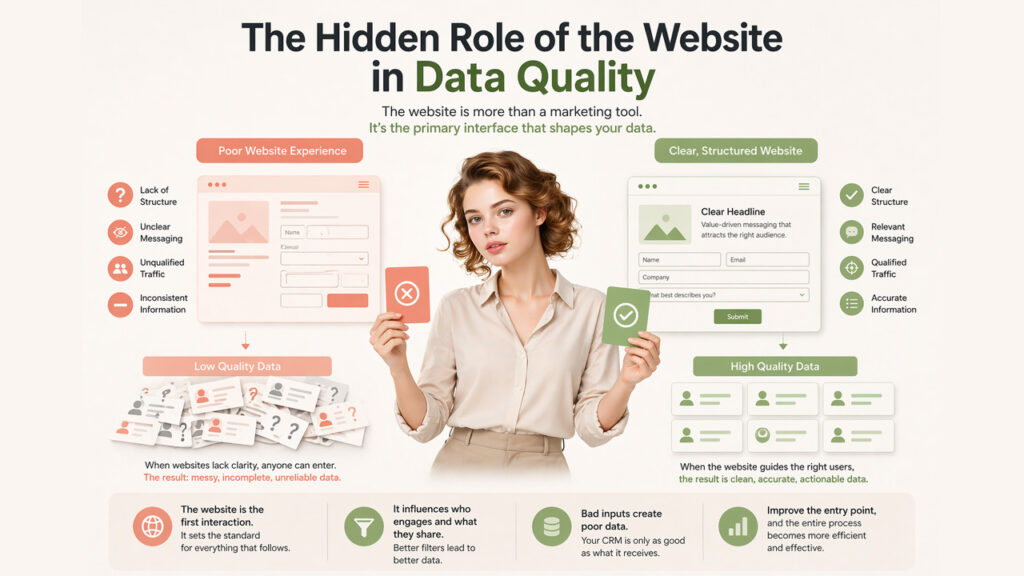
One of the most overlooked factors in data quality is the role of the website.
One of the most overlooked factors in data quality is the role of the website.
The website is not just a marketing tool. It is the primary interface where potential customers decide whether to engage. It shapes who submits a form, what information they provide, and how accurately that information reflects their needs.
When a website lacks structure or clarity, it allows a wide range of users to enter the system without proper qualification. This leads to inconsistent data, making it difficult to distinguish between high-value prospects and low-intent inquiries.
In many cases, improving data quality starts at the source. If a website is not guiding users effectively or capturing the right information, the CRM ends up working with flawed inputs from the start.
When the entry point improves, everything that follows becomes more efficient.
Why More Leads Often Make the Problem Worse
At first glance, increasing lead volume may seem like a solution to poor performance. If conversion rates are low, generating more leads appears to compensate for the gap.
In reality, this often amplifies the problem.
More leads introduce more variability. Sales teams must spend additional time reviewing, qualifying, and following up. This increases workload without necessarily improving outcomes. High-intent opportunities become harder to identify within a larger pool of low-quality data.
As a result:
- response times slow down
- prioritization becomes more difficult
- valuable leads may be overlooked
- overall efficiency declines
Instead of improving results, the system becomes more strained.
As Sam Mendelsohn, owner of Mendel Sites, puts it, “Bad leads don’t become good just because you follow up faster. If the wrong people are coming in to begin with, nothing you do afterward is going to fix that.”
This dynamic also affects team morale. Sales professionals may become frustrated by the volume of unproductive conversations, while marketing teams continue to focus on metrics that do not reflect true performance.
Over time, this misalignment creates friction and reduces trust between teams.
Rethinking How Lead Performance Is Measured
To address these challenges, organizations must reconsider how they evaluate success.
Traditional metrics such as lead volume or cost per lead provide limited insight into actual performance. They measure activity but not effectiveness.
A more meaningful approach focuses on metrics that reflect outcomes, such as:
- conversion rate from lead to opportunity
- sales acceptance rate
- pipeline contribution
- revenue generated from leads
These metrics provide a clearer picture of how well the system is functioning.
As highlighted by Syntrio, many organizations are shifting away from volume-based measurements toward indicators that capture the true impact of their efforts. This includes tracking how leads progress through the pipeline and how often they result in meaningful engagement.
By aligning metrics with outcomes, businesses can identify where improvements are needed and make more informed decisions.
Aligning Marketing and Sales Around Better Data
One of the most common challenges in lead generation is the disconnect between marketing and sales.
Marketing teams are often evaluated based on the number of leads generated, while sales teams are measured on conversions and revenue. This creates competing priorities.
When lead volume is emphasized, marketing may prioritize quantity over quality. Sales, in turn, must filter through these leads to identify viable opportunities. This dynamic can lead to frustration on both sides.
Improving data quality helps bridge this gap.
When leads are better qualified at the point of capture, marketing delivers more relevant opportunities, and sales can focus on high-value interactions. This alignment reduces friction and improves overall efficiency.
A key component of this process is feedback. Sales teams must provide insight into which leads convert and which do not. This information allows marketing to refine targeting and improve lead generation strategies.
Without this feedback loop, the system remains disconnected, and data quality continues to suffer.
Better Data, Better Outcomes
The assumption that more leads drive better results is deeply ingrained in many organizations. However, as systems become more complex and competition increases, this approach becomes less effective.
The real opportunity lies in improving the quality of data entering the system.
When leads are aligned with the target audience, demonstrate genuine intent, and provide meaningful information, the entire pipeline becomes more efficient. Sales cycles shorten, conversion rates improve, and teams can operate with greater clarity.
Focusing on data quality requires a shift in mindset. It involves prioritizing precision over volume and understanding that not all leads are created equal.
Ultimately, the performance of any system is determined by its inputs. When those inputs improve, every downstream process benefits.
Better data leads to better decisions, stronger alignment, and more consistent outcomes.
%201.png)

%201.png)

%201.png)